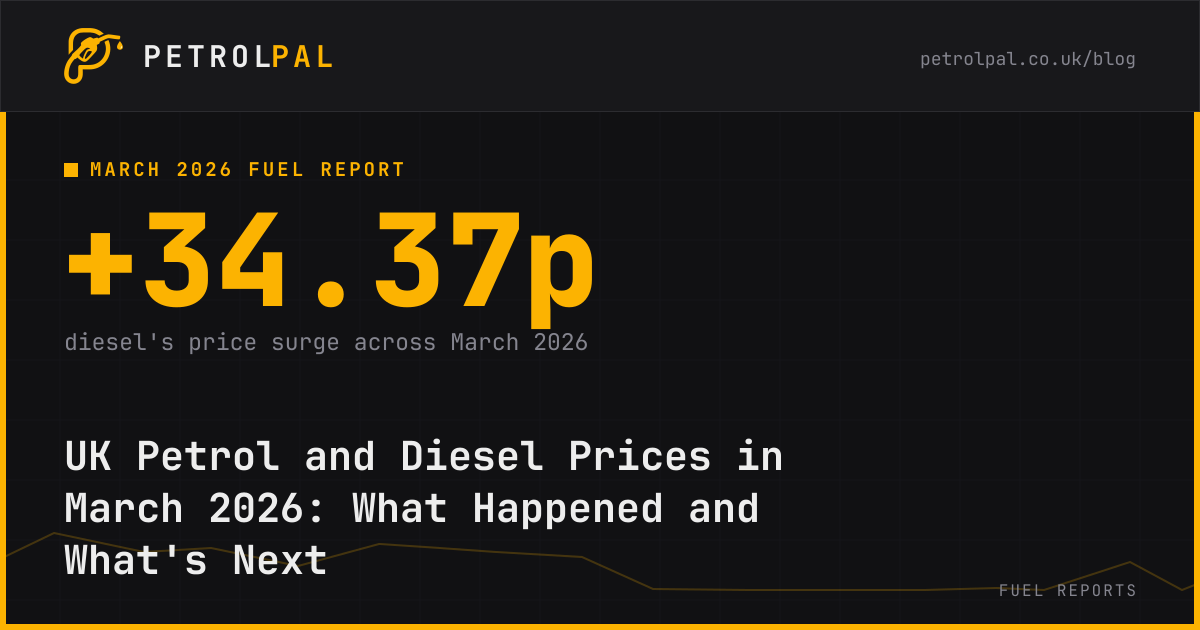
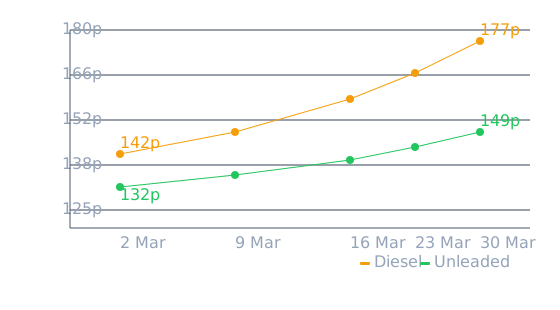
UK drivers saw some of the sharpest monthly price increases in recent memory during March 2026. Unleaded petrol climbed 16.64p per litre across the month — from 132.14p on 2 March to 148.78p by 30 March. Diesel rose even faster, jumping 34.37p to close at 176.52p. If you filled up at the end of March, you paid roughly £9.15 more for a 55-litre tank than someone who filled up at the start.
What Did UK Petrol Prices Do in March 2026?
The Department for Energy Security and Net Zero (DESNZ) publishes official weekly pump price data every Monday. The March 2026 figures tell a stark story: five consecutive weekly increases across both unleaded and diesel, with no relief as the month progressed.
| Week commencing | Unleaded (p/litre) | Diesel (p/litre) | Weekly change (unleaded) |
|---|---|---|---|
| 2 March 2026 | 132.14 | 142.15 | — |
| 9 March 2026 | 135.67 | 149.01 | +3.53p |
| 16 March 2026 | 140.28 | 158.78 | +4.61p |
| 23 March 2026 | 144.16 | 166.88 | +3.88p |
| 30 March 2026 | 148.78 | 176.52 | +4.62p |
The pace was relentless. Unleaded gained ground every single week, while diesel's 34.37p total rise over four weeks is extraordinary by any recent standard. To put it in context: diesel closed March 2026 at 176.52p, a level not seen since the energy crisis of mid-2022.
[See how March 2026 fits into the longer-term picture in our UK fuel price trends analysis for 2026.]
Why Did Fuel Prices Surge Through March?
A sustained pump price spike of this magnitude — 16.6p on unleaded, 34p on diesel in a single month — doesn't happen by accident. Several forces combined in March 2026:
Crude oil climbed sharply. Brent crude, which directly underpins UK wholesale fuel costs, rose significantly through March. A combination of tighter-than-expected OPEC+ supply discipline and stronger global demand signals from manufacturing data pushed oil prices higher. UK retailers pass crude cost increases through to pump prices within two to three weeks, so the full impact of early-March wholesale moves was visible by the end of the month.
Diesel was hit hardest by refinery factors. The unusually large diesel premium — 27.74p above unleaded by 30 March — points to additional supply-side pressure specific to middle distillates. Refinery maintenance cycles, tighter European diesel stocks, and seasonal demand for heating oil (which competes with road diesel at the refinery stage) all contributed to diesel's outsized move.
Sterling softened. Fuel is priced globally in US dollars. When sterling weakens against the dollar, UK import costs rise even if crude oil holds steady. The pound came under modest pressure in March, amplifying the crude oil increases at the wholesale level.
Info
PetrolPal data note
Across the 7,000+ stations in the PetrolPal network, the spread between the cheapest and most expensive forecourt within any given postcode area averaged 11–14p per litre by late March. At the top of a price spike, that spread is worth even more — choosing the cheapest local station rather than the first one you pass could save £6–£8 on a full tank.
Warning
Warning
Diesel at 176.52p/litre as of 30 March 2026 is approaching levels not seen since the 2022 energy crisis. Diesel drivers — particularly van owners and small business operators — should compare prices carefully before filling up.
How Does March 2026 Compare to Previous Years?
The March 2026 spike looks even more striking when set against the same month in recent years. In March 2025, prices were falling through the month. In March 2024, prices were broadly flat. March 2026 broke that pattern decisively.
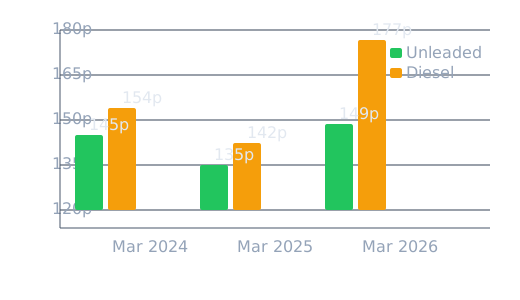
End-of-March unleaded in 2026 (148.78p) is now 3.72p higher than the same point in 2024 (145.06p), and 13.87p above March 2025's close (134.91p). Diesel's year-on-year comparison is more alarming: 176.52p in March 2026 versus 142.26p in March 2025, a 34.26p increase. That's an extra £18.84 on a typical 55-litre diesel fill.
According to the DESNZ weekly series, unleaded at the end of March 2025 was 134.91p/litre and diesel was 142.26p/litre (DESNZ, 2025). The contrast with March 2026's close is sharp.
Info
PetrolPal station data
Even at the peak of the March spike, the cheapest 10% of unleaded forecourts in the PetrolPal network were pricing below 139p — roughly 10p below the national average. The most expensive 10% crossed 162p, almost exclusively at motorway services. That 23p spread at peak is the widest we've recorded since early 2023, making price comparison especially valuable right now.
Which Supermarkets Had the Cheapest Petrol in March 2026?
Supermarket forecourts consistently undercut branded stations, and that held true even as prices rose through March. While exact averages varied week by week as prices climbed, supermarkets maintained a 4–7p advantage over the national average throughout the month.
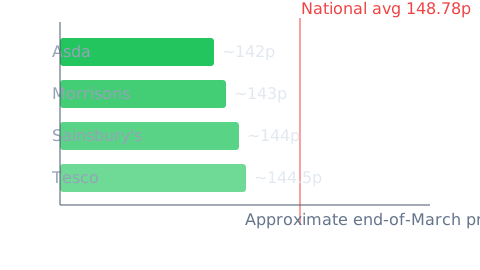
Asda ended March at approximately 142p/litre — around 6–7p below the national average of 148.78p. That margin represents roughly £3.50 saved on a 55-litre fill. With pump prices at elevated levels, the absolute saving from choosing a supermarket forecourt is larger in cash terms than at any point in the past year.
Tip
Tip
Supermarket prices update frequently during fast-moving price periods. Check PetrolPal before every fill — station-level prices can vary by 2–3p even within the same chain on the same day.
[Compare supermarket petrol prices in depth in our cheapest supermarket petrol guide.]
What Will Petrol Prices Do in April and Q2 2026?
March 2026 ended with pump prices at multi-year highs. The direction of travel in April depends on whether the forces that drove March's spike continue or reverse.
If crude oil stays elevated or rises further, April will see prices consolidate at current highs or push higher still. Unleaded above 150p — last seen in late 2023 — is possible if Brent crude holds above $85/barrel. Diesel breaking through 180p would match levels not seen outside the 2022 energy crisis.
If crude reverses, prices could ease by 3–6p over April and May as the wholesale deflation works through to forecourts. The lag from wholesale to pump typically runs two to three weeks, so any crude correction visible in the first two weeks of April should be felt at the pump by late April.
Seasonal demand adds a floor. Spring typically lifts driving activity, and the Easter break generates a short-term demand spike. Refineries are also transitioning to summer fuel blends, which costs marginally more to produce. These seasonal factors make a sharp near-term correction less likely even if crude softens modestly.
Fuel duty is frozen. The government confirmed at the Autumn 2025 Budget that fuel duty remains at 52.95p per litre — unchanged since March 2022. That freeze is already priced in. Any reversal would add to pump prices immediately, but no change has been signalled for the near term.
Info
Timing your fill-up
During rapid price increases, filling up earlier in the week tends to be cheaper than waiting for the weekend. PetrolPal data shows Monday and Tuesday prices are typically 0.5–1p below Friday levels at supermarket forecourts, as weekend demand increases prompt modest mid-week adjustments upward.
[Read our detailed analysis of whether petrol prices will fall in 2026 in the full 2026 fuel price forecast.]
What March 2026 Means for Your Fuel Budget
March 2026 was a difficult month for UK drivers. The 16.64p rise in unleaded and 34.37p surge in diesel represent some of the sharpest monthly increases in recent years. A family that fills up twice monthly is paying roughly £18–£19 more for unleaded than they were in February, and diesel drivers face an even larger hit.
The macro forces — crude oil and currency — are outside anyone's control. What you can control is where you fill up. The gap between the cheapest and most expensive forecourt in most UK postcode areas reached 20p or more during the March peak. On a 55-litre tank, that difference is worth up to £11. Checking prices before you pull into a forecourt is the single most effective thing you can do to manage fuel costs in a high-price environment.
[Find the cheapest petrol or diesel near you right now with PetrolPal's live price map.]