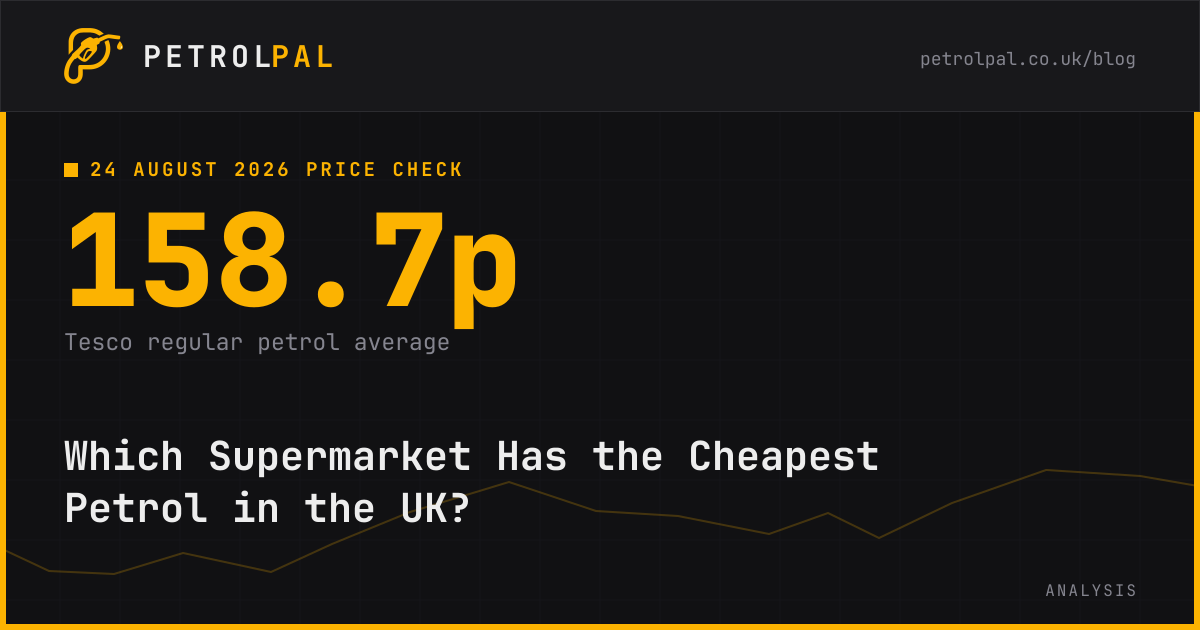
Tesco had the cheapest average regular petrol among Tesco, Sainsbury's, Morrisons and Asda on 30 September 2026. Its 516 priced forecourts averaged 172.1p per litre. Sainsbury's averaged 172.7p, Morrisons 173.1p and Asda 173.3p. These are national station averages, not a promise that Tesco is cheapest near your home. PetrolPal's fuel statistics supplied the dated comparison.
The same snapshot covered 7,908 regular-petrol prices across a UK database of 8,132 stations. Before choosing where to fill up, compare the correct fuel grade and the stations you can reach without an expensive detour. The public price embed provides a separate national summary. It uses different aggregation, so its averages and station count should not be treated as the denominators for the brand table below.
Which supermarket had the cheapest regular petrol on 30 September 2026?
Tesco led the four large chains in PetrolPal's live data. The figures below round each station-based mean to one decimal place. The sample count is the number of priced forecourts for regular petrol. Diesel counts can differ, so the count column does not describe every fuel grade.
| Supermarket | Regular petrol average | Standard diesel average | Petrol forecourts |
|---|---|---|---|
| Tesco | 172.1p/L | 196.7p/L | 516 |
| Sainsbury's | 172.7p/L | 196.8p/L | 316 |
| Morrisons | 173.1p/L | 198.5p/L | 341 |
| Asda | 173.3p/L | 197.7p/L | 405 |
The unrounded Tesco and Sainsbury's petrol means differ by about 0.51p per litre. On a 55-litre fill, that is about 28p. A drive across town can easily cost more than such a national-average saving. For diesel, Tesco and Sainsbury's differ by only about 0.10p per litre before rounding, or roughly 6p on 55 litres. Neither difference predicts the actual gap between two local pumps.
The four chains are not the entire market. PetrolPal lists Costco at 157.9p for regular petrol across 21 priced sites in this snapshot. That much smaller, membership-dependent sample is not a like-for-like substitute for a broad-access big-four ranking. Check entry rules and your nearest station before treating any national figure as an offer available to you. This is a snapshot of recorded prices, not a forecast.
How much cheaper were supermarkets than other forecourts?
PetrolPal's UK statistics put supermarket regular petrol at 172.0p across 2,495 prices on 30 September. Branded forecourts averaged 175.6p across 4,480 prices, and independent forecourts averaged 174.0p across 933. Using the unrounded averages, the supermarket-to-branded gap was about 3.67p per litre. That amounts to about £2.02 on a 55-litre fill.
For standard diesel, supermarkets averaged 196.9p across 2,500 prices. Branded sites averaged 200.9p across 4,464, a difference of about 3.97p per litre and about £2.19 on 55 litres. Independents averaged 199.0p across 1,052 diesel prices. These category means are calculated over different stations and do not measure a saving that every driver can collect.
Averages also differ from the single cheapest local price. A nearby independent might undercut a supermarket, while a motorway stop might cost more than either. Search by location and grade before travelling. The Competition and Markets Authority's August 2026 update describes Fuel Finder as a way to help people compare sites and support competition. It also reports broad registration across UK forecourts, but registration does not guarantee a cheaper price at any particular pump.
Does the cheapest chain change from town to town?
Yes. A chain average combines its priced sites across the country. A town has a different mix of sites, competitors and travel routes. PetrolPal's national Tesco lead does not establish a Tesco lead in London, Belfast or your own postcode. This update does not repeat the earlier article's regional winner counts because those counts came from an August snapshot. Presenting them as September results would be misleading.
Start with the PetrolPal fuel price finder. Select your fuel type, then compare stations close to your actual trip. Check whether the price has a useful observation time and whether the station is open and accessible. An unusual low price deserves an extra check at the forecourt, especially if it would require a long detour. A search result can become out of date after a retailer changes its price.
The government's Fuel Finder factsheet explains why comparisons are possible: the scheme makes retailers' reported prices available to third-party services. Its API guidance describes how those services obtain the data. Neither document makes a fixed supermarket brand the winner everywhere. Use the national table to orient yourself, then make the buying decision from nearby pump prices.
Is Asda still the cheapest supermarket for petrol?
Not in this dated big-four national comparison. On 30 September, Asda averaged 173.3p across 405 regular-petrol sites; Tesco averaged 172.1p across 516. The unrounded gap was about 1.20p per litre. For a 55-litre purchase, that equals about 66p. This calculation describes two national averages, not a price difference guaranteed at your nearest stores. PetrolPal's statistics show the underlying brand means and sample counts.
It would be wrong to turn this into a permanent warning against Asda. Each branch sets or reports its own price, and a competitive Asda forecourt can beat a nearby Tesco. The chain ordering may also change after the next update. Do not use an old reputation, a supermarket advert or an earlier article as the only reason to make a fuel trip.
If you see a different price on the sign, trust the confirmed pump price for your purchase. An article can only explain what its snapshot measured. PetrolPal's public data had last synced at 03:18 UTC on 30 September when this comparison was prepared. Later changes may make the figures here historical even while the live comparison moves on.
Which supermarket was cheapest for diesel and premium petrol?
Tesco also led the big four for standard diesel on 30 September, with an average of 196.7p across 516 priced sites. Sainsbury's followed at 196.8p across 316, Asda at 197.7p across 405 and Morrisons at 198.5p across 341. The difference between the first two unrounded means is only about 0.10p. Check nearby pumps rather than choose a national diesel winner by habit. These diesel figures come from PetrolPal's fuel statistics.
For premium unleaded, Tesco averaged 182.7p across 462 sites, Sainsbury's 184.6p across 292, Morrisons 190.8p across 340 and Asda 191.9p across 76. The Asda sample is much smaller for premium than for regular petrol. It does not cover every Asda location, and premium products can differ in octane or additives. A comparison only helps if it matches the grade your vehicle needs.
PetrolPal's supermarket premium-unleaded category averaged 185.1p, versus 195.1p for branded sites in this dated sample. That category gap is about 9.99p per litre before rounding, or about £5.50 on 55 litres. It is not evidence that premium fuel is worth buying for every car. Check the manufacturer's requirement first, then compare like-for-like fuel at stations you can use.
Can loyalty rewards change the cheapest choice?
They can. The Tesco-to-Sainsbury's national regular-petrol gap in the 30 September snapshot was about 0.51p per litre before rounding. A reward you can actually redeem could exceed that small difference, while a points offer you will never use is worth little to you. Retailer schemes change, and account-specific offers have conditions. Do not subtract an assumed permanent discount from a posted pump price.
Compare the price of the fuel you plan to buy, then account for the value of any valid reward. For example, a hypothetical 2p-per-litre gap across 40 litres is 80p before rewards or travel. This is an illustration, not a quoted station price. If you drive extra miles just to collect it, your travel cost can erase the gain. The PetrolPal route planner can help you consider the full journey.
A useful check is to write down the litres you expect to buy, the two pump prices, the usable reward and the detour. Multiply the per-litre difference by the litres, then compare it with the extra journey cost. Also consider whether you need the fuel immediately. A station on your normal route may be the better purchase even if it is not the lowest listed price.
How should you find the cheapest supermarket petrol near you?
Use a local search rather than a national league table. PetrolPal's 30 September snapshot contained 7,908 regular-petrol prices within a database of 8,132 UK stations. The price embed separately reported 8,163 stations and a 174.2p petrol average at the same last-update time. Those totals are produced through different public summaries; do not mix their station counts or averages in one calculation.
First, choose regular petrol, diesel or the premium grade your handbook specifies. Second, limit the search to stations on your trip. Third, compare the reported price, its freshness and any reward you can redeem. Fourth, confirm the price at the station before filling. Fuel Finder data helps comparison, but a retailer can change a pump price after a snapshot. PetrolPal's fuel finder is the place to check again before you travel.
If a detour saves only a few pence, skip it. On a 50-litre purchase, a 1p-per-litre difference is 50p. Even a larger gap is only useful when the station is accessible and the route makes sense. PetrolPal's route planner can help you compare stops during a journey. This is a decision about your trip, not a contest to find the lowest national average.
What is the final verdict?
Tesco led the broad-access big four for regular petrol and standard diesel in PetrolPal's 30 September snapshot. Its lead over Sainsbury's was small for both fuels. The national averages describe recorded sites, not a guaranteed saving for a specific driver. Even a cheaper category average can hide an expensive local forecourt.
Use the dated table as context. Check the right grade, a nearby pump's reported price, any reward you can redeem and your travel cost. The cheapest useful fill is the suitable station that costs least on your actual route, not the chain that happened to win a nationwide snapshot.