Drivers across the UK make the same choice at the pump: use the supermarket forecourt or drive to Shell, BP or Esso. The board shows the price gap, but it does not show whether the cheaper fuel is the same product.
This is a long-running debate in UK motoring, so we checked the fuel rules, additive claims, live price data and real-world evidence.
Quick Comparison: Supermarket vs Branded Fuel
| Category | Supermarket Fuel | Branded Fuel |
|---|---|---|
| Meets UK standards | Yes (BS EN 228/590) | Yes (BS EN 228/590) |
| Core specification | BS EN 228/590 | BS EN 228/590 |
| Fuel formula | Retailer-specific | Retailer-specific; premium grades market extra additives |
| UK average unleaded, 7 August | 159.4p/litre | 162.8p/litre |
| Annual cost (50 litres fortnightly) | ~£2,072 | ~£2,116 |
| Premium option available | Rarely | Yes (V-Power, Ultimate) |
| Loyalty rewards | Clubcard, Nectar, etc. | Shell Go+, BPme |
| Best for | Everyday drivers | Performance/enthusiast cars |
Which Has Better Fuel Quality?
It's a draw on the core standard. UK petrol follows BS EN 228, while diesel follows BS EN 590. These rules cover key points such as octane, cetane and the fuel blend. The Government's E10 guide says E10 is now the standard 95-octane petrol grade in the UK.
Meeting the same standard does not make every litre the same. Biofuel blends and brand additives can vary within the rules. Ask whether your car needs a certain grade, not whether one logo is always better.
The main difference is the product range. Big fuel brands tend to sell premium grades with higher octane or extra cleaning claims. Supermarkets sell fuel that meets the same core rules, and some also sell premium fuel, but the choice varies by site.
Verdict: both must meet the applicable UK specification. Formulations can differ, especially between standard and premium grades.
Which Has Better Additives?
Branded premium fuel comes with stronger additive claims. Each product uses its own blend and test claims, but those claims do not prove that every engine will run better on premium fuel.
A car built for 95 RON cannot always turn higher octane into more power or lower fuel use. Check the handbook for the grade your engine needs or can use.
Brand tests can tell you about that product, but they do not compare every fuel sold in the UK. Treat cleaning claims as an extra, not a replacement for servicing or the right fuel grade.
Verdict: branded premium fuels make additional additive claims. Whether they are worth paying for depends on your engine and priorities.
Which Is Cheaper?
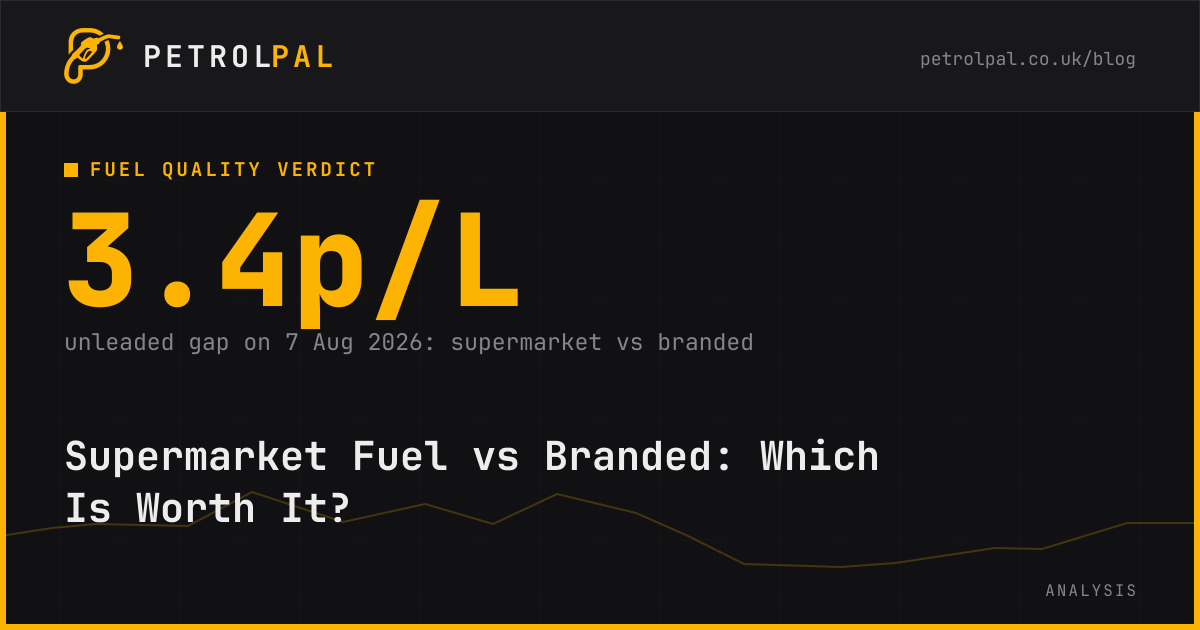
Supermarkets currently win on the UK average. PetrolPal's live price data put supermarket unleaded at 159.4p/litre on 7 August 2026. Branded unleaded was 162.8p, which made the gap 3.4p, while diesel was 178.6p at supermarkets and 183.5p at branded sites. These are UK averages, so your nearest supermarket may not be the cheapest local site.
Here is the dated national snapshot:
| Retailer Type | Average Unleaded Price | Difference |
|---|---|---|
| Supermarkets | 159.4p/litre | Baseline |
| Branded stations | 162.8p/litre | +3.4p |
| Premium unleaded, all retailer types | 178.6p/litre | +19.2p vs supermarket standard |
On a 50-litre tank, the gap is about £1.69 for unleaded and £2.42 for diesel. Fill up every two weeks and that becomes about £44 or £63 per year. Your local saving may be higher or lower, so compare the sites you can use.
Premium unleaded averaged 178.6p/litre in the same snapshot, which was 19.2p above standard supermarket unleaded. A 50-litre premium fill every two weeks would add about £249 a year, although this is not a like-for-like check of the same fuel grade.
Verdict: the current average supermarket saving is about £44 a year for unleaded or £63 for diesel at 50 litres every fortnight. Check live local prices before choosing.
Which Is Better for Your Engine Long-Term?
Use the grade in your car handbook. Most modern petrol cars can use standard 95 RON E10, but some cannot, and diesel drivers should also use the fuel grade named by the car maker.
Some drivers fear that cheap fuel will cause dirt or damage over time, but price alone does not show fuel quality. Both supermarket and branded fuel must meet the core rules, while servicing, the right oil and the way you drive also matter.
Where branded fuel has a genuine edge is in specific scenarios:
- Turbocharged and high-performance engines that need or advise 97-99 RON.
- Cars whose handbook advises a premium grade.
- Drivers who value a premium fuel's cleaning claims and accept the extra cost.
If your family car is approved for 95 RON E10, higher octane is optional unless the car maker advises it. Premium fuel is not a fix for a warning light, rough running or another fault.
Verdict: standard fuel from either retailer type is suitable when it matches the handbook. Premium grades matter most when the manufacturer recommends them.
What About Diesel: Does It Matter More?
The same rule applies to diesel: follow the handbook. Standard UK road diesel is usually marked B7, and each brand can use a different blend within the core rules.
DPF regeneration problems have several possible causes, including driving pattern and mechanical faults. A premium diesel may carry additional cleaning claims, but changing brand is not a reliable diagnosis or repair.
If the car cleans its DPF too often, or a warning light comes on, follow the handbook or get it checked. The current UK diesel gap is 4.8p/litre, but local prices vary.
Verdict: supermarket and branded diesel are both valid choices when they match the vehicle specification. Do not treat premium fuel as a DPF repair.
Which Has Better Loyalty Rewards?
This one depends on where you already shop. Supermarket programmes such as Clubcard, Nectar and Morrisons More tie fuel to grocery rewards, while branded programmes such as Shell Go+ and BPme offer fuel deals and partner rewards.
If you already shop at a supermarket each week, its joined-up rewards are hard to beat, but branded programmes can compete for other drivers.
Verdict: supermarket loyalty wins if you already shop there. Otherwise, branded programmes are comparable.
Common Myths About Supermarket Fuel
Several persistent myths circulate about supermarket fuel. Here's what the evidence says.
"Supermarket fuel is watered down." The forecourt logo is not proof of a bad batch because road fuel must meet the core rules. If you think fuel is faulty, keep the receipt and report that site.
"My car feels sluggish on supermarket fuel." One tank is a poor test because traffic, weather and driving style change. If you used the right grade and the problem stays, get the car checked.
"You get worse MPG on supermarket fuel." MPG changes with the route, weather, tyre pressure and driving style. Compare several similar fills before blaming the fuel brand.
"Premium fuel will clean up an old engine." There's a grain of truth here. A tank of high-detergent fuel can help with significant carbon deposits. But it's a one-off treatment, not a reason to permanently spend more.
Tip
Tip
Want to see the real price difference in your area? Check PetrolPal's statistics dashboard for live brand-by-brand comparisons across 7,000+ UK stations.
Who Should Choose What
Choose supermarket fuel if you:
- Drive a standard family car.
- Cover about 8,000-12,000 miles a year.
- Want the lowest local price for the right grade.
- Already shop at Tesco, Sainsbury's, Asda, or Morrisons.
Choose branded standard fuel if you:
- Prefer one brand's fuel or service offer.
- Find that a branded site is the cheapest easy option nearby.
Choose premium branded fuel (V-Power, Ultimate) if you:
- Drive a car that needs or advises 97+ RON.
- Own a sports car where full power matters.
- Value the fuel's cleaning claims enough to pay more.
The best strategy for everyone: compare prices and use the cheapest practical station with the right fuel grade, because the board matters more than the logo.
How PetrolPal Helps You Save Either Way
The biggest saving comes from checking the sites you can use. The CMA's June 2026 update said supermarkets were still cheapest on average and that shopping around could save up to £9 per tank.
PetrolPal's free tools make this easy:
- Fuel Finder shows live prices near you, with the cheapest first.
- Route Planner finds cheap fuel stops along your trip.
- Price Alerts tell you when fuel falls below your target.
- Statistics Dashboard shows average prices by brand.