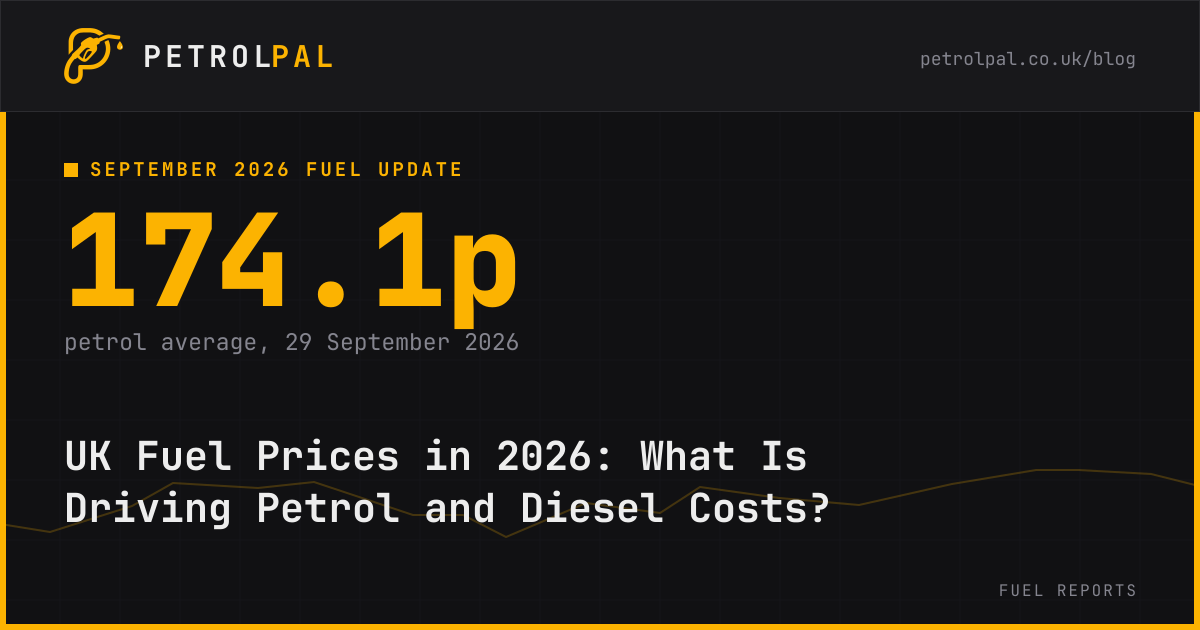
UK petrol averaged 174.1p per litre and diesel 199.2p in PetrolPal's 29 September 2026 snapshot. At those averages, a 55-litre fill cost about £95.77 for petrol or £109.56 for diesel. These are observations across 7,908 unleaded and 8,014 diesel prices, not a price guarantee at any one forecourt. The PetrolPal data was fetched after its 03:23 UTC fuel update on 29 September.
The rise has several causes, but no single national average explains what you will pay. The official weekly series shows a sustained increase through September; local competition, wholesale supply, tax and the delay between a wholesale move and a pump change all matter. This guide separates measured prices from forecasts and replaces the old article's cancelled September and December fuel-duty rises.
What do the latest measured UK fuel prices show?
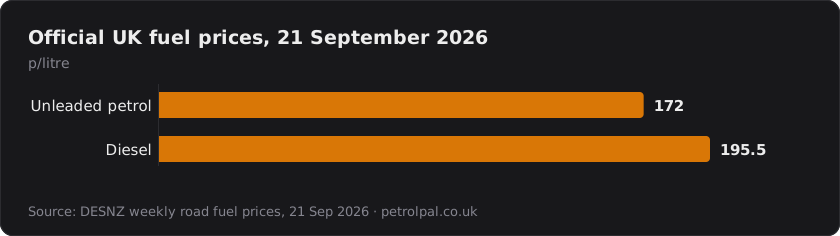
The latest row available in the government's weekly road fuel price dataset is for the week beginning 21 September 2026. It reports petrol at 172.01p and diesel at 195.53p per litre. That is a completed weekly observation, not a prediction for October. The government also publishes the series and its method.
PetrolPal's separate 29 September snapshot put unleaded at 174.13p and diesel at 199.21p before rounding. The snapshot contains 7,908 unleaded prices and 8,014 diesel prices across its UK-wide coverage. The fuel-price page lets drivers compare nearby stations rather than rely only on a national average. Its statistics API records the underlying national counts and group averages.
Do not read the difference between the two sets of figures as a one-week official price increase. They use different dates, station sets and aggregation methods. It is fair to say that both put diesel much higher than petrol. In PetrolPal's snapshot, the difference between the two unrounded averages was 25.07p per litre. For a 55-litre fill, that grade gap alone was about £13.79, before accounting for differences in vehicle efficiency.
The official sequence gives useful context. The government recorded petrol at 161.61p and diesel at 183.49p in the week beginning 31 August. By 21 September those figures had risen 10.40p and 12.04p respectively. Those comparisons come from the same official CSV, so they avoid mixing two different collection methods. A large movement over three weekly observations makes an old article's undated price headline particularly misleading.
Why did prices rise through late summer 2026?
Crude oil and refined fuel are important inputs to pump prices. Supply disruption can raise the cost of crude or the products refiners sell. Sterling matters because oil trades internationally in US dollars. UK wholesale buyers can face a higher sterling bill when the pound weakens, even if a dollar price changes little. None of those inputs converts into one fixed number of pence at every station.
The official weekly series confirms the outcome at UK pumps: petrol moved from 161.61p in the week beginning 31 August to 172.01p on 21 September, and diesel from 183.49p to 195.53p. It does not isolate how much of that rise came from oil, currency, distribution or retail margins. Assigning a precise percentage to any one cause from pump averages alone would overstate the evidence.
Forecourts also buy and replace stock at different times. A wholesale rise does not make every price board change at once. A retailer may still sell stock bought before the latest wholesale move, while a competitor may have bought at a higher price. The lag can work in the other direction when wholesale prices fall. That is one reason to compare specific stations instead of assuming that every sign tracks the national average on the same day.
Diesel has its own supply and demand conditions. The petrol-diesel gap is not a fixed tax surcharge: the government fuel-duty table lists the same 52.95p-per-litre duty for ordinary road petrol and diesel through December. Their pump-price difference therefore cannot be explained by a higher ordinary diesel duty. Refining and distribution costs, demand and local retail prices can differ by grade.
Did fuel duty increase in September 2026?
No. The old version of this article said duty would rise on 1 September and again on 1 December. That schedule was superseded. The government's amended fuel-duty measure extends the temporary 5p-per-litre cut through 31 December 2026. The rate for ordinary unleaded petrol and road diesel is 52.95p per litre throughout that period.
The measure describes a legislative default from January 2027 and rates in its table, but it also says the government will confirm the final rates at Budget 2026. Do not treat that default as an unconditional promise about what you will pay after December. Check the confirmed Budget decision before planning around a 2027 duty change. The previously announced 1p September and 2p December steps are not part of the current 2026 timetable.
VAT is separate from duty. The government weekly data lists a 20% VAT rate alongside the 52.95p duty. VAT applies to the whole retail price, which includes duty. At PetrolPal's 29 September averages, the VAT element of a VAT-inclusive litre works out at about 29.02p for petrol and 33.20p for diesel. Adding duty gives about 81.97p and 86.15p in combined duty and VAT per litre. These are illustrations using a dated group average, not the tax breakdown of a particular receipt.
A rising pump price can increase the pence amount of VAT even while duty stays fixed. It does not prove that a scheduled duty rise occurred. This distinction matters when the article is used to explain the September price climb: the measured increase happened during a duty freeze. Oil, wholesale markets, transport and retail pricing need separate evidence before anyone assigns them an exact share of the increase.
How much does a full tank cost at the measured averages?
At PetrolPal's 29 September averages, 55 litres of petrol cost £95.77 and 55 litres of diesel cost £109.56. Multiply the per-litre price in pence by the litres bought, then divide by 100 to get pounds. A smaller 40-litre purchase costs less in total, but the price per litre does not change merely because you buy less. Vehicle tank size and remaining fuel also vary, so 55 litres is an illustration, not a standard fill for every car.
The official 21 September weekly figures imply roughly £94.61 for 55 litres of petrol and £107.54 for diesel. Those are earlier official averages, not current PetrolPal offers. The practical amount at a pump depends on the actual sign and the fuel grade. Premium petrol and premium diesel are different products; do not substitute their prices into a regular-fuel comparison.
For a household budget, note both the date and the source next to any average. A historic weekly figure can explain how prices moved, while a recently updated local listing is more useful when choosing a stop. If a comparison service shows a time stamp, check it before making a special trip. A few pence per litre of apparent saving may not cover a long detour.
Are supermarket stations always cheaper?
No. PetrolPal's 29 September statistics put the supermarket group average at 171.79p for unleaded, against 175.48p at branded forecourts. The 3.69p-per-litre difference is about £2.03 over 55 litres. For diesel, supermarkets averaged 196.76p and branded forecourts 200.67p. That 3.90p group difference is about £2.15 over 55 litres.
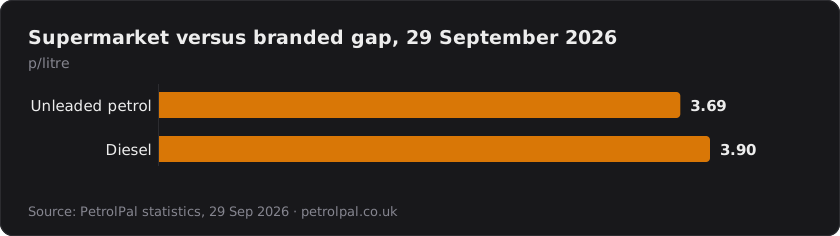
A group average does not rank the individual stations near your home. Some independent stations can beat a supermarket, and some branded sites may compete closely with it. PetrolPal's same snapshot recorded an independent group average of 173.91p for petrol, between its supermarket and branded groups. The groups also have different station counts, so the figures are descriptive, not a controlled comparison of neighbouring forecourts.
Compare stations along a route you already plan to take. For a 55-litre fill, a 3p-per-litre difference is £1.65. A detour can use fuel and time, so a cheaper sign is not automatically a cheaper journey. The PetrolPal map helps you inspect nearby prices, and its route planner can help you look for a practical stop on your journey.
The 29 September dataset also reports medians of 173.9p for unleaded and 199.9p for diesel. The median describes the middle listed station price, while the average weights every listed price in the group equally. A close median and average can make the broad picture easier to read, but neither tells you what a particular forecourt will charge when you arrive. Check the actual listing and its update time.
How current are Fuel Finder prices?
The government's Fuel Finder guidance tells motor fuel traders to submit a price update within 30 minutes of a change. That is a reporting duty, not a guarantee that every downstream comparison app updates instantly or that every submitted record is correct. The government provides a route to report incorrect forecourt details and prices.
PetrolPal's embedded price snapshot identified its latest fuel update at 03:23 UTC on 29 September 2026, while the statistics API was fetched later. The embed rounded the national petrol and diesel averages to 174.1p and 199.8p respectively; the statistics API returned 174.13p and 199.21p from its own aggregation. These endpoints have different outputs, so this article uses the statistics API for its calculations and names the embed only to show the update time. Do not mix their rounded figures in a single calculation.
If a displayed price looks wrong, check the listing's time and confirm the sign or pump at the station. Fuel Finder is designed to improve visibility, but a late report or a data error remains possible. These checks matter most when a saving is small and the trip to the station is long.
What should drivers watch next?
Watch three separate signals: the next government weekly price release, the local station prices that determine your bill, and the final Budget 2026 decision on duty after December. The weekly release helps confirm a trend with a consistent method. Local listings help with the next fill. The Budget decides policy; a table showing a legislative default cannot substitute for that decision.
Do not turn a late-September figure into an October forecast. Prices may move in either direction as wholesale conditions and local competition change. PetrolPal's September snapshot and the official 21 September data show where the market stood at specific times. They cannot tell a driver the exact price of a future fill. Compare prices shortly before travelling, and account for any extra distance before choosing the cheapest-looking sign.