Yes, you can trust Fuel Finder prices as a strong comparison guide, but not as a guaranteed quote. The CMA says around 97% of UK petrol stations are registered, covering an estimated 99% of fuel sales volume. Retailers must report each price change within 30 minutes. A final check at the forecourt still matters.
The distinction is simple. Registration measures market coverage, not perfect price accuracy. A timestamp shows the last reported change, not a fresh confirmation every 30 minutes. PetrolPal's live feed listed 8,092 stations at 04:03 UTC on 27 August 2026. Use that broad coverage to shortlist a station, then confirm the sign and pump before filling.
What Does 97% Fuel Finder Registration Really Mean?
The 97% figure measures registered stations, while the CMA's estimated 99% figure measures sales-volume coverage (CMA, 2026). Together, they show that Fuel Finder covers nearly all UK road fuel sales. They don't show that 97% or 99% of displayed prices were independently checked against pumps.
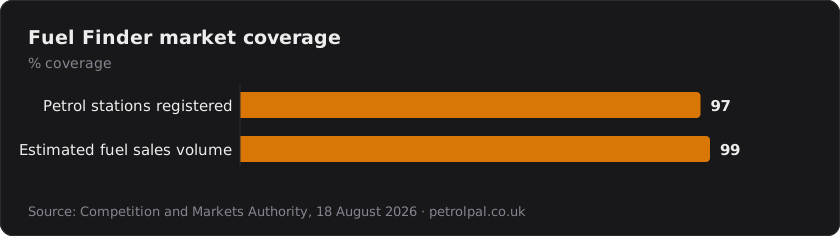
The CMA matched Fuel Finder registrations against a private forecourt dataset from Green Street. It then estimated sales for registered sites that didn't match. The report calls the 99% result an indicative analytical estimate, not an audited measure. That caveat matters. Coverage is broad, but the estimate isn't an accuracy audit.
Why can 97% of stations represent 99% of sales? The remaining unregistered sites are disproportionately smaller, lower-volume forecourts. A few missing sites can therefore represent a much smaller share of total litres sold. The measure says more about consumer reach than raw site count.
The CMA also said most registered sites had recent price records. The overwhelming majority showed a price change during the previous week. That finding supports Fuel Finder as a useful national comparison source. It still leaves room for local mismatches, reporting delays and prices that change while a driver is travelling.
The CMA reported broad market coverage on 18 August 2026: about 97% of stations were registered, representing an estimated 99% of fuel sales volume. The estimate wasn't an audit of price accuracy. It measured how much of the market Fuel Finder could cover through registered retailers.
For the broader market context, see the CMA's August fuel-market update. PetrolPal also publishes live UK fuel-price data by region and brand.
Does an Old Fuel Finder Timestamp Mean the Price Is Wrong?
No. Retailers must report a price change within 30 minutes, not refresh every unchanged record twice each hour (CMA, 2026). A price can stay unchanged for several days. Its timestamp can therefore look old while the number still matches the pump.
Fuel Finder doesn't accept a new submission when it exactly matches the recorded price. The timestamp reflects the last recorded change, not the last retailer check or login. This design prevents duplicate updates, but it can confuse drivers who expect every current price to have today's date.
Smaller and rural sites tend to change prices less often than large supermarkets or motorway operators. The CMA specifically warned against treating record age as proof of a reporting breach. Recency is useful context, but it needs the correct interpretation.
What should you look for instead? Check the price, fuel grade, source time and journey time together. A 48-hour-old record may still be right. A ten-minute-old record can become wrong if the forecourt changes its price after the update and before you arrive.
An older Fuel Finder timestamp doesn't prove that a price is stale. The legal duty starts when a pump price changes, and the record time represents the last reported change. Drivers should treat timestamps as evidence of price movement, not as repeated confirmations that a forecourt inspected every pump.
Our guide to how the 30-minute Fuel Finder rule works explains the reporting chain in more detail.
How Accurate Are Fuel Finder Prices in Practice?
The CMA found that no suspected price-reporting breaches had been referred by VE3 by 18 August 2026 (CMA, 2026). That is encouraging, but it isn't an independently tested accuracy rate. It means the aggregator had made no qualifying referrals for CMA enforcement.
Fuel Finder data comes from retailers. The official service then publishes current prices, forecourt details and update timestamps for third-party tools. The DESNZ access guidance says changed prices are published within 30 minutes. Apps can add their own sync and cache time.
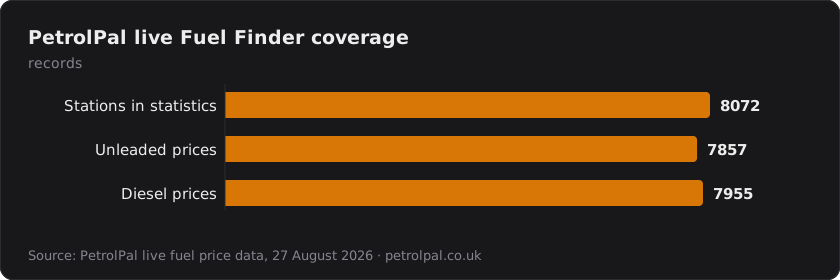
PetrolPal's live statistics at 04:06 UTC on 27 August recorded 7,857 unleaded prices and 7,955 diesel prices across 8,072 stations (PetrolPal, 2026). Its public embed, refreshed from the same 04:03 source time, listed 8,092 stations (PetrolPal, 2026).
Why do live station totals differ between endpoints? Different filters, query paths and cache moments can produce small differences. A station count also isn't the same as a fuel-grade price count. Some sites don't sell every grade, and some records can be excluded from a specific calculation.
The useful conclusion isn't that one total must be wrong. It is that every number needs a label and timestamp. PetrolPal shows both market summaries and current listings, so drivers can compare broad patterns with local results.
Fuel Finder is accurate enough to support a shortlist, especially across a large market. It can't remove every delay, retailer error or change during travel. No comparison service can guarantee a future pump price because the retailer can change it before the driver arrives.
What Should You Check Before Driving to a Cheaper Station?
PetrolPal showed 161.4p per litre for petrol and 183.8p for diesel at 04:03 UTC on 27 August 2026 (PetrolPal, 2026). Those national averages give context, but your saving depends on the exact local station, grade, fill size and detour.
Start with the correct fuel grade. Standard unleaded, premium unleaded, diesel and premium diesel can differ sharply. A driver who compares premium with standard can mistake a grade difference for bad data. Confirm the selected grade before judging any mismatch.
Next, check the source time and your arrival time. A correct listing can change during a long journey. For routine fuel stops, compare stations close to your current route. Our guide explains how to find the cheapest petrol near you without wasting the saving on travel.
Then calculate the gross saving. A 3p difference saves £1.50 on 50 litres. A special journey can consume that amount through extra fuel and time. Is the cheapest sign still cheapest after a six-mile diversion? Often, the best choice is a slightly dearer forecourt already on your route.
Treat Fuel Finder as a decision system, not a promise. Its value comes from comparing many reachable choices quickly. The final forecourt sign converts that data into a purchase decision. This two-step method uses the service's scale without pretending that a live market stands still.
Use the PetrolPal map to compare current prices nearby. For longer trips, compare fuel stops along your route before choosing a diversion.
What Can You Do When the Pump Price Doesn't Match?
Drivers can report a mismatch with the date, time, station, source and optional evidence through the official Fuel Finder error service (DESNZ, 2026). The report may go to the forecourt operator or local Trading Standards. Persistent late or inaccurate reporting can lead to CMA action.
First, check the grade and any membership condition. Some signs display a loyalty price, while the app may show the standard price. Confirm whether the figure applies to your payment method. Then check the pump display before you start fuelling.
If the mismatch remains, take a safe screenshot showing the app price and time. Photograph the forecourt sign or pump if you can do so safely. Keep the receipt. Record the station name, postcode, fuel grade and exact time. These details help the service separate a genuine reporting issue from a grade mistake or old screen.
The official error-reporting guidance allows anonymous reports. Contact details are optional. Evidence is also optional, but a clear screenshot and receipt can make the report more useful.
The CMA had sent 1,166 letters and issued compliance notices covering 53 sites by 18 August. Its early work focused on registration, not proven bad prices. No financial penalties had been imposed. Those numbers show active oversight, but they shouldn't be presented as an error count.
A mismatch doesn't prove that the whole feed is unreliable. It identifies one record at one moment. Reporting it improves the shared data and gives the operator a chance to correct the issue.
Can You Trust Fuel Finder Prices Overall?
Yes, with one limit. Fuel Finder reached around 97% of stations and an estimated 99% of fuel sales volume by 18 August 2026 (CMA, 2026). That scale makes it one of the strongest ways to compare UK pump prices. It doesn't make each listing a binding quote.
The best method has three steps. Compare nearby or on-route stations. Check the price time and fuel grade. Confirm the sign and pump when you arrive. This takes seconds and protects you from a recent change, a grade mix-up or a reporting problem.
Would you rather rely on one roadside sign or compare thousands of current listings first? Fuel Finder gives drivers a much better starting point. PetrolPal turns the official feed into searchable local, regional and route-based choices.
The CMA's 97% registration finding supports confidence in coverage. Its report doesn't publish an independently verified accuracy percentage. Honest use means keeping those claims separate. Broad coverage helps you shop around, while the forecourt remains the final source for the price you pay.