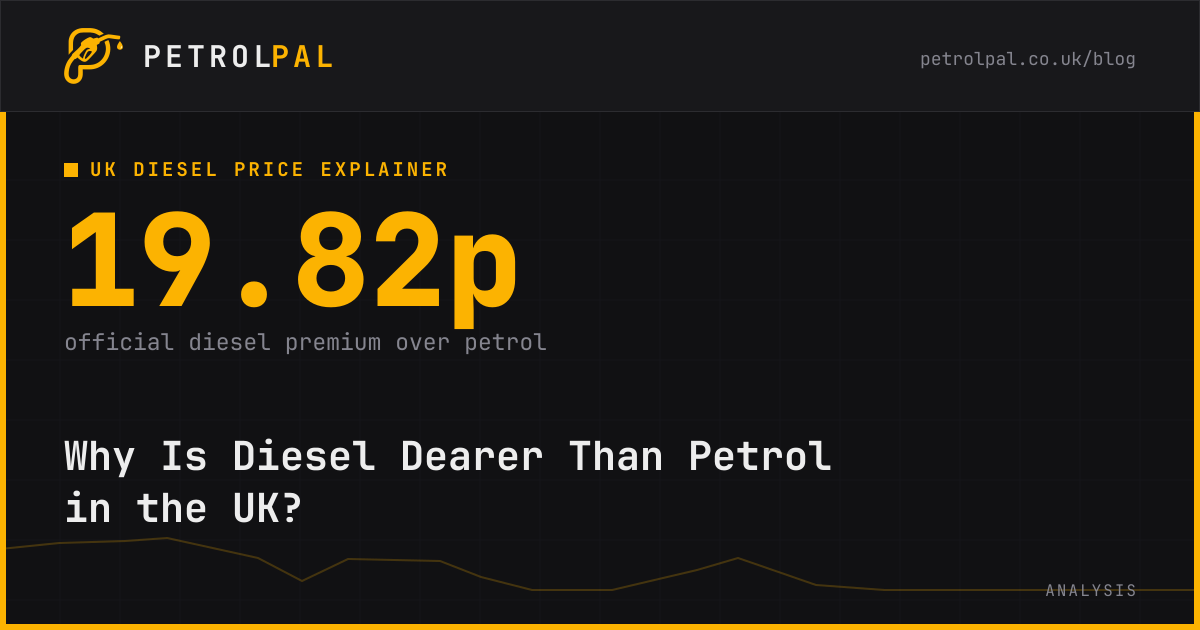
Diesel was 22.58p per litre dearer than petrol on 14 September 2026. Petrol averaged 168.14p, while diesel reached 190.72p. A 55-litre diesel fill therefore cost £12.42 more than the same amount of petrol. These official UK figures come from the Department for Energy Security and Net Zero, or DESNZ.
The gap does not come from a higher diesel duty rate. Both fuels carried 53.95p per litre of duty and 20% VAT that week (HMRC, 2026). Most of the gap forms before tax, where fuel trade prices, refinery problems and supply all matter. Delays at shops and local competition can then change the gap at each forecourt.
Why Is Diesel More Expensive Than Petrol Right Now?
The official 14 September averages were 190.72p for diesel and 168.14p for petrol, which made the gap 22.58p (DESNZ, 2026). Diesel costs more because its trade market is under greater strain. Oil costs and refinery problems also affect each fuel in a different way.
A litre at the pump contains several costs, and crude oil is only the starting material. Refineries turn crude into petrol, diesel and other products, each with its own traded price. Storage, biofuel blending, transport, duty, retailer costs and VAT complete the price.
This explains why petrol and diesel do not move together. An oil price change affects both fuels, yet each fuel has its own supply and demand. Refineries cannot always change their output fast enough to meet those needs.
The latest official week shows that the gap grew during the September price rise. Petrol rose 3.74p from 7 September, while diesel rose 4.36p. The diesel premium therefore grew by 0.62p in one week. Since 10 August, petrol rose 5.99p and diesel rose 8.75p, making the gap 2.76p wider.
The 22.58p gap is not only an oil price gap because petrol and diesel share crude oil, tax rules and much of the same delivery network. Their trade prices can still move far apart before the fuels reach a forecourt.
How Is a Litre of Diesel Priced at the Pump?
Fuel duty was 53.95p per litre for both fuels on 14 September, and both also had 20% VAT (HMRC, 2026). Tax adds a lot to each pump price, but equal tax rates do not create the diesel premium.
The pre-tax fuel cost covers several moving parts:
- Crude oil: The refinery's raw material.
- Refinery price gap: The difference between crude oil and the fuel sold by a refinery.
- Biofuel content: Diesel includes renewable components with their own market prices.
- Exchange rate: International oil products are commonly priced in US dollars.
- Distribution: Fuel must be stored and delivered to each forecourt.
- Retail spread: The station covers operations and earns its margin.
VAT makes a pre-tax gap larger because it is a percentage, so a higher diesel cost also attracts more tax. VAT is not a special diesel charge because the same 20% rate applies to petrol.
The CMA calls the gap between crude oil and trade fuel prices the refining spread. Its road fuel review found that sudden supply or demand changes can raise this gap, as can limited refinery space. The 2022 report explains how the market works, but it does not give one cause for every September 2026 price move.
Why Did Oil Above $100 Not Affect Both Fuels Equally?
Brent crude settled at $104.87 a barrel on 18 September after several weeks of fresh conflict and supply problems. Reuters said that refinery limits had also raised key fuel prices, mainly diesel (Reuters, 2026).
Crude above $100 raises the raw cost for both fuels, but it does not set their final trade prices at the same level. Middle distillates is the industry name for diesel, heating fuel and jet fuel. Refinery outages, shipping limits and high demand for this group can push diesel higher.
The UK also relies more on imported road diesel than imported petrol. The CMA's 2022 review found that imports supplied about 57% of road diesel in 2021, against about one quarter of road petrol. These older figures show how the market worked, not the exact 2026 share, but they show why global diesel supply matters to UK prices.
Refineries make several fuels from one barrel, and they cannot freely change the mix. A refinery cannot turn all its petrol into diesel when diesel supply falls, which helps explain why diesel can rise faster during the same oil shock.
Two forces shaped the September figures. Crude oil raised the base cost of both fuels, while refinery and diesel-market problems added more pressure to diesel. Since 10 August, diesel rose 8.75p and petrol rose 5.99p, which shows the split at the pump.
Did Retail Pricing Also Keep Diesel Higher?
Pump prices do not follow trade markets at once because forecourts use different contracts and receive fuel on different dates. They also sell fuel bought at an older price, so today's pump price can reflect market prices from days or weeks ago.
The CMA's August monitoring report found that diesel pump prices fell more slowly than petrol after some earlier trade price falls. It used two weeks as a guide, while noting that buying terms differ by seller.
The regulator found no proof that sellers changed their plans to exploit the earlier crisis. It did find high margins and passive pricing at many sellers, some of which did not cut diesel prices fast enough to win customers.
That earlier finding does not explain every September price because the latest official data shows a fresh rise in oil and trade prices. Slow shop price cuts are not the only factor, and retail timing cannot explain the full 22.58p difference.
How Much Does the Diesel Gap Change by Forecourt Type?
PetrolPal's live UK snapshot at 04:03 UTC on 21 September showed diesel at 195.95p and unleaded at 172.25p. That is a 23.70p gap across 8,001 diesel prices and 7,897 petrol prices (PetrolPal, 2026). PetrolPal tracked 8,120 stations in the same snapshot.
The public embed feed showed rounded averages of 196.3p for diesel and 172.2p for petrol, a gap of 24.1p. The detailed data feed gives the more exact figures above.
Supermarket diesel averaged 192.60p, while branded forecourts averaged 197.96p. The 5.36p gap equals £2.95 on 55 litres, and petrol had a 4.43p gap between the same groups. Local checks can save money even when diesel costs more across the UK.
Independent diesel averaged 195.38p in the same snapshot, but some independent stations can still beat nearby supermarkets. Group averages hide local choices, and a UK average cannot find the cheapest useful station on your route.
Why can towns differ so much? Local rivalry, delivery costs, motorway sites, land costs and shop policy all matter. Check current local prices rather than assuming that one brand or type is always cheapest.
Compare Petrol and Diesel Prices Near You — Search current fuel prices across the UK before you fill up.
What Can Diesel Drivers Do About the Price Gap?
The official 22.58p gap adds £11.29 to 50 litres and £12.42 to 55 litres (DESNZ, 2026). Drivers cannot put petrol in a diesel engine. They can still reduce the local premium they pay.
Start with these steps:
- Compare diesel prices before the fuel warning light appears.
- Check stations already on your planned route.
- Multiply the price gap by the litres you expect to buy.
- Reject detours that cost more than the gross saving.
- Compare supermarket, independent and branded options locally.
- Check the recorded price time before a long diversion.
Use this simple sum: saving in pounds = pence-per-litre gap × litres ÷ 100. A 5p local gap saves £2.50 on 50 litres. A 10p gap saves £5. A long detour can use part of that saving.
PetrolPal used the UK Government Fuel Finder service. Since 2 February 2026, sellers must report a price change within 30 minutes (Fuel Finder guidance, 2026). An older time can simply mean that the price has not changed, so treat odd prices with care and check nearby options.
Plan a Lower-Cost Diesel Stop — Compare fuel stops along your route before a longer journey.
Will Diesel Stay More Expensive Than Petrol?
UK road diesel use in 2024 was 16% below 2019, while petrol use was 6% higher (DESNZ, 2025). This long-term change does not promise a smaller diesel premium because global fuel supply and refinery problems can matter more than UK road demand.
The gap can shrink when diesel trade costs fall faster than petrol costs, but it can grow if diesel supply falls, refinery output drops or global demand rises. Sellers can take time to pass either move to the pump.
Brent stayed above $100 on 18 September, and Reuters said that the oil outlook was not clear. A firm short-term pump price forecast would therefore be unsafe. The next move depends on supply, refinery output, trade prices and how fast sellers change pump prices.
Watch three signals instead of one forecast. Follow weekly DESNZ pump prices, current local Fuel Finder data and future CMA checks on how fast trade costs reach pump prices. Together, they show the UK gap, local choices and shop price delays.