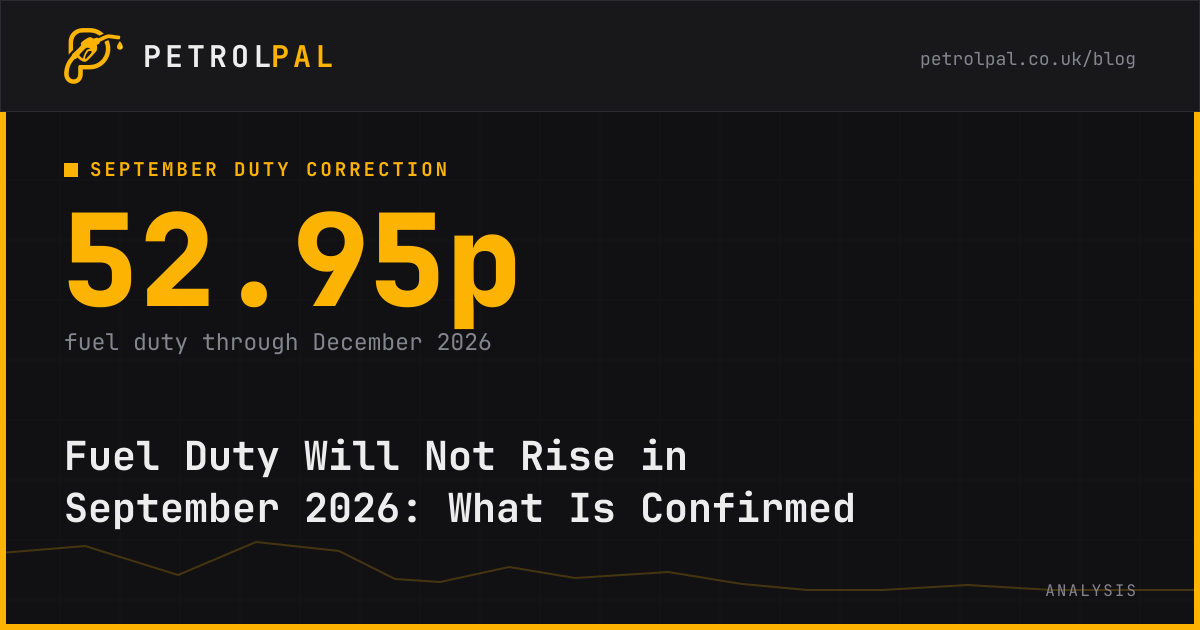
Fuel duty will not rise in September 2026 under the government's current policy. Petrol and road diesel duty stays at 52.95p per litre until 31 December 2026. HMRC confirmed the extension on 22 May, replacing an earlier plan for a 1p rise on 1 September (HMRC, 2026).
That correction matters because older articles still show the superseded timetable. The old plan would have added 1.2p per litre after standard VAT, assuming full retailer pass-through. PetrolPal recorded average prices of 161.6p for petrol and 182.4p for diesel across 8,043 stations on 11 August (PetrolPal, 2026). Drivers should follow current policy and live prices, not outdated September warnings.
What Is Confirmed About Fuel Duty in September 2026?
The confirmed road-fuel duty rate is 52.95p per litre through 31 December 2026 (HMRC, 2026). Therefore, the planned 1 September rise will not happen under current government policy. Petrol and diesel keep the temporary 5p reduction first introduced in March 2022.
HM Treasury announced the change on 20 May. It said the 5p cut would continue for the rest of 2026 (HM Treasury, 2026). HMRC then published the precise end date, 31 December 2026, and the applicable duty tables two days later.
What should drivers expect at midnight on 1 September? No tax-led change is scheduled for standard petrol or diesel. Pump prices can still rise or fall because wholesale costs, exchange rates, delivery timing, and retailer margins continue moving. The duty decision removes one planned pressure. It does not freeze forecourt prices.
According to HMRC, standard petrol and road diesel both remain at 52.95p per litre through 31 December 2026 (HMRC, 2026). This official rate replaces the earlier 53.95p September figure and gives drivers a clear tax baseline for the rest of 2026.
Use PetrolPal's fuel price index to separate national price movements from fuel-duty policy. The live fuel map shows the prices that motorists can actually pay nearby.
Why Do Some Reports Still Predict a September Rise?
The old schedule did include a 1p rise on 1 September 2026, followed by two further 2p steps (HMRC, 2026). Reports based on Budget 2025 or February's legislation can therefore look authoritative while giving a timetable that May's policy change superseded.
The February order set one period from 1 September to 30 November. It then set another period from 1 December 2026 to 28 February 2027 (UK Legislation, 2026). Those dates explain the older headlines. They do not reflect the later extension announced on 20 May.
HMRC's amended paper records both versions. Budget 2025 had planned to reduce the 5p cut by 1p in September, 2p in December, and 2p in March 2027. The same paper then states that the full 5p cut now continues from 1 September through 31 December 2026.
The safest test is the publication date and page title. A source published before 20 May may describe the old path accurately for its time. Current decisions should use the amended HMRC rates published on 22 May. Search snippets can preserve old numbers long after policy changes.
HMRC says the earlier path began with 53.95p per litre in September, but its amended table keeps the rate at 52.95p through December (HMRC, 2026). The one-word difference between "original" and "amended" changes the answer for every UK driver.
How Much Does Cancelling the September Step Save?
The avoided September step is 1p of duty, or 1.2p per litre after 20% VAT, under full pass-through (GOV.UK, 2026). That equals 66p on a 55-litre fill. It is a useful tax comparison, but it is not a forecast for the total pump-price movement.
Fuel duty forms part of the taxable price. A 1p duty increase would therefore add 0.2p of VAT at the standard 20% rate. The cancelled September step avoids that fixed tax effect. Retailers can still change prices by more than 1.2p as wholesale fuel and local competition move.
HM Treasury says the extended support will have saved the average driver £120 since 2025 by the end of 2026 (HM Treasury, 2026). That government estimate covers a wider policy period. It should not be confused with the 66p avoided on one 55-litre September fill.
Would filling early in late August create a guaranteed saving? No. There is no September duty rise to beat. A cheaper station today can matter more than timing the calendar. Drivers should compare reachable forecourts and avoid a detour that consumes the saving.
The cancelled 1p September duty step avoids a tax-only 1.2p-per-litre increase after standard VAT (HMRC; GOV.UK). For a 55-litre fill, that is 66p, while market movements can easily create a larger difference between nearby stations.
What Do PetrolPal's Live Prices Show Now?
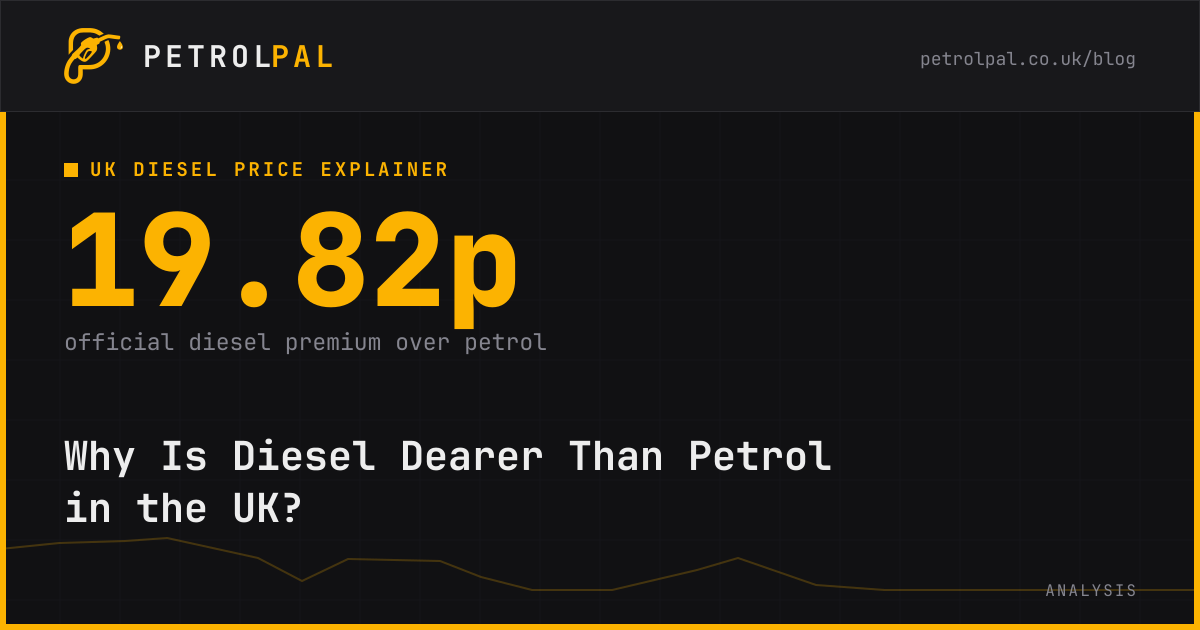
PetrolPal recorded 161.6p for petrol and 182.4p for diesel across 8,043 stations on 11 August 2026 (PetrolPal, 2026). Those live averages show why duty policy and pump prices must be discussed separately. Diesel was 20.8p per litre above petrol despite both fuels carrying the same 52.95p duty rate.
The detailed PetrolPal dataset contained 7,819 unleaded prices and 7,903 diesel prices during the same check (PetrolPal, 2026). The slight difference from the station total occurs because not every site reports every fuel grade. Current national averages therefore use thousands of reported prices, not one selected chain.
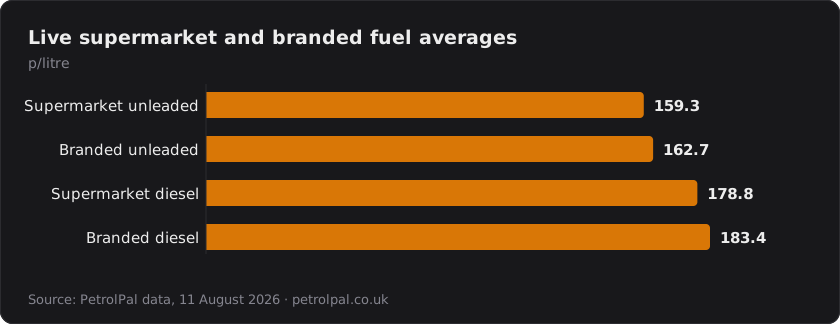
PetrolPal's live data showed supermarket unleaded averaging 159.3p, compared with 162.7p at branded forecourts. The 3.4p gap is about £1.88 on 55 litres. Supermarket diesel averaged 178.8p, against 183.4p at branded sites, a 4.6p gap worth about £2.55 on the same fill (PetrolPal, 2026).
Those group averages do not guarantee that the nearest supermarket is cheapest. Some independent or branded sites beat their category average. Why spend extra fuel chasing a national average? Check the regional price view, then compare stations already close to your route.
PetrolPal data from 11 August covered 8,043 UK stations and placed national petrol at 161.6p per litre (PetrolPal, 2026). Within that market, the 3.4p supermarket-to-branded petrol gap was almost three times the avoided September tax step after VAT.
What Could Happen to Fuel Duty in 2027?
HMRC lists a legislative default of 55.95p from 1 January 2027, then 57.95p from 1 March (HMRC, 2026). However, the same official paper says the government will confirm final rates at Budget 2026. These figures are the default path, not a final promise to motorists.
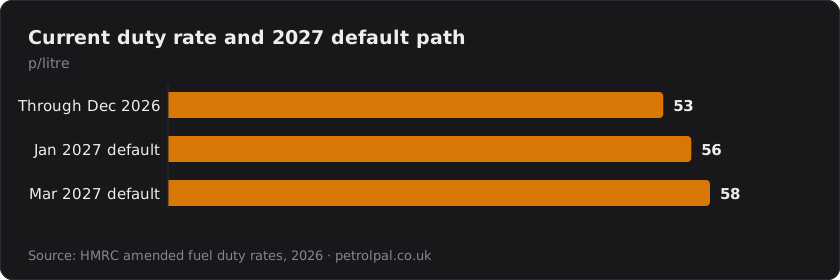
The January default would be 3p above the current 52.95p rate. With standard VAT and full pass-through, that is a 3.6p tax-only pump difference. It equals £1.98 on a 55-litre fill. The March default would restore the full 5p, producing a 6p tax difference after VAT, or £3.30 on 55 litres.
Those calculations describe the published default. They do not predict January or March pump prices. They also do not settle what the Chancellor will announce. The Office for Budget Responsibility says its next forecast is due on 28 October 2026 (OBR, 2026). That fiscal event is the next clear decision point.
The key distinction is between a default and a confirmed rate. HMRC must publish a legal baseline, but ministers can change that path at the Budget. Articles that call the January and March figures "confirmed rises" remove the caveat that HMRC itself includes.
HMRC's amended paper sets 55.95p for January and 57.95p for March as the legislative default, while reserving final confirmation for Budget 2026 (HMRC, 2026). Drivers should treat 2027 calculations as scenarios until the Budget decision is published.
What Should Drivers Do Before the Budget?
The immediate fact is simple: 52.95p per litre remains the duty rate through 31 December 2026 (HMRC, 2026). Drivers do not need to rush to fill before September. They should watch live local prices and revisit 2027 planning after the 28 October fiscal event.
First, remove reminders based on the old 1 September rise. Second, compare nearby prices before a normal fill. Third, treat claims about January and March as provisional unless they cite the Budget decision. This approach avoids both panic buying and false certainty.
For household budgeting, keep scenario figures separate. The January default would add £1.98 to a 55-litre fill after VAT under full pass-through. The March default would make the total difference £3.30 against today's duty rate. Actual fill costs can move in either direction as the fuel market changes.
Could price comparison offset those possible tax differences? PetrolPal's current supermarket-to-branded gaps suggest it can. The 11 August averages imply about £1.88 on a 55-litre petrol fill and £2.55 on diesel (PetrolPal, 2026). Local results will differ, so use the route planner instead of making a special journey.
The next reliable update should come with Budget 2026 and the OBR forecast on 28 October (OBR, 2026). Until then, the confirmed 2026 answer does not change: no September duty rise, and 52.95p per litre through December.
The amended policy keeps the 5p-per-litre cut through 31 December 2026, while the next forecast is due on 28 October (HMRC; OBR). These answers separate current rules from 2027 scenarios.
What Is the Bottom Line for September 2026?
Fuel duty remains 52.95p per litre through 31 December 2026, so the old 1 September rise will not happen (HMRC, 2026). Drivers should ignore superseded timetables, compare current forecourt prices, and wait for Budget 2026 before treating 2027 rates as final.
The practical points are clear:
- Do not make a special August fill to beat a September duty rise.
- Use live local prices because petrol and diesel markets still move daily.
- Treat 55.95p in January and 57.95p in March as default scenarios.
- Check the Budget and OBR forecast on 28 October for final policy.
PetrolPal will track the real price movement through the fuel price index and live map. Policy sets one part of the pump price. Local comparison still decides what each driver pays.