For 2026-27, eligible drivers can claim 55p for their first 10,000 business miles in a car or van. After that, they can claim 25p per mile. Or they can claim the work share of actual vehicle costs. Vehicle purchase rules also apply. The best choice depends on your car and trips, not just pump prices. HMRC's vehicle guide sets out the rates.
A PetrolPal statistics snapshot, saved at 05:05:44 UTC on 22 November 2026, recorded 7,555 regular-unleaded prices averaging 160.5021p per litre. Its separate fuel-price feed had last updated at 04:22:55 UTC. That sample helps illustrate fuel spending, but it cannot establish which tax method is best for your vehicle. Fuel is only one component of actual costs, while the mileage rate includes ownership and running costs.
Who can claim self-employed mileage in 2026-27?
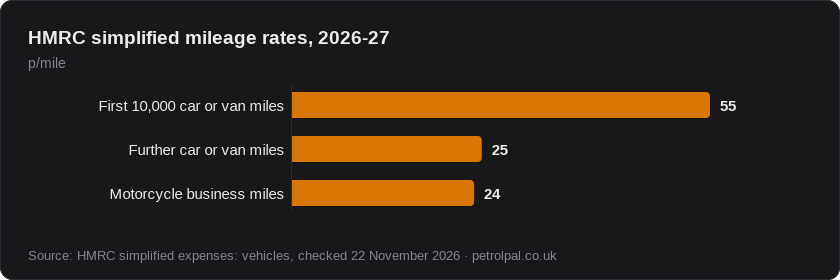
Sole traders and partnerships without a company partner can use simplified mileage for eligible vehicles. Limited companies and partnerships with a company partner cannot. Most cars qualify, but black cabs and dual-control driving instructor cars do not. These are cars designed for commercial use. HMRC's vehicle guidance lists the exclusions. For 2026-27, the first 10,000 business miles in a car or van qualify at 55p per mile. The rate then falls to 25p, while motorcycles qualify at 24p.
| Vehicle and qualifying miles | 2026-27 flat rate | Before 6 April 2026 |
|---|---|---|
| Car or goods vehicle, first 10,000 miles | 55p per mile | 45p per mile |
| Car or goods vehicle, miles above 10,000 | 25p per mile | 25p per mile |
| Motorcycle | 24p per mile | 24p per mile |
The change from 45p to 55p applies to the 2026-27 tax year. Do not use the old rate for that tax year. Does your business year cross two tax years? HMRC's manual explains which rate to use. These rates reduce taxable profits. HMRC does not pay you 55p for each mile. The tax you save depends on your full return.
You can choose a method, but not after you claim the vehicle's purchase cost. This includes a van or motorcycle bought under the cash basis. HMRC's manual explains why. Keep a log of business miles for each vehicle. Employee car fuel rates are different. Our employee fuel-rate guide does not replace these rules.
How much can you deduct using the mileage method?
At 12,000 qualifying car miles, the 2026-27 mileage deduction is £6,000. Calculate 10,000 × 55p = £5,500, then 2,000 × 25p = £500. Add the two deductions, not 55p for every mile. HMRC's vehicle table uses the 10,000-business-mile threshold. The calculation does not use your total odometer reading.
Keep a trip log. Note the date, reason, place and business miles. A log made at the time helps prove your claim. HMRC's manual allows trips made only for work. Part of a trip can count if you can tell it apart. Do not count a whole trip that also had a private purpose.
The flat rate covers buying or hiring the vehicle, fuel, repairs, insurance, tax and MOT. You cannot claim those costs again for that vehicle. Work-only parking, tolls and congestion charges sit outside the rate. They may qualify as separate costs. Train fares are separate too. PetrolPal fuel prices help you compare pumps, not prove your work miles.
Warning
Warning
A mileage deduction is not a payment from HMRC. Keep a journey record and exclude private journeys before calculating it.
Which actual car costs can a self-employed driver claim?
For actual costs, claim only the work share of allowed vehicle bills. HMRC's travel guide lists fuel, insurance, repairs, hire, road tax and breakdown cover. Work parking may count too. Keep bills and a record of private miles. A fuel receipt alone cannot show how much driving was for work.
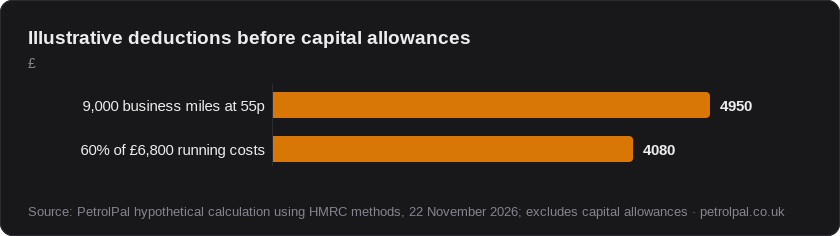
Suppose a car travels 15,000 miles in a year. Of these, 9,000 miles are for work. Its made-up running costs are £6,800. Work miles are 9,000 ÷ 15,000 = 60% of all miles. So the work share of costs is £4,080. The mileage claim is £4,950, or £870 more before any car purchase relief. These are sample costs, not PetrolPal data or a tax saving.
| Illustrative route | Calculation | Expense before other eligible items |
|---|---|---|
| Simplified mileage | 9,000 × £0.55 | £4,950 |
| Actual annual running costs | £6,800 × 60% | £4,080 |
A cost test that ignores the car purchase can give the wrong answer. HMRC's car purchase guide sets out separate tax relief. Mileage already covers the cost of owning the car. A large repair bill or a change in work miles can also change the result. Use the same vehicle and year for both sums.
Can you claim capital allowances as well as mileage?
No, not for the same vehicle. HMRC's manual says mileage already covers wear and loss of value. You cannot add actual running costs or capital allowances. Prior capital allowances rule out mileage for that vehicle. So does a prior deduction for buying a van or motorcycle under the cash basis. If you already chose actual costs, you cannot switch that vehicle to mileage later. A method change requires a replacement vehicle.
Cars do not qualify for the annual investment allowance. HMRC's car guide lists other forms of purchase relief. A new, unused zero-emission car can get a 100% first-year allowance if it meets the rules. A used electric car follows another rate. If you drive the car for private trips, claim only the business share.
A van or motorcycle purchase may follow different rules from a car purchase. HMRC's travel guide explains the cash basis and other ways to keep accounts. Paying cash for a car does not make its full price a running cost. Employee travel payments also follow different rules. Check which rules fit your business before you claim.
The choice is best made before the first claim for a particular vehicle, not when a year's receipts look unusually high. HMRC says the mileage basis must continue for as long as that vehicle remains in the business. Its manual says the switch to or from actual costs happens only when the vehicle is replaced. Different vehicles can use different methods, so a van choice need not dictate a car choice.
Which journeys count as business miles?
Only work trips count, not private trips or normal travel to work. HMRC's vehicle guide excludes trips with both work and private aims. Its travel guide rules out fines and normal home-to-work travel too. Being self-employed does not make every trip from home a work trip.
Consider a self-employed person who drives to a regular work site and later visits a separate client. The first trip needs a home-to-work assessment; the client visit may be business travel if it meets the trade-purpose test. Record destinations and purposes rather than applying a blanket rule. If a trip includes a personal errand, identify any solely business part where the facts support it. Do not treat a whole mixed trip as eligible merely because the client visit occurred.
Keeping tools at home does not make every trip from home a work trip. HMRC's home-to-work guide sets out some exceptions for jobs with no fixed base. The facts of each trip still matter. Ask a tax adviser if you are not sure whether a route counts.
What does the November PetrolPal fuel sample tell you?
A dated fuel-price sample can estimate spending, but not the tax deduction under actual costs. The PetrolPal statistics page returned 7,555 regular-unleaded prices averaging 160.5021p per litre in our snapshot at 05:05:44 UTC on 22 November 2026. Its fuel-price feed reported 8,211 stations and a 04:22:55 UTC update. The two outputs use different summaries; neither is a receipt for your own business.
At the sample's average, 1,000 litres would cost about £1,605.02. This is arithmetic from the saved average, not a claim about one driver's annual usage. Fuel bought at a different station or time will differ. More importantly, the simplified mileage method remains tied to qualifying miles, not to the petrol bill. Actual costs require your own invoices, eligible amounts and private-use split. Why would a national pump average determine your vehicle's tax relief? It cannot.
Our raw snapshots are dated 20261122T050544Z for both data feeds. They preserve the quoted figures. Compare stations on PetrolPal's fuel prices page, but keep receipts for an expense claim. Prices can change after the snapshot. The national sample cannot tell you which tax method gives a larger deduction.
How should you record costs and decide between the two methods?
Count your work miles, then compare both methods for the same car and year. HMRC's guide says to keep a log of work miles. For actual costs, keep bills and a record of private use. HMRC's record rules often require these files for five years after the 31 January tax return deadline.
- Confirm that you are a sole trader or an eligible partnership and identify the vehicle.
- Separate trade journeys from private travel and ordinary commuting. Record dates, routes, purposes and business miles.
- Calculate the 2026-27 mileage deduction with the first 10,000-mile band and the excess band.
- Total allowable actual costs from records, then apply a supportable business-use fraction.
- Check prior car allowances, any cash-basis van or motorcycle purchase deduction, and the method already used. Do not switch the same vehicle from actual costs to mileage.
- Compare deductions, not assumed refunds, and keep your workings with your tax records.
If your business is VAT-registered, the whole mileage claim is not VAT you can reclaim. HMRC's VAT fuel notice has separate rules for petrol and charging. VAT and income tax are different claims. Check the rules before you reclaim VAT on fuel used for private trips or home charging.
Keep the sum you did not claim beside the one you did. Save the other mileage total, bills, work-use sums and past vehicle claims. This makes your choice easier to explain. It can also stop a double claim. A pump-price page cannot replace a trip log or a bill.
Bottom line: which self-employed car-cost method should you use?
Choose the eligible method before your first claim for each vehicle. For 2026-27, mileage starts at 55p per qualifying car or van mile. It falls to 25p after 10,000 miles. Black cabs and dual-control instructor cars cannot use simplified mileage. Nor can a vehicle with past capital allowances or a cash-basis van or motorcycle purchase deduction. Actual costs need receipts and a private-use split. You cannot move the same vehicle from actual costs to mileage next year. Compare your own records and ask an adviser about unusual cases.