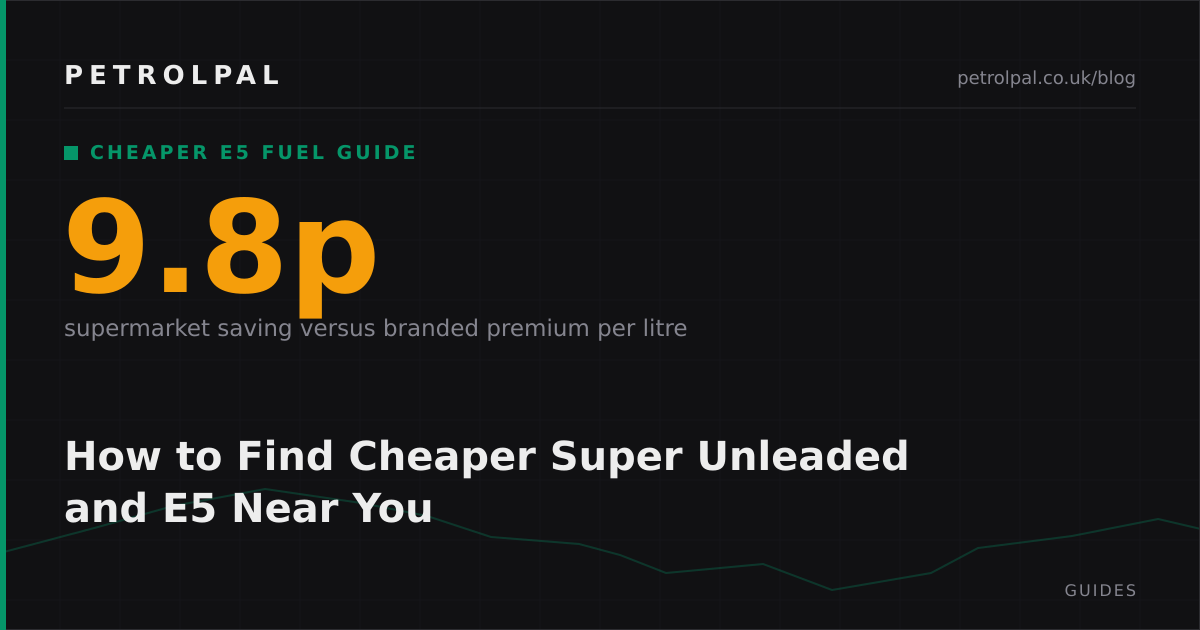
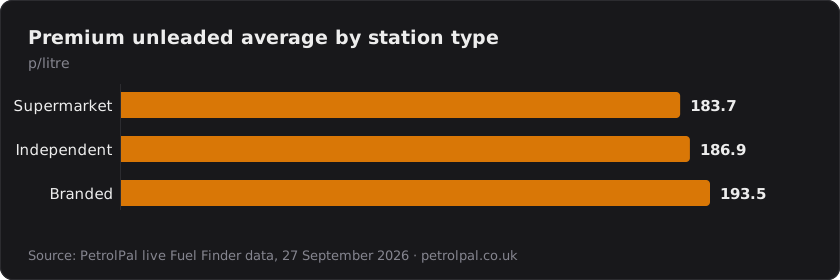
You can find cheaper super unleaded by filtering for premium petrol, comparing nearby stations, checking each price timestamp and confirming the E5 label at the pump. PetrolPal's latest detailed UK snapshot showed premium unleaded averaging 190.2p per litre across 6,258 prices. Supermarket sites averaged 183.7p, while branded sites averaged 193.5p. That 9.8p gap is worth about £4.90 on 50 litres. Source
Price is only part of the decision. E5 describes ethanol content, while super unleaded usually describes a higher-octane grade. Confirm what your vehicle needs before choosing a forecourt. Then compare stations that fit your route, not a distant national minimum that costs more to reach.
What Do E5 and Super Unleaded Actually Mean?
E5 and super unleaded describe different properties. The E5 label means the petrol contains no more than 5% ethanol. E10 means up to 10% ethanol. Super unleaded normally describes petrol with a higher Research Octane Number, usually 97 RON or above in the UK.
The distinction matters because a premium product name does not prove its ethanol content. The Department for Transport says standard 95-octane petrol became E10 in Great Britain during September 2021 and in Northern Ireland during November 2022. It says drivers of vehicles that cannot use E10 can buy E5 as the super grade, 97 octane or higher, at most filling stations.
The RAC fuel guide describes super unleaded as 97 or 98 RON and notes that some retailer products reach 99 RON. Retailers can use different brand names and additive packages, so compare the grade and pump label rather than the marketing name alone.
Use the circular E5 or E10 label on the dispenser and nozzle as the final ethanol check. If your handbook specifies a minimum octane rating, follow that requirement too. A cheap 95 RON E10 price is not a substitute for 97 RON E5 when the vehicle requires the latter.
Does Your Car Need E5 Petrol?
Check before paying extra. GOV.UK says almost all petrol vehicles on the road, about 95%, can use E10 and all cars built since 2011 are compatible. That still leaves older cars, some classic vehicles, certain mopeds and some petrol-powered equipment that may need E5. Source
Start with the official E10 vehicle checker. You will need the manufacturer and may also need the model, engine size and year. Check the handbook, fuel flap and manufacturer advice when the service cannot give a definite answer. Vehicle age alone is not a safe compatibility test.
If the manufacturer requires higher-octane petrol, use that grade even when the engine can accept E10. Ethanol compatibility and octane requirement are separate questions. One tells you whether the fuel blend suits the vehicle's materials and system. The other tells you the fuel's resistance to uncontrolled ignition.
Do not assume a more expensive fuel benefits every compatible car. When the handbook permits standard 95 RON E10, premium petrol is optional unless the manufacturer gives another reason. This guide helps you reduce the cost when you need or choose super unleaded. It does not turn an optional grade into a requirement.
How Can You Search for Cheaper Super Unleaded Near You?
Open PetrolPal's fuel map and search your town, postcode or present area. Select premium unleaded rather than standard unleaded. Keep the search area close enough to include stations you can use without a special long journey.
Use this order:
- Set the correct fuel type. Filter for premium unleaded before comparing any number.
- Check practical distance. Prefer stations on your planned route or close to home, work or another regular stop.
- Compare the listed price. Calculate the difference against the station you would otherwise use.
- Inspect freshness. Check the update time and be cautious with older or unusual records.
- Check access. Confirm opening hours, site access and any membership requirement.
- Confirm at the pump. Read the grade, octane and E5 or E10 label before lifting the nozzle.
Do not use the lowest national record as a promise. PetrolPal's feed can contain old, incorrect or unusual submissions. A local result with a recent timestamp is more useful than an extreme price hundreds of miles away. The displayed forecourt price remains the final price you can buy.
Price order can also change quickly. Save two or three suitable options rather than relying on one station. If your first choice has no E5 pump available, a nearby second choice can prevent an expensive or unsuitable emergency fill.
How Current Are Fuel Finder Prices?
The UK government's Fuel Finder scheme supplies fuel prices and forecourt details to third-party apps and websites. The data includes fuel type, price, site address, operator, brand, amenities, opening hours and timestamps. Source
Public forecourt operators must register and report their prices. The official Fuel Finder overview says operators must update a fuel price within 30 minutes of a change. Government guidance also says API prices are published within 30 minutes of a change. The downloadable CSV is updated twice daily, so different services can show different refresh times.
A reporting rule does not guarantee that every record is perfect at every moment. A retailer can submit an error, a feed can lag or a station can temporarily run out of a grade. Always check the timestamp. Treat the app as a strong pre-trip guide, then verify the product and price at the forecourt.
PetrolPal's public figures used here were fetched on 27 September 2026 and carried a source update time of 26 September at 11:36 UTC. Prices will move after publication. Use the live map for today's nearby options rather than relying on this article's snapshot.
What Do PetrolPal's Latest Premium Prices Show?
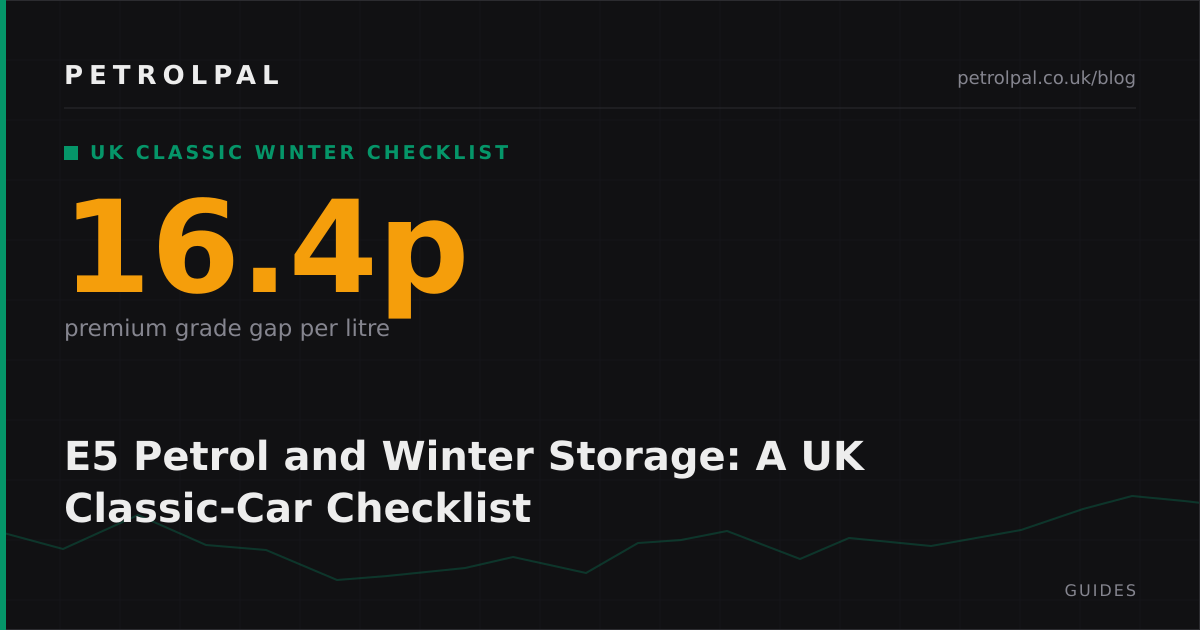
PetrolPal's detailed snapshot covered 8,131 stations and contained 6,258 premium-unleaded prices. The premium average was 190.2p per litre, and the median was 189.9p. Standard unleaded averaged 173.8p, creating a 16.4p average grade gap. Source
On 50 litres, that average grade gap adds about £8.20. This is useful budget context, but it is not the saving from choosing one E5 station over another. For that decision, compare local premium prices only.
The same snapshot showed a larger station-type difference than many drivers may expect:
- Supermarket premium unleaded averaged 183.7p per litre across 1,756 prices.
- Independent sites averaged 186.9p across 528 prices.
- Branded sites averaged 193.5p across 3,974 prices.
The supermarket-to-branded average gap was 9.8p per litre. That equals about £2.94 on 30 litres, £3.92 on 40 litres or £4.90 on 50 litres. These are group averages, not promises about an individual retailer. A nearby branded site can still beat a particular supermarket.
PetrolPal's separate public summary reported premium petrol at 190.0p and standard petrol at 173.7p across 8,162 stations. Source Its station count differs from the detailed endpoint because the two summaries use different views. Use the detailed figures consistently for the comparisons above.
How Can You Tell Whether a Detour Saves Money?
Calculate the fill saving first:
Saving in pounds = price difference in pence × litres needed ÷ 100.
If a nearby station is 8p per litre cheaper and you need 40 litres, the gross saving is £3.20. If it is 4p cheaper and you need 25 litres, the gross saving is only £1.00. The amount you actually buy matters more than the tank's maximum size.
Next, judge the extra journey. A station already on your route adds almost no special fuel cost. A station requiring a return detour uses petrol and time. Your exact detour cost depends on distance, real fuel economy and the price paid, so there is no honest universal mileage limit.
Use this practical test:
- Calculate the gross fill saving.
- Estimate only the extra miles caused by the cheaper station.
- Estimate the fuel used for those extra miles from your normal economy.
- Price that fuel at a realistic local rate.
- Include any membership fee, toll, parking charge or valuable extra time.
- Choose the station only when the remaining saving is worthwhile to you.
Combine fuel stops with another journey where possible. A 9.8p saving on 50 litres looks useful at £4.90. It can disappear if you make a long special trip through congestion. Convenience and reliable E5 availability can be worth more than the final penny per litre.
What Should You Check When You Reach the Forecourt?
Look at the totem and pump before committing. Confirm that the listed price applies to premium unleaded, not standard petrol or premium diesel. Find the E5 label, then check the octane number and product name against your handbook.
Stop if the pump label conflicts with the app description. Ask staff when the grade or price is unclear. Do not fill first and expect the comparison service to change the transaction later. PetrolPal shows reported data, while the forecourt sells the fuel.
Keep the receipt when you monitor local prices or test an optional grade. It records the station, date, litres, unit price and total. That gives you reliable evidence for future comparisons and helps you avoid judging a saving from memory.
For an E5-dependent vehicle, refill before the tank becomes critically low. A planned stop gives you time to compare recent prices and confirm availability. An urgent stop can force you to use the only suitable station nearby, regardless of price.
What Is the Cheapest Safe Way to Buy E5?
First, confirm that your vehicle needs or permits the grade. Then filter for premium unleaded, compare recent prices at practical nearby stations and calculate the saving on the litres you will buy. Check the route and opening status before leaving.
At the forecourt, verify the price, E5 label and octane number. PetrolPal's latest data shows why local comparison can matter: supermarket premium averaged 9.8p less than branded premium, worth about £4.90 on 50 litres. The cheapest safe choice is the suitable fuel you can actually buy without spending the saving on the journey.