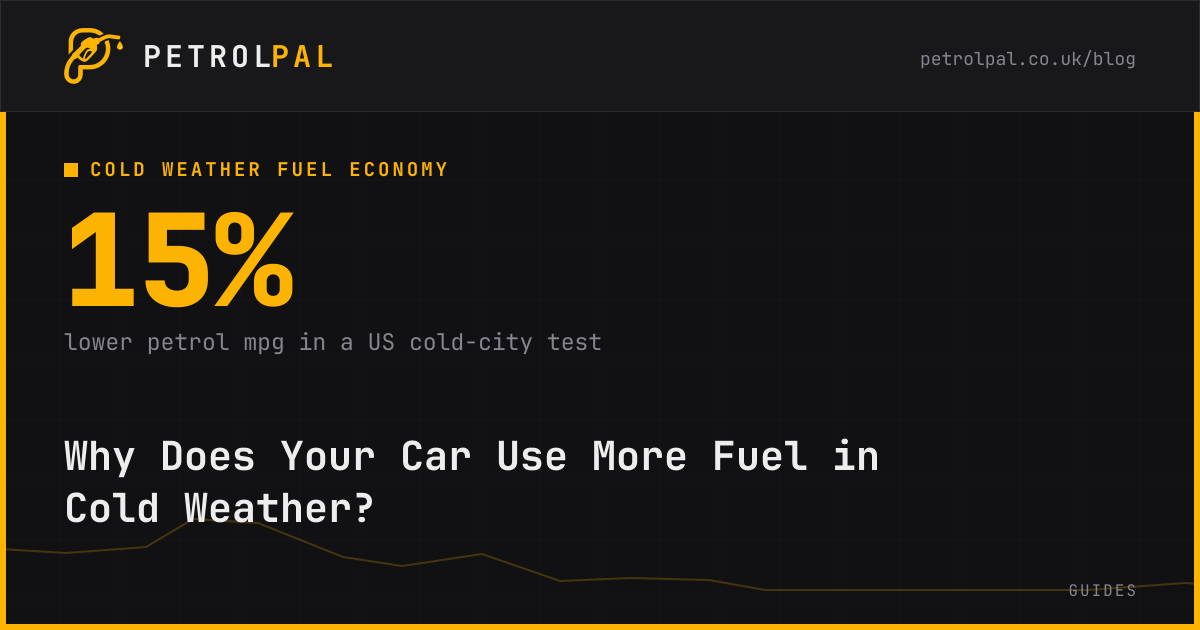
Cold weather can make the same journey use more fuel, even when you drive the same car on the same route. The biggest reason is a cold engine that spends more of a short trip below its efficient operating temperature. In a U.S. test comparison, a conventional petrol car returned about 15% fewer miles per gallon at −7°C than at 25°C in city driving. The measured loss reached 24% on journeys of roughly 3 to 4 miles. Those are test conditions, not a forecast for every UK winter commute. Source
Why does a cold engine use more fuel?
Engine oil and other driveline fluids are thicker when cold, so moving parts face more resistance. An engine also takes time to reach its efficient operating temperature. The U.S. Department of Energy lists both effects among the reasons for lower winter fuel economy. Its data show that shorter trips suffer more because warm-up takes a larger share of the journey. Source
This does not mean a fixed percentage penalty applies to every vehicle. The U.S. source compares substantially different ambient temperatures, and its cited tests include older and later model-year cars. UK weather may be milder. Your engine type, vehicle, trip length, traffic, tyres, driving style and road surface all change the result. The useful lesson is the pattern, not a precise winter multiplier.
The displayed mpg figure can also swing on one short run. A cold start, a queue at the school gates or a long period demisting while stationary can dominate a three-mile average. Compare several similar journeys before deciding that a change is abnormal. If consumption suddenly worsens outside cold conditions, or warning lights appear, arrange a mechanical check rather than dismissing it as seasonal.
Why are short winter trips especially expensive?
A journey that ends soon after the engine warms up gives little time to recover the fuel spent in its least efficient phase. The U.S. test comparison measured a larger reduction for 3- to 4-mile trips than for general city driving. That is why a set of separate errands can cost more than one combined route with fewer cold starts. Source
There are limits to this advice. Do not add a long detour simply to keep the engine warm. Extra miles still consume fuel. If a trip is safe and practical on foot or by another transport mode, avoiding the drive removes that cold start altogether. The RAC also recommends planning journeys and considering whether very short drives are needed. Source
Try comparing the same route at similar traffic times over several weeks. Record distance and litres added at the pump instead of relying only on the dashboard estimate. Fill to a consistent level and remember that mixed journeys, temperature and traffic still make a strict before-and-after comparison difficult. You are looking for a trend, not a laboratory result.
How much could a winter mpg drop cost in the UK?
Here is an illustration, not an observed PetrolPal driver result. Suppose your car normally returns 40 UK mpg over 200 miles. It uses approximately 22.73 litres, using an imperial gallon of 4.54609 litres. If its mpg falls by 15% to 34 mpg on comparable journeys, it uses about 26.74 litres. That is about 4.01 extra litres.
PetrolPal's fuel-price embed showed 174.3p per litre for petrol at its 2 October 2026 update. At that dated price, 4.01 extra litres cost approximately £6.99. This calculation isolates a change in mpg. It does not assume pump prices stay fixed or that all 200 miles involve cold starts. It uses a U.S. test percentage as a scenario, not a measured UK average. Source Source
The price is also an average across stations, not a quotation for your nearest forecourt. PetrolPal's UK statistics showed a 174.4p petrol average across 7,907 unleaded station prices when checked on 2 October 2026. The separate embed reported 8,164 stations across its fuel-price view. These products use different counts and update paths; do not treat the station totals as identical samples. Check a nearby station's current price before you choose where to fill up. Source Source
To adapt the example, divide your planned miles by your expected UK mpg and multiply by 4.54609 for litres. Repeat with the lower mpg, subtract the first litres figure, then multiply by the pump price in pounds per litre. Do not use a U.S. gallon conversion, which would distort a UK driver's estimate. Keep the assumptions visible so you can change them as your own journey data improve.
Do tyre pressure and winter roads change consumption?
Yes, but safety comes first. Colder air can reduce tyre pressure, and an underinflated tyre has more rolling resistance. The RAC says low tyre pressure can raise fuel use and affect handling. Check your tyres when cold against your vehicle's door-frame label or handbook, including the pressure specified for your load. The RAC recommends checking about once a month. Do not inflate beyond the vehicle recommendation in pursuit of a small saving. Source Source
Cold, denser air increases aerodynamic drag, especially at higher speeds. Snow and ice can reduce grip, and a vehicle can expend energy without moving forward as efficiently. Those effects vary by conditions and are not a reason to drive faster on a slippery road. The AA advises gentle manoeuvres, slower speeds and extra stopping room in snow or ice. It explicitly warns against letting air out of tyres to seek extra grip. Source Source
Winter equipment may also change the result. A roof box adds drag, while electrical loads such as heated screens and fans place demands on the vehicle. Use equipment when you need it, especially to keep windows clear. Remove an unused roof box or rack if practical. Do not disable a safety feature to chase a better mpg number. Source
Should you idle to warm up before driving?
Do not leave a modern car running for a prolonged warm-up merely to save fuel. An idling vehicle burns fuel without covering distance. The U.S. Department of Energy says most manufacturers recommend driving off gently after about 30 seconds, and the RAC says prolonged driveway warming is unnecessary for modern engines. Follow your vehicle handbook if it gives a different instruction. Source Source
Clear and demist the whole windscreen and other windows before moving. That can take longer than the engine's mechanical warm-up. A scraper, de-icer and the demister may be necessary; avoid pouring hot water on glass. The AA says to allow extra time and wait until the windscreen is fully demisted. Visibility and control outrank the fuel saved by leaving quickly. Source
Once the windows are clear, accelerate smoothly and let the engine warm under a normal, gentle load. Avoid hard acceleration and abrupt braking, particularly when grip is poor. If you wait in a parked car, do not idle simply to improve a trip-computer average. No single idle time applies to every vehicle or every frost event.
Do diesel, hybrids and electric cars behave the same way?
The causes overlap, but the published test percentages should not be copied from one powertrain to another. Petrol and diesel engines both take time to warm and face cold-fluid resistance. The U.S. study cited here gives a conventional gasoline example. It does not supply a matching UK diesel percentage, so do not promise that every diesel loses exactly 15% of its mpg. Source
Hybrids may lose some efficiency when their engine needs to run to provide heat and when cold conditions affect battery and regenerative braking performance. The U.S. source reports a larger typical cold-weather impact for hybrids under its conditions, but your model and journey pattern matter. An electric car does not burn petrol on its drive, yet cabin heating and battery conditions can reduce range. That is an energy and range question, not a petrol-mpg penalty. Source
For a plug-in hybrid or electric car, preheating the cabin while plugged in may preserve battery range. Do not claim the energy is free: it comes from the charger rather than the traction battery. The RAC and U.S. fuel-economy guidance both identify plugged-in preheating as a useful winter option. Source Source
What is the safest practical way to spend less?
Start with the decisions that do not compromise safety. Keep the car maintained and tyre pressures at the stated cold values. Combine nearby necessary errands when that reduces total distance and cold starts. Clear windows completely. Leave gently rather than idling for an extended period. Remove unused drag-producing equipment, and compare actual local pump prices before a planned fill. Source Source Source
Do not drive farther for cheaper fuel without counting the extra miles. Do not shorten your stopping distance, underinflate tyres, skip demisting or run out of fuel to protect an mpg figure. The AA advises keeping at least a quarter tank for unexpected winter delays. A safe journey costs less than a breakdown or collision, even when the trip computer shows a worse number. Source