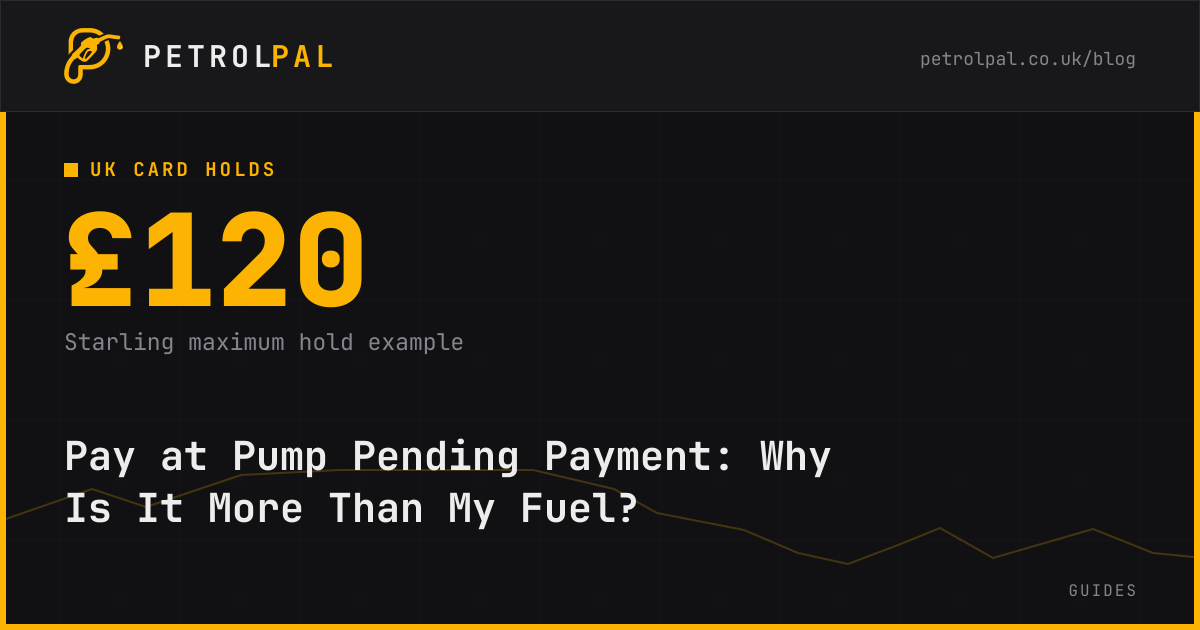
A pay-at-pump pending payment larger than your fuel bill is often a temporary card hold, not a second purchase. The pump requests approval before it knows the final litres. Starling Bank explains that it temporarily reserves up to £120 at a UK automated pump. The retailer then submits the fuel payment and returns unused funds. That limit describes Starling's guidance, not every card or pump. Check whether the larger entry still says pending before reporting a duplicate settled charge.
A hold can still disrupt a journey. It may reduce your available money even when your account's displayed balance looks healthy. NatWest distinguishes available and current balances for precisely this reason. Compare the final receipt with the posted card transaction, then ask your card issuer about a hold that does not clear. If the retailer actually collected the wrong amount, contact the retailer first. You can compare nearby fuel prices before your next fill, but a pump price cannot tell you the size of its card hold.
Why Does Pay at Pump Show a Larger Pending Payment?
The pump authorises an amount before your final fuel total exists. Shell UK's pay-at-pump terms say its app-based fuel transaction holds the value you preselect, then charges only for fuel dispensed. The unused part is released, but the issuer controls when your account reflects that release. These terms describe Shell's app service, not every Shell forecourt or every other retailer.
The sequence has four steps: the pump requests approval, the bank approves, you buy fuel, then the payment settles. Your bank app may highlight the first step, while your receipt shows the fuel purchase. NatWest's pending-payment guide explains why the available balance may decrease before the payment enters the normal balance. A pending entry is therefore a status, not proof that the retailer collected its face value.
Think of a hold as reserved capacity. The final fuel charge normally uses that authorisation. You do not usually need the full hold plus the full fuel bill in separate funds. Starling's guidance says it can reserve up to £120. After fuelling, the retailer sends the unused part back and it returns to your available balance. It is not a second fuel transaction. Other banks can show these steps differently.
What if the forecourt asks for a smaller authorisation? The amount can depend on the retailer's system, the payment method and the amount you select. Shell's terms explicitly link its app hold to the selected amount. Don't treat a figure on another firm's website, or a past payment on your own card, as a guaranteed minimum for your next fill.
Info
Info
If the larger amount is still pending, check the available balance and keep the receipt. If two larger amounts have actually posted, treat that as a separate payment dispute.
Is the Hold the Same as the Final Fuel Charge?
No. A pending authorisation and a settled purchase serve different jobs. Shell UK states that its app-based customer pays for the fuel taken, not the full reserved amount. The final receipt provides the amount to compare with a posted bank charge. A notification about an initial reservation does not by itself show a completed second payment.
Check the exact status next to each transaction. One entry may show pending while the final purchase appears separately. A bank may instead adjust one entry or show an authorisation and release. Starling's guidance distinguishes the reserved amount from what you finally pay. Don't add every visible line and conclude that all were taken permanently. Look at your available balance and your settled transaction history together.
For example, if your card reserves £120 and you buy £30 of fuel, £90 remains unused. The £30 charge normally settles against the £120 authorisation. Your bank may display both entries during processing, but you do not normally pay £150. Starling says its bank can reserve up to £120, but neither the hypothetical £30 purchase nor the £90 release describes a particular customer's transaction.
If the final posted amount differs from the receipt, ask the retailer to inspect the sale. Keep the pump number, date, time, receipt and a screenshot showing the transaction statuses. If the retailer does not correct a completed overcharge, ask your bank to investigate. The Financial Ombudsman Service explains how to complain to the bank and when to contact the ombudsman. Hide other transactions when sharing a screenshot.
Why Do Shell Fuel and Costco UK EV Holds Differ?
A fuel pump and an EV charger can reserve different amounts. Shell's app holds the amount you choose before filling. Costco UK's EV-charging FAQ describes a £30 hold for a charging session, not a petrol purchase. Neither example sets a rule for all UK fuel pumps.
Shell's terms say that each payment authorisation can produce a separate hold. If a driver cancels, the reservation can stay unavailable until it expires. Shell also says that it does not control the time a bank takes to release it. That makes your card issuer the right contact for the exact status and expected release of a Shell app hold. The site cashier can help identify the transaction but cannot promise your bank's timeline.
Costco UK describes a bank error that can leave its £30 EV hold pending longer. Costco says this hold typically clears after 3 to 5 working days. Banks vary. This example concerns a charging error, not the time it takes to release a fuel-pump hold.
For the fuel cost itself, PetrolPal fuel prices reported 8,186 stations and a national petrol average of 172.7p per litre. We captured the raw response at 05:01 UTC on 28 October 2026; its own updated field says 04:23:33 UTC. The UK fuel statistics page separately showed 5,335 unleaded price records, captured at 05:01:22 UTC that day. We saved both raw files for review. These are different datasets. Neither count predicts your card hold.
What Happens After a Failed or Cancelled Attempt?
A failed fill can leave a pending hold even if you bought no fuel. Shell says a hold can remain after a failed or cancelled app payment. Each new attempt can create another hold. Two attempts can therefore tie up money without creating two fuel bills.
If the pump declines, first ask staff whether any fuel was dispensed or any sale completed. Record the pump number and time. Then open the card app and inspect each entry's status. A declined transaction with a pending reservation is different from a completed purchase for fuel you never received. Don't keep retrying the same card if another hold would leave you unable to pay for essential travel.
What failed? For a pending hold, ask your card issuer when it should clear. The retailer can say if it sent a final payment request or cancelled the sale. If you paid but got no fuel, ask the retailer to check and correct the sale. Speak to your bank if needed. The Financial Ombudsman Service explains how to make a formal bank complaint.
When Should You Contact the Bank or Make a Complaint?
Contact your card issuer when a pending hold persists or blocks essential spending. Shell UK directs customers to their bank for the release time. Ask whether the entry is still an authorisation, whether a completion message arrived and what the issuer needs to investigate. Don't assume a fixed expiry period from another driver's account or a different payment network.
If the amount posted twice, start with the retailer and provide the receipt. If the retailer confirms one sale but the second posted charge remains, ask the bank to investigate. The FCA Handbook's DISP 1.6.2A rule requires a final response to a qualifying payment-services complaint within 15 business days. If circumstances beyond the firm's control prevent a final response, it must send a holding response within 15 business days and a final response within 35 business days. This complaint rule is not a deadline for releasing a card hold. Explain whether you dispute a hold or a completed debit.
Your evidence should be simple: receipt, site, pump, time, card's last four digits and screenshots of pending versus posted entries. Do not share a full card number. Ask for a case reference and keep a record of calls. If the bank rejects your complaint or misses the applicable response window, the Financial Ombudsman Service explains when you can bring a complaint to it. A card dispute is not a shortcut to erase a valid fuel purchase.
Can you prevent all holds by paying inside? You can ask the site whether paying at the cashier after filling is available. Shell's app terms distinguish pay-at-pump from pay-at-cashier transactions. That describes its service, not a promise about every forecourt. Choose the option offered at your site, and still check the card terminal before confirming.
The Bottom Line
A pending pay-at-pump amount is a hold, not a final charge. It can lower the money you can spend. Your receipt and posted bank entry show what you paid. Ask the bank about a hold that stays too long. Tell the retailer about a settled overcharge. Keep enough card balance for the hold. The final fuel bill normally uses that hold, rather than adding to it.