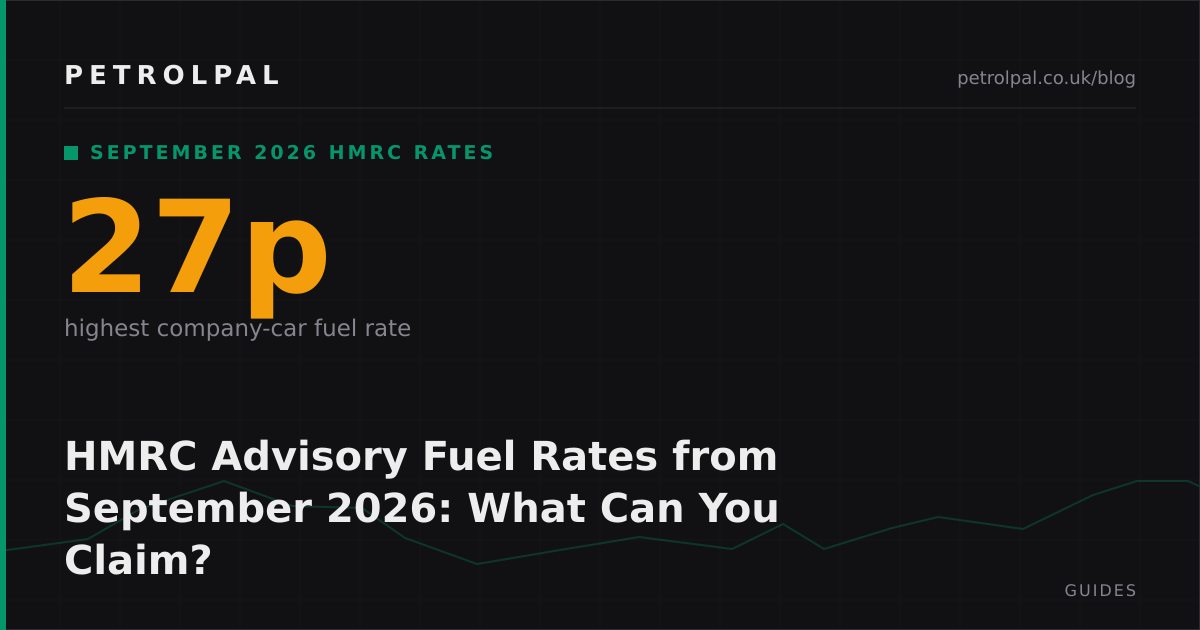
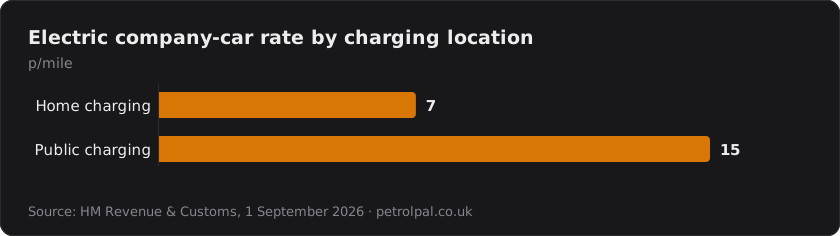
HMRC's company-car fuel rates from 1 September 2026 run from 14p to 27p per mile for petrol, 15p to 22p for diesel and 11p to 20p for LPG. Fully electric company cars use 7p per mile for home charging or 15p for public charging. These rates apply only to company cars, not an employee's own car. Source
The correct figure depends on fuel, engine size and, for an electric car, charging location. Employers can use the previous rates for one month after the change. They can also use a higher evidence-based rate when the real fuel cost per mile is higher.
What are the HMRC advisory fuel rates from 1 September 2026?
The new rates apply from 1 September 2026. HMRC reviews them quarterly, on 1 March, 1 June, 1 September and 1 December. Source
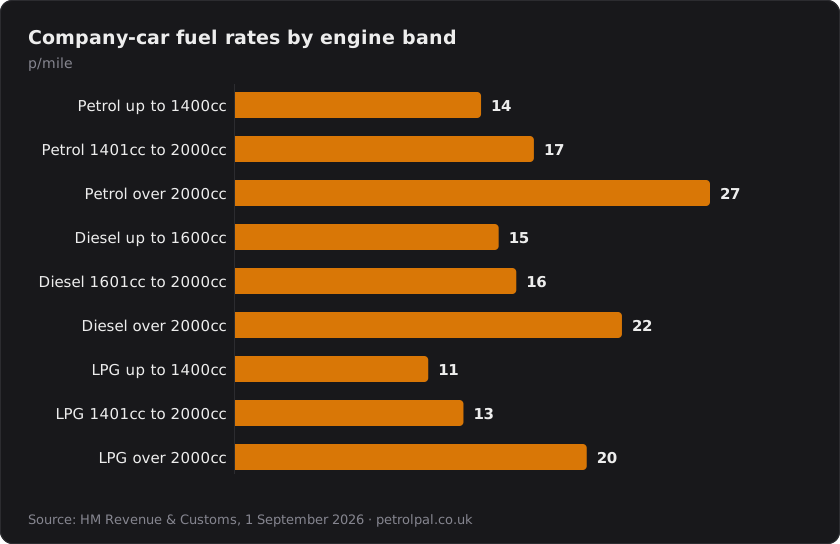
| Fuel and engine size | Rate per business mile |
|---|---|
| Petrol, 1400cc or less | 14p |
| Petrol, 1401cc to 2000cc | 17p |
| Petrol, over 2000cc | 27p |
| Diesel, 1600cc or less | 15p |
| Diesel, 1601cc to 2000cc | 16p |
| Diesel, over 2000cc | 22p |
| LPG, 1400cc or less | 11p |
| LPG, 1401cc to 2000cc | 13p |
| LPG, over 2000cc | 20p |
| Fully electric, home charging | 7p |
| Fully electric, public charging | 15p |
A petrol company car with a 1,600cc engine therefore uses 17p per mile. A diesel company car with the same engine size falls into the diesel band of 1,600cc or less, so it uses 15p per mile. Always match the engine threshold for the correct fuel.
For 1,000 business miles, those examples produce £170 and £150 respectively. A fully electric company car produces £70 for 1,000 home-charged miles or £150 for 1,000 public-charged miles. These are simple mileage-rate calculations, not separate HMRC allowances.
Who can use advisory fuel rates?
HMRC says these rates apply only when an employee uses a company car. Employers can use them in two situations: reimbursing fuel for business travel, or calculating what an employee must repay for fuel used on private travel. They must not be used in other circumstances. Source
For business travel, a payment at or below the relevant advisory rate normally creates no taxable profit and no Class 1A National Insurance charge. If an employer pays more without evidence that fuel cost per mile is higher, the excess can become taxable profit and earnings for Class 1 National Insurance.
For private travel, the employer must correctly record all private mileage. The employee can then repay the private fuel at the correct rate or a higher rate. HMRC also permits a lower rate where the employer can prove that it still covers the full private fuel cost.
Good records matter. Keep journey dates, destinations, business purposes, distances, vehicle details and charging or fuel evidence. The mileage total must separate business and private travel clearly.
Are these rates the same as the 55p mileage allowance?
No. Advisory fuel rates and mileage allowance payments cover different vehicles and costs.
The rates in this guide apply to fuel or electricity used in a company car. The 55p per mile rate applies for tax purposes to the first 10,000 business miles when an employee uses their own car during the 2026 to 2027 tax year. The own-car rate then falls to 25p per mile. Source
That difference is important because an employee using their own car bears more than the fuel cost. Their payment also reflects costs such as depreciation, servicing, tyres and insurance. A company-car user does not use the 55p rate merely because the journey was for work.
Before processing a claim, ask who owns or provides the car. If the employer provides it, check the advisory fuel table. If the employee owns it, check the mileage allowance payment rules instead.
What changed from the June 2026 rates?
Most bands stayed the same. Four rates changed from the period beginning 1 June 2026. Source
| Band | June 2026 | September 2026 | Change |
|---|---|---|---|
| Petrol, over 2000cc | 26p | 27p | +1p |
| LPG, over 2000cc | 21p | 20p | -1p |
| Diesel, 1601cc to 2000cc | 17p | 16p | -1p |
| Diesel, over 2000cc | 23p | 22p | -1p |
Petrol engines up to 2000cc, small diesels, LPG engines up to 2000cc and both electric rates did not change. Public electric charging remains more than twice the home rate, at 15p instead of 7p per mile.
HMRC allows employers to use the previous rates for up to one month from the date new rates apply. This creates a short transition for September expense processing. It does not extend the old rates indefinitely.
How does HMRC calculate the rates?
HMRC combines fuel prices with representative vehicle efficiency. For petrol and diesel, it uses recent Department for Energy Security and Net Zero prices. It combines these with manufacturer MPG information weighted by company-car sales over the previous three years. LPG uses a lower MPG assumption because of its lower energy density. Source
For September, HMRC used 159.9p per litre for petrol and 179.2p for diesel. Its efficiency assumptions range from 50.7 MPG for smaller petrol cars to 27.2 MPG for petrol cars over 2000cc. Diesel assumptions range from 55.7 MPG to 36.6 MPG. HMRC calculates an unrounded cost per mile, then rounds the final advisory rate to the nearest whole penny. Source
The electric calculation uses energy consumption of 3.59 miles per kWh. HMRC used 24.47p per kWh for home charging and 54p for slow or fast public charging below 50kW. That produced calculated costs of 6.81p and 15.02p per mile, rounded to 7p and 15p. Source
These are national benchmarks. They are not a statement that every driver can buy fuel or electricity at HMRC's assumed price.
What if your actual fuel cost is higher than the HMRC rate?
An employer can use its own rate when fleet efficiency or real travel costs differ from HMRC's assumptions. A higher rate needs evidence that the actual fuel cost per mile is higher. Source
PetrolPal's live UK snapshot, updated 17 September, showed average prices of 171.9p per litre for petrol and 195.7p for diesel. Those averages were 12.0p and 16.5p above HMRC's September calculation inputs. Source
A petrol car returning 45 MPG at 171.9p per litre costs about 17.37p per mile in fuel. A diesel car returning 45 MPG at 195.7p costs about 19.77p per mile. Those examples show why actual cost can differ from a broad rate band. They do not automatically justify a higher payment because the vehicle's measured economy and paid price still matter.
Keep receipts or charging records and calculate a defensible cost per mile. For liquid fuel, multiply the paid pence per litre by 4.54609, then divide by measured MPG. For electricity, divide the paid pence per kWh by actual miles per kWh. Use a consistent period rather than one unusual fill or charge.
How should mixed home and public EV charging be claimed?
HMRC permits a fair and reasonable split when a fully electric company car charges at home and in public. Apply 7p per mile to the home-charged share and 15p per mile to the public-charged share. Source
For example, suppose charging records show that 70% of energy came from home and 30% from public chargers. For 1,000 business miles, a matching mileage split gives 700 miles at 7p and 300 miles at 15p. The total is £94.
Do not classify every mile at the public rate merely because the car used one public charger. Keep home and public charging records, then use a reasonable allocation method. If a public charger creates a cost per mile above 15p, HMRC allows a higher evidence-based rate.
Hybrid cars do not use the electric rates. HMRC treats hybrids as petrol or diesel cars for advisory fuel-rate purposes. Use the engine-size band that matches the hybrid's liquid fuel. Source
What should employers and drivers do now?
Update expense systems with the September bands and keep the one-month transition visible. Check that forms ask for fuel type, engine size and, for a fully electric car, charging location.
Drivers should record business mileage as each journey occurs. Keep pump receipts or charging statements when actual costs may support a different rate. For mixed EV charging, retain enough evidence to explain the split.
Employers should also stop claims from mixing company-car advisory rates with own-car mileage allowances. A short vehicle-ownership question prevents many errors before payroll or expenses teams review them.
Finally, check the HMRC page each quarter. The next scheduled review date is 1 December 2026, and fuel or electricity movements can change the table. Source