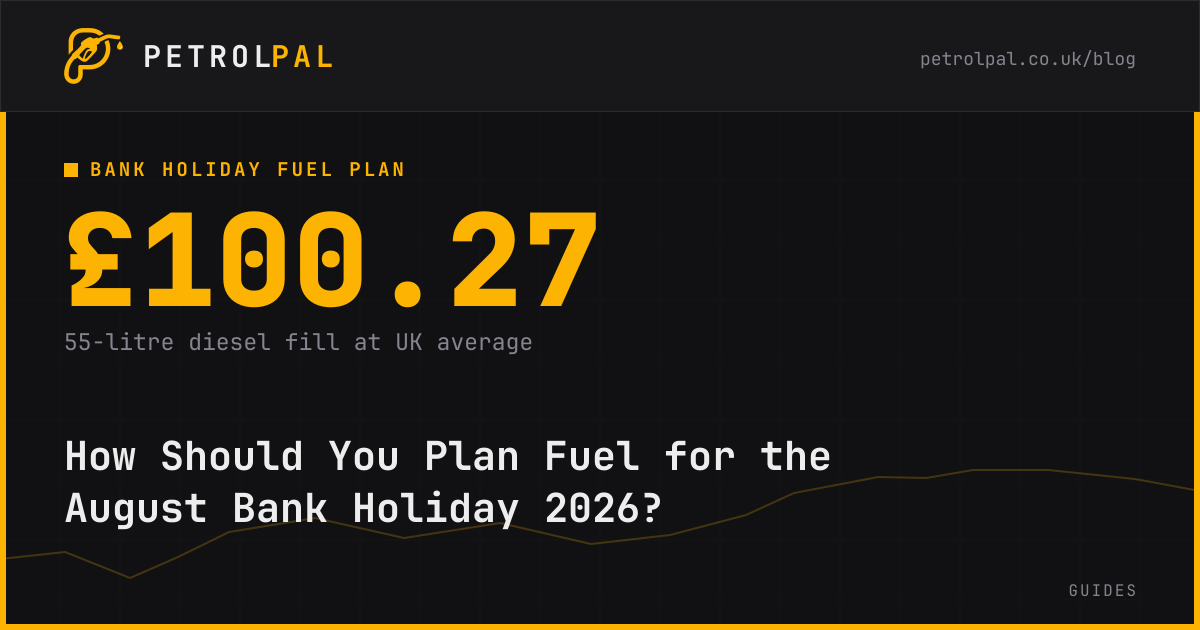
A 55-litre fill cost about £88.66 for petrol or £100.27 for diesel at PetrolPal's UK averages on 14 August 2026. The summer bank holiday falls on Monday 31 August in England, Wales and Northern Ireland. A quick plan can prevent a costly motorway top-up, an unsuitable E10 fill, or a long detour during a busy journey.
Start with three checks. Price the route using your car's real economy. Compare suitable forecourts near home and along the route. Then review live incidents and closures before departure. PetrolPal's route planner can place fuel stops around the journey instead of forcing the journey around fuel stops.
When Is the August Bank Holiday in 2026?
The summer bank holiday is Monday 31 August 2026 in England, Wales and Northern Ireland, according to the official GOV.UK calendar. Scotland's summer bank holiday falls earlier, on Monday 3 August. Check the calendar that applies to your destination and workplace before fixing travel dates.
That gives most travellers a three-day weekend from Saturday 29 August. PetrolPal has not found a reliable national forecast for 2026 bank holiday traffic yet. Quoting an older forecast as a 2026 prediction would mislead drivers, so this guide uses current prices and live road information instead.
Could the busiest period change once traffic forecasts appear? Yes. Check for a new forecast during the final week, but don't wait to complete the basic vehicle and route checks. Planned closures, local events, weather and collisions can matter more than one national journey estimate.
Use National Highways live traffic updates for current incidents, delays and England's daily closure report. Check Traffic Scotland, Traffic Wales or TrafficWatchNI when your route crosses those networks. Repeat the check shortly before leaving because conditions can change after breakfast.
The dependable planning fact is the date, not an invented traffic total. Monday 31 August creates a three-day weekend for many drivers, while National Highways provides current incident and closure data. Build flexibility into the route until an authoritative 2026 forecast becomes available.
How Much Could Your Bank Holiday Fuel Cost?
PetrolPal recorded UK averages of 161.2p for unleaded, 182.3p for diesel and 178.2p for premium unleaded at 05:04 UTC on 14 August. Those figures covered about 8,050 stations in the live PetrolPal fuel-price data. Local prices can differ, so treat these as planning benchmarks.
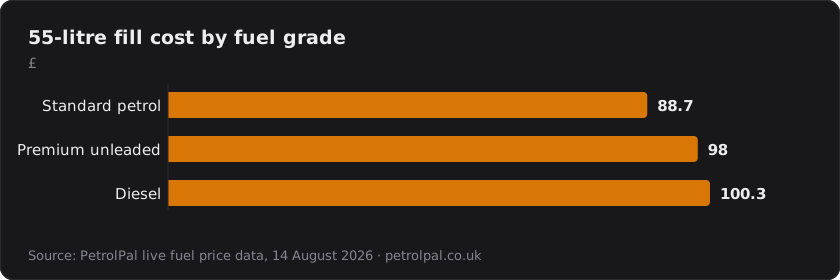
At those averages, 55 litres cost £88.66 for standard petrol, £100.27 for diesel and £98.01 for premium unleaded. Diesel therefore cost £11.61 more than standard petrol for the same volume. Premium unleaded cost £9.35 more, before allowing for each vehicle's fuel economy.
Volume alone doesn't show trip cost. The Weights and Measures Act 1985 defines one imperial gallon as 4.54609 litres. Use this formula:
Journey fuel cost = route miles ÷ real miles per gallon × 4.54609 × price per litre
For example, a 300-mile return journey in a petrol car returning 40mpg needs about 34.1 litres. At 161.2p per litre, that costs about £54.96. A roof box, queues, short cold trips and fast driving can reduce real economy, so add a sensible margin.
Why not use the dashboard's claimed economy? It may reflect recent urban trips or a short sample. A longer average from your own fill records gives a better estimate. If you don't have one, use a cautious figure rather than the most optimistic manufacturer number.
The official DESNZ weekly series reported 162.15p for petrol and 181.97p for diesel for the week beginning 10 August. PetrolPal's live reading was close, but not identical. That is expected because one is a weekly national measure and the other is a live market snapshot.
PetrolPal's 14 August data put a 55-litre diesel fill above £100 at the national average. This isn't a quote for one station. It is a useful budget trigger: compare prices on the fuel map before accepting the first convenient forecourt.
Should You Fill Up Before Joining the Motorway?
The Competition and Markets Authority found in 2023 that motorway services charged about 20p more per litre for petrol and 15p more for diesel than other stations. That historical finding isn't today's guaranteed gap, but it supports checking prices before joining the motorway.
At a 20p difference, 40 litres costs £8 more. At 15p, the same volume costs £6 more. The detour must still make sense. Driving ten miles solely to save a few pence can consume the saving and add stress before a long trip.
The CMA also estimated that a typical family-car driver could save up to £4.50 per tank within a five-minute drive by comparing prices. The words “up to” matter. Savings vary by place, grade and tank size, but a short comparison has little downside.
So when should you fill? Compare nearby prices one or two days before departure, then check again on the day. Fill enough to pass expensive or uncertain sections. You don't need a full tank if a better, convenient stop sits safely along the planned route.
What if the cheapest station has a stale or implausible listing? Check the update time and compare nearby alternatives. Extremely low or high values can be reporting errors. PetrolPal's local fuel-price pages show nearby options, while the pump display remains the price that you accept.
A good fuel stop has three values: price, distance from the route and timing. The absolute cheapest station can be poor value if it requires a long diversion. A slightly dearer stop beside the route can cut mileage, delay and uncertainty.
How Should You Plan E5 Petrol Stops?
Around 95% of petrol-powered vehicles can use E10, and all new cars made since 2011 are compatible, according to the Department for Transport. Drivers with an incompatible or uncertain vehicle should plan E5 stops before entering rural or remote areas.
E10 is the standard 95-octane petrol across the UK. E5 is normally sold as a 97-octane or higher premium grade. Stations selling two petrol grades should offer standard E10 and premium E5, but some small or remote sites may carry only one grade.
PetrolPal recorded 6,217 premium-unleaded prices and 7,823 standard-unleaded prices on 14 August. Premium listings therefore appeared at about four-fifths of the standard count. This is a route-planning proxy, not a verified E5 stock rate, because the source feed classifies grades rather than pump ethanol labels.
Need E5 for a classic car? Filter for premium unleaded on the PetrolPal map, choose a backup station, then confirm the circular E5 label at the pump. Keep enough reserve to reach the alternative. Don't assume every rural forecourt has premium fuel.
If your car accepts E10, you can safely mix E5 and E10 in one tank. The DfT guidance also estimates that E10 may reduce economy by around 1%, although drivers may not notice it. Tyre pressure and driving style can have a larger effect.
The 14 August price gap between premium and standard unleaded was 17.0p per litre. That adds £9.35 to 55 litres. E5 remains necessary for some vehicles, but an E10-compatible car shouldn't buy premium solely because “premium” sounds safer.
What Should You Check Before Departure?
The RAC's March 2026 fuel-saving guide says incorrect tyre pressures harm fuel economy, while repeated slowing and acceleration uses more fuel. A short vehicle check can therefore protect safety, range and cost before a heavily loaded holiday journey.
Use this order:
- Check tyres cold. Use the loaded-vehicle pressure in the handbook or door label.
- Confirm oil, coolant and screenwash. Follow the handbook and avoid opening a hot cooling system.
- Remove unused weight. Take off an empty roof rack or box when you don't need it.
- Load safely. Keep the driver's view clear and secure heavy items low in the car.
- Set the route and backup stop. Save both before mobile coverage becomes weak.
- Review live roads. Check incidents, closures and weather immediately before leaving.
Do you need to chase a precise departure minute? Not without credible current evidence. A flexible window is more useful. Leave time for breaks, avoid racing a predicted queue, and change the route when live information supports it.
Drive smoothly and keep a safe distance. Early observation reduces unnecessary braking and acceleration. Cruise control can help on clear, level roads, but it isn't a cure for congestion or steep terrain. Safety and legal speed limits always come before fuel saving.
National Highways offers live incidents and advance closure information, while RAC advice supports correct tyre pressures and smooth driving. Together, these checks address two preventable bank holiday costs: avoidable delay and avoidable fuel use. Neither requires a special product or a risky roadside repair.
The GOV.UK calendar confirms the 31 August date, while PetrolPal covered about 8,050 stations on 14 August. These short answers handle the main fuel and route questions that drivers ask before the 2026 summer bank holiday.
What Is the Best August Bank Holiday Fuel Plan?
Petrol averaged 161.2p per litre and diesel averaged 182.3p on 14 August, based on PetrolPal's live UK data. The best plan is to calculate your route cost, compare suitable nearby stations, save one backup stop and check live roads shortly before departure.
Fill before the motorway when the saving beats the detour. Confirm E5 stops if your vehicle needs them. Use real fuel economy, not a hopeful dashboard number. Then let the route planner handle convenient stops while you keep enough reserve for delays.
Will prices and road conditions change before 31 August? Almost certainly. Repeat the price and traffic checks during the final 24 hours. PetrolPal provides live fuel prices, and National Highways provides live road updates. That final check turns an early plan into a current one.