Fuel duty increases by 1p per litre on 1 September 2026 for standard petrol and diesel (HMRC, 2026). If retailers pass the tax change through fully, the 20% standard VAT rate takes the pump effect to 1.2p per litre. That adds 66p to a 55-litre fill, rather than £2.75 from restoring the whole 5p cut at once.
The dates and rates are confirmed in HMRC's 2026 to 2027 fuel duty policy paper. Yet the displayed price at each forecourt won't move in lockstep. Wholesale fuel costs, sterling, delivery timing and retailer margins can offset or amplify the tax change. PetrolPal's live fuel map will show what actually happens locally.
By PetrolPal, using HMRC, GOV.UK VAT guidance and live UK Fuel Finder data. Prices checked on 5 August 2026.
What Changes on 1 September 2026?
Fuel duty rises from 52.95p to 53.95p per litre on 1 September for both unleaded petrol and diesel (HMRC, 2026). This is the first of three scheduled steps. It restores only 1p of the temporary 5p cut introduced in March 2022.
The change applies to the duty charged when fuel leaves the duty-suspension system. Drivers don't file anything or pay HMRC directly. The tax is already built into the forecourt price. Existing stock and different delivery dates mean stations may change their signs at different times. So will every pump rise at midnight? No.
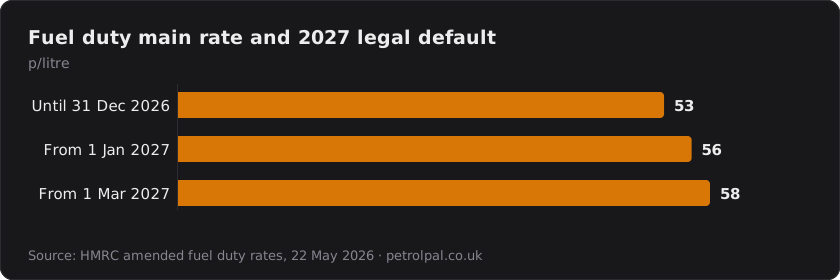
HMRC says the cut continues through 31 August. It then sets standard petrol and diesel duty at 53.95p from September, 55.95p from December and 57.95p from March 2027 (HMRC, 2026). Those published rates make the timetable legislation-led, not a forecast about oil prices or retailer behaviour.
The inflation-linked increase planned for 2026 to 2027 was also cancelled. HMRC estimates this policy package saves the average car driver £49 during 2026 to 2027 against earlier plans (HMRC, 2026). That figure compares with the old policy path. It isn't the cost of September's 1p rise.
The useful comparison is therefore not “rise or freeze”. Drivers face a smaller staged restoration instead of the earlier combination of a March expiry and inflation uprating. PetrolPal's fuel price index can separate that fixed tax timetable from the much larger daily movements caused by the fuel market.
Why Does a 1p Duty Rise Add 1.2p at the Pump?
VAT is charged after fuel duty, so a 1p duty increase carries another 0.2p of VAT at the standard 20% rate. Full pass-through therefore adds 1.2p per litre. This is tax arithmetic, not a promise about the displayed pump price.
The calculation starts with HMRC's 52.95p duty rate and GOV.UK's 20% standard VAT rate. That produces 10.59p of VAT on the duty component. When duty reaches 53.95p, the VAT attached to it becomes 10.79p (HMRC; GOV.UK). VAT also applies to the pre-tax fuel price and retailer margin.
A 55-litre fill illustrates the scale. Multiply 55 litres by the sourced 1.2p tax effect and September adds 66p. A 40-litre fill adds 48p, while 60 litres adds 72p (HMRC; GOV.UK). Could normal market changes hide that amount? Easily.
Fuel duty remains a major part of the bill. PetrolPal's 5 August live feed reports 161.2p for petrol and 181.8p for diesel across 8,031 stations (PetrolPal, 2026). The tax share changes whenever the underlying pump price changes, so a fixed percentage quickly becomes stale.
The tax-only rule is exact: each 1p duty change becomes 1.2p after VAT at 20% (GOV.UK). The real-world price change isn't exact because retailers set prices against wholesale costs, competition, stock and margins. Use 1.2p as a clean benchmark, then compare it with PetrolPal's national statistics.
What Are the Confirmed Fuel Duty Dates and Rates?
The confirmed schedule restores 5p per litre of duty across three dates (HMRC, 2026). Duty rises 1p in September, 2p in December and 2p in March. With VAT, the cumulative pump benchmark reaches 6p per litre by 1 March 2027.
- Until 31 August 2026: duty is 52.95p per litre (HMRC).
- From 1 September 2026: duty is 53.95p, a 1.2p tax-only pump uplift with VAT (HMRC; GOV.UK).
- From 1 December 2026: duty is 55.95p, a cumulative 3.6p pump uplift with VAT (HMRC; GOV.UK).
- From 1 March 2027: duty is 57.95p, a cumulative 6.0p pump uplift with VAT (HMRC; GOV.UK).
For a 55-litre fill, those cumulative tax-only amounts are 66p after September, £1.98 after December and £3.30 after March (HMRC; GOV.UK). They compare each stage with the rate before September. They don't predict the total future fill price.
Why use cumulative figures? They prevent a common error. December adds 2p of duty, worth 2.4p with standard VAT. It doesn't add 3.6p on top of September. March adds another 2.4p, taking the staged effect to 6p (HMRC; GOV.UK).
HMRC says the final 57.95p rate returns duty to its pre-March 2022 level. RPI uprating is due to resume from 2027 to 2028 (HMRC, 2026). Any later cash rate still depends on future fiscal decisions, so this article stops at the three confirmed steps.
Will Every Forecourt Add 1.2p on the Same Day?
No. PetrolPal's live feed shows national averages of 161.2p for petrol and 181.8p for diesel across 8,031 stations (PetrolPal, 5 August 2026). Those prices change before any duty rise. A fixed 1.2p tax effect can be hidden by larger market movements.
Retailers buy fuel on different contracts and schedules. A station may still hold fuel delivered under the previous duty rate. Another may receive new stock sooner. Wholesale petrol, wholesale diesel and sterling can also move in opposite directions. Local rivals then influence when each retailer updates its board.
A fair pass-through check needs two views. First, compare each station shortly before and after the duty date. Second, compare its change with the national market over the same period. If wholesale costs fall while one forecourt rises, tax explains only part of the gap. A single before-and-after photograph can't settle it.
The PetrolPal regional price view helps with that second step. It shows whether your town follows the wider direction. The route planner can then compare stations already near your journey, which avoids spending extra fuel to chase a small saving.
The September increase sets a 1.2p-per-litre tax benchmark under full pass-through (HMRC; GOV.UK). It doesn't require identical pump movements at 8,031 stations (PetrolPal). Wholesale costs, stock timing and local competition decide the final sign price.
How Much Could Drivers Save by Comparing Prices?
Supermarket petrol averages 159.0p, against 162.7p at branded sites, a 3.7p gap (PetrolPal, 5 August 2026). Supermarket diesel averages 178.0p against 183.2p, a 5.1p gap. Both gaps exceed September's 1.2p tax-only uplift (GOV.UK).
On a 55-litre fill, those current differences are about £2.04 for petrol and £2.83 for diesel, based on PetrolPal's group averages (PetrolPal, 5 August 2026). That doesn't mean a supermarket is always cheapest nearby. Individual branded and independent sites can sit below their group average. Why drive several miles to save less than the detour costs?
PetrolPal's detailed dataset contains 7,813 unleaded prices and 7,894 diesel prices (PetrolPal, 5 August 2026). The supermarket and branded comparisons use thousands of current listings, not one selected forecourt. Shopping around can outweigh the first duty step, although local checks remain more useful than national averages.
Set a practical threshold before leaving. At current prices, a 3.7p gap on 45 litres is about £1.67 (PetrolPal, 5 August 2026). If the cheaper station is already on your route, take it. If it requires a long detour, compare the extra mileage and time using PetrolPal's map and route planner.
PetrolPal data shows a 3.7p petrol gap and 5.1p diesel gap between supermarket and branded averages on 5 August 2026 (PetrolPal). Those gaps are roughly three to four times September's 1.2p tax benchmark (GOV.UK). Price comparison can offset the first duty rise before driving habits change.
What Should Drivers Do Before September?
Start with the 1.2p-per-litre benchmark, not a prediction that prices will jump by exactly that amount (HMRC; GOV.UK). Record nearby prices in late August, then check them after 1 September. The difference will include tax and market changes.
Don't make a special long trip merely to beat the 66p tax effect on a 55-litre tank (HMRC; GOV.UK). A detour can consume the saving. Filling earlier can make sense when you already pass a competitive station. Otherwise, local comparison usually offers more value than timing one tax date.
Watch diesel and petrol separately. PetrolPal reports 181.8p for diesel and 161.2p for petrol, a 20.6p difference (PetrolPal, 5 August 2026). Refining and demand can move each fuel differently. A falling petrol market doesn't guarantee diesel will follow, or vice versa.
Add the later dates to your calendar. The 1 December increase adds another 2.4p per litre with standard VAT under full pass-through. The 1 March step does the same (HMRC; GOV.UK). Together, those later changes matter more than September's first move.
Finally, check the live PetrolPal map before a large fill. The duty rate is national, but savings are local. PetrolPal's current 3.7p supermarket-to-branded petrol gap equals about £2.04 on 55 litres (PetrolPal, 5 August 2026), more than September's 66p tax-only effect.
Frequently Asked Questions
Fuel duty rises by 1p per litre on 1 September 2026, with two further 2p steps confirmed (HMRC, 2026). These answers separate the statutory rates from the pump-price outcome that drivers will see.
How much will fuel duty rise in September 2026?
Fuel duty rises by 1p per litre, from 52.95p to 53.95p, on 1 September (HMRC). Because the standard VAT rate is 20%, full pass-through adds 1.2p at the pump (GOV.UK).
How much more will a full tank cost?
The September tax change adds 66p to a 55-litre fill if passed through fully. A 40-litre fill adds 48p and a 60-litre fill adds 72p (HMRC; GOV.UK). Actual totals may differ as wholesale costs and margins move.
When are the next fuel duty increases?
HMRC confirms another 2p duty rise on 1 December 2026 and a further 2p on 1 March 2027 (HMRC). With standard VAT, each later step has a 2.4p tax-only pump effect and the cumulative uplift reaches 6p (GOV.UK).
Will petrol and diesel duty rise by the same amount?
Yes. Standard petrol and road diesel share the same duty schedule: 52.95p before September, 53.95p from September, 55.95p from December and 57.95p from March 2027 (HMRC). Their pump prices can still move differently because wholesale markets differ.
Can retailers charge more or less than the tax increase?
Yes. The September tax benchmark is 1.2p per litre with standard VAT (HMRC; GOV.UK). PetrolPal tracks 8,031 stations whose prices also reflect fuel costs, stock timing and margins (live prices).
What Is the Bottom Line for September?
September's confirmed duty rise is 1p per litre, or 1.2p with VAT under full pass-through (HMRC, 2026; GOV.UK). That means 66p on a 55-litre fill. It is noticeable, but smaller than many current local price gaps.
The tax path is clear through March 2027. The pump path isn't. December and March each add another 2.4p per litre with standard VAT (HMRC; GOV.UK). Wholesale markets and retailers will shape the final price around those dates.
Use the PetrolPal fuel price index to track the national movement, then check the live map before filling. The best response isn't panic buying. It's knowing the tax benchmark and comparing the prices you can actually reach.