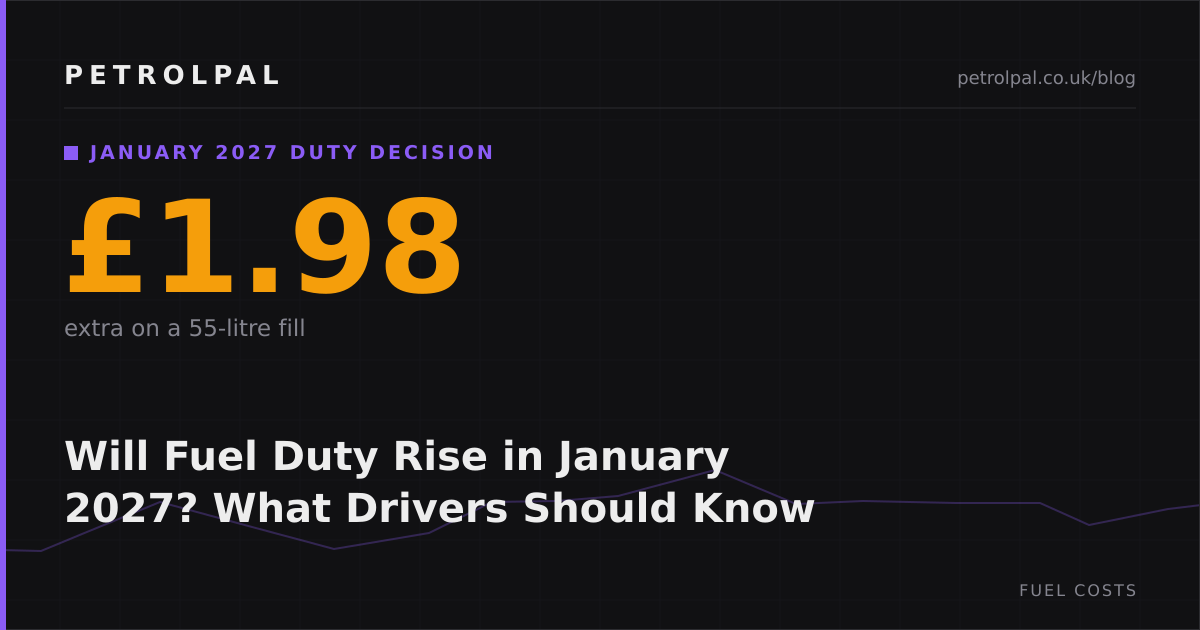
Fuel duty is due to rise by 3p per litre on 1 January 2027 under the current legal default. Petrol and diesel duty would move from 52.95p to 55.95p per litre. If the full duty rise reaches pump prices and attracts 20% VAT, drivers could pay about 3.6p more per litre, or £1.98 more for 55 litres.
That increase is not yet the final government decision. HM Revenue & Customs says the government will confirm the final rates at Budget 2026. The safe answer is therefore: a January rise is the current default, but the Budget could keep, change or cancel it (HMRC, 2026).
What Is the Confirmed Fuel Duty Position Today?
The temporary 5p-per-litre fuel duty cut remains in place until 31 December 2026. The main rate for both unleaded petrol and road diesel is 52.95p per litre during this period. HMRC's amended rate table then lists 55.95p from 1 January 2027 and 57.95p from 1 March 2027 (HMRC, 2026).
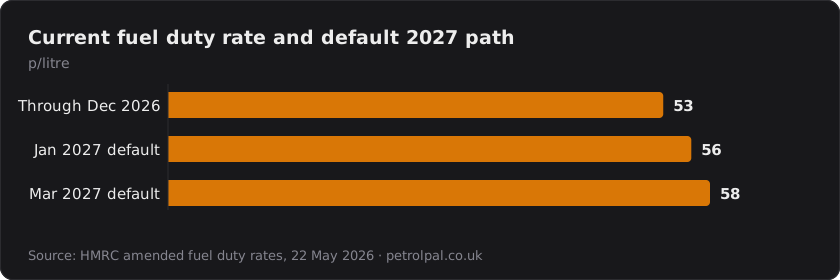
These dates reverse the temporary cut in two stages:
- Until 31 December 2026: 52.95p per litre.
- From 1 January 2027: 55.95p per litre, a 3p increase.
- From 1 March 2027: 57.95p per litre, a further 2p increase.
The 57.95p rate is the level that applied before the temporary cut began in March 2022. The January and March steps would remove the full 5p cut without adding a separate inflation rise for 2026 to 2027.
The most important qualification sits in HMRC's own policy paper. It calls the January rate the "legislative default" and says the government will confirm final rates at Budget 2026. Drivers should treat 55.95p as the current scheduled rate, not a promise that prices will rise on that date.
Why Did the September 2026 Increase Not Happen?
The February plan would have started reversing the 5p cut earlier. It scheduled a 1p rise on 1 September 2026, another 2p on 1 December 2026 and the final 2p on 1 March 2027 (HMRC, 2026).
The government changed that plan in May. It extended the whole 5p cut through 31 December 2026. HMRC said the change supported motorists during elevated fuel prices linked to the Iran war. The amended plan moved the first reversal to January and combined the cancelled September and December steps into one 3p increase.
This distinction matters because some older articles and calculators can still show the February timetable. The September 1p rise and December 2p rise are no longer the active schedule. The current schedule has no main-rate increase before January 2027.
The May change also reduced the rebated rate for red diesel and certain related fuels. That separate measure does not change the 52.95p main rate paid on road petrol and diesel.
How Much Could the January Rise Add at the Pump?
Fuel duty is charged before VAT. Road fuel is standard-rated for VAT, and the UK standard rate is 20% (HMRC, GOV.UK). If a seller passes through the full 3p duty increase, VAT can add another 0.6p. The simple maximum direct tax effect is therefore about 3.6p per litre.
Here is the possible extra cost for common fill sizes:
| Litres bought | January duty rise | Approximate rise with 20% VAT |
|---|---|---|
| 40 litres | £1.20 | £1.44 |
| 50 litres | £1.50 | £1.80 |
| 55 litres | £1.65 | £1.98 |
| 60 litres | £1.80 | £2.16 |
These figures isolate the tax change. They are not forecasts for the full pump price. Oil, wholesale fuel, exchange rates, transport, retailer margins and local competition can move prices up or down at the same time.
HMRC says fuel producers and importers ordinarily pass fuel duty through to motorists. A forecourt can still change its price by a different amount because the tax change is only one part of its cost. Pump prices may also change at different times as sellers receive new deliveries and update their boards.
What Would the March Step Cost if Both Rises Happen?
The current default adds another 2p of duty on 1 March 2027. That would restore the full 57.95p rate. Across January and March, duty would rise by 5p per litre compared with the rate in force today.
With 20% VAT, the combined direct tax effect could be about 6p per litre. That equals £2.40 on 40 litres, £3 on 50 litres, £3.30 on 55 litres and £3.60 on 60 litres.
Do not add 6p to today's pump price and call it a March forecast. The calculation only shows the possible tax contribution if both current steps happen and sellers pass them through in full. Market prices could make the actual pump movement larger, smaller or even move in the opposite direction.
HMRC also says motorists would still have a lower fuel duty rate during January and February than before March 2022. The 55.95p January rate is 2p below the restored 57.95p rate listed for March.
How Large Is 3.6p Compared With Current Fuel Prices?
PetrolPal's UK snapshot at 04:04 UTC on 24 September showed unleaded averaging 172.93p per litre across 7,899 prices. Diesel averaged 197.22p across 8,003 prices. The data covered 8,122 stations and was last synced on 23 September (PetrolPal, 2026).
The public embed feed listed 172.9p for petrol and 197.5p for diesel in its separate rounded summary (PetrolPal, 2026). Against those prices, a possible 3.6p January tax effect is noticeable, but it is smaller than many local differences between forecourts.
At the detailed PetrolPal averages, 55 litres cost about £95.11 for petrol and £108.47 for diesel before any January tax change. Adding £1.98 would take those examples to about £97.09 and £110.45 if every other price component stayed unchanged.
That last condition will not hold perfectly in the real market. It gives drivers a clear scale for the tax decision without pretending to predict oil or retail prices four months ahead.
Check Fuel Prices Near You — Compare current petrol and diesel prices before you fill up.
When Will Drivers Know the Final January Rate?
HMRC says Budget 2026 will confirm the final rates. Until that fiscal event publishes a decision, three broad outcomes remain possible: the government can follow the scheduled 3p rise, change its size or timing, or extend the cut again.
Only an official Budget document, HMRC rate notice or new legislation should settle the question. A ministerial comment or newspaper forecast can signal a possible choice, but it does not change the rate by itself.
Check the details rather than the headline when the Budget arrives:
- Look for the main duty rate for unleaded petrol and road diesel.
- Check the exact start date and time.
- Check whether the March 2027 step remains.
- Separate road fuel from red diesel and other rebated fuels.
- Check whether any inflation-based rise is added or still cancelled.
PetrolPal will update this guide when the final rate is published. Drivers do not need to change fuel-buying plans months early based only on the legislative default.
What Can Drivers Do Before January?
Start with normal price comparison, not panic buying. A 3.6p difference saves £1.80 on 50 litres, but a long special journey can use much of that saving in fuel and time.
Use these practical steps:
- Compare stations already near your home, work or planned route.
- Check the recorded price and fuel grade before travelling.
- Multiply the local pence-per-litre saving by your expected litres, then divide by 100.
- Compare the gross saving with the cost of any detour.
- Recheck official policy after Budget 2026.
A local 5p-per-litre difference saves £2.50 on 50 litres. That is already larger than the £1.80 possible January effect on the same fill. Shopping locally can therefore matter as much as the scheduled tax change.
Plan a Lower-Cost Fuel Stop — Find useful fuel stops along your route and avoid wasteful detours.