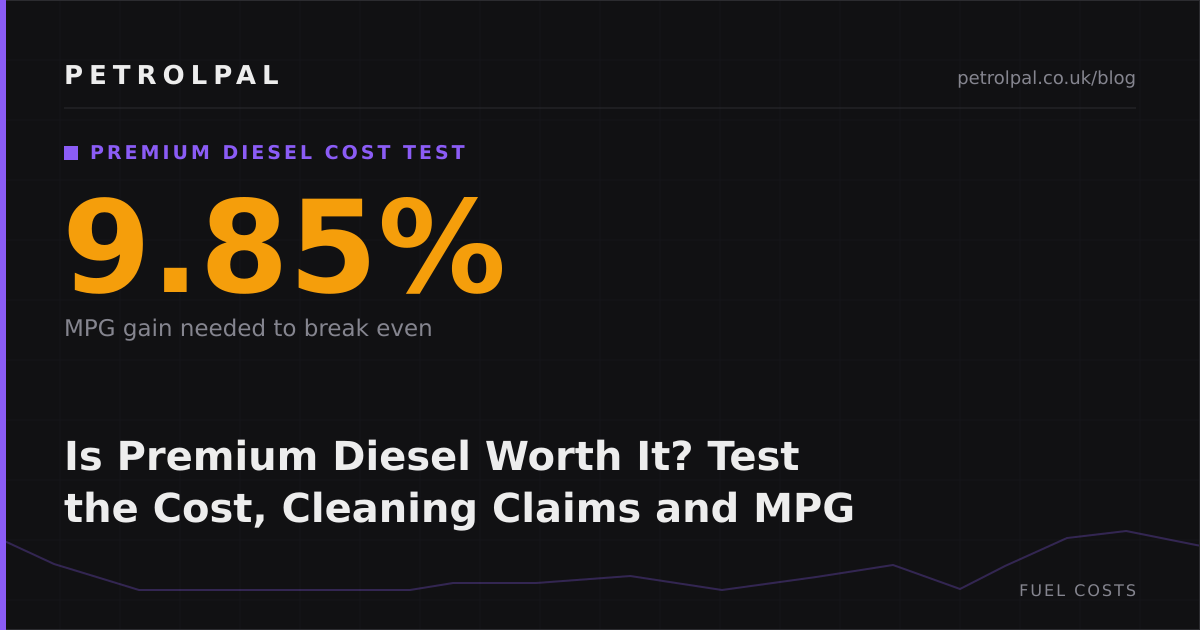
Premium diesel is unlikely to pay for itself through fuel economy alone unless your car gains about 9.85% MPG at current average prices. PetrolPal's live UK snapshot put regular diesel at 194.323p per litre and premium diesel at 213.465p, a 19.142p gap. That adds about £10.53 to a 55-litre fill. Source
Premium diesel can still have a purpose. Fuel suppliers sell it with stronger cleaning and protection claims, while some drivers value smoother running. Those possible benefits are not guaranteed savings. Check your handbook, measure several complete tanks and judge the result by pence per mile.
What is the real price difference between regular and premium diesel?
PetrolPal's 17 September snapshot contained 7,998 regular diesel prices and 4,190 premium diesel prices. Regular diesel averaged 194.323p per litre, while premium averaged 213.465p. The difference was 19.142p per litre, or 9.85% of the regular price. Source
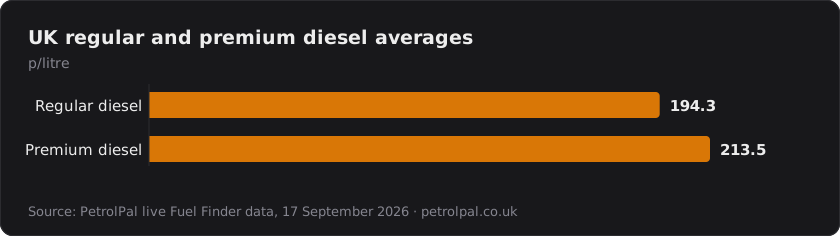
That percentage is the important figure. Premium must improve fuel economy by the same percentage before its higher pump price stops increasing fuel cost per mile.
For a 55-litre fill, the average difference was £10.53. A driver filling 40 litres would pay about £7.66 extra. These figures use UK-wide averages, not a promise about your nearest station. Compare the two grades at forecourts you can use without a costly detour.
Availability also matters. The snapshot had 3,808 fewer premium diesel prices than regular diesel prices. A premium trial can become poor value if you drive farther, use a motorway forecourt or buy at an unusually expensive site just to find the grade. Source
What does premium diesel need to achieve to break even?
Use this rule:
Required premium MPG = regular MPG × premium price ÷ regular price.
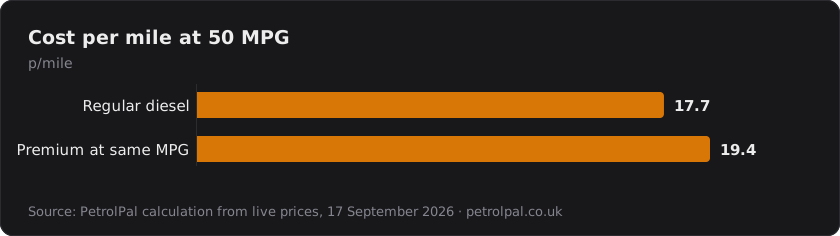
At PetrolPal's average prices, a car returning 50 MPG on regular diesel would need about 54.925 MPG on premium to break even. At 50 MPG, regular diesel costs about 17.668p per mile. Premium costs about 19.409p per mile if economy stays unchanged.
You can calculate your actual result with this formula:
Pence per mile = price in pence per litre × 4.54609 ÷ measured MPG.
The legal imperial gallon is 4.54609 litres. Source
Do not accept a higher dashboard MPG as proof of a saving. A gain from 50 MPG to 52 MPG is 4%, which is well below the 9.85% average price premium in this snapshot. Range improves, but fuel still costs more for each mile.
Run the calculation with the prices you actually paid. If regular costs 190p and premium costs 205p, the required gain is lower than PetrolPal's national average. If premium costs 220p, the hurdle is higher. Recheck whenever local prices change.
What is different about premium diesel?
UK automotive diesel is governed by a common fuel specification. The 2021 fuel regulations identify BS EN 590:2013 as the British Standard for automotive diesel requirements and test methods. Source
The UK Health Security Agency lists a minimum cetane number of 51 in its diesel properties table. It also explains that diesel can contain brand-specific chemical additives, including detergents intended to prevent deposits. Source
Meeting a shared standard does not make every product identical. Retailers can use different additive packages while supplying fuel that meets the required diesel specification. Premium products are mainly sold on those additional cleaning, protection and performance claims.
BP says Ultimate Diesel starts cleaning from the first fill and helps prevent dirt returning. It also promotes up to 375 more miles per year, but states that the diesel claim compares engines in dirty and cleaned conditions. BP says benefits vary with the vehicle, its condition, driving style and driving conditions. Source
Shell says V-Power Diesel removes up to 100% of performance-robbing deposits and can improve fuel economy. Its qualification says results were shown in industry-standard and Shell tests. Shell also says actual effects vary with vehicle type, age, condition and driving style, with no guarantees. Source
Read these as supplier claims, not a fixed MPG forecast. A cleaner dirty injector is different from making a clean, healthy engine nearly 10% more economical. Your car, use pattern and starting condition decide whether any change becomes measurable.
Can premium diesel clean injectors or prevent repairs?
Premium diesel can contain detergents designed to control deposits. Both BP and Shell state that their premium products clean fuel-system parts, especially injectors. Their own pages also limit those claims and do not guarantee the same benefit for every driver. Source Source
That makes premium diesel a possible preventive choice, not a repair. If an injector is faulty, the engine warning light is on, starting is poor or smoke has increased, arrange diagnosis. Do not use repeated premium fills to postpone a needed inspection.
Follow the vehicle handbook before adding a separate bottle treatment. Ford tells drivers to use diesel that complies with EN 590 and to consult the relevant owner's manual. Source
A Mazda manual gives a useful example of why model-specific guidance matters. It requires EN 590 diesel and warns against adding fuel-system additives because they could damage the emissions system. That warning concerns added treatments. It does not prove that all branded premium diesel is unsuitable, so check the handbook for your exact model. Source
Will premium diesel clean or regenerate a DPF?
Do not treat premium diesel as a DPF repair. The Driver and Vehicle Standards Agency explains that a diesel particulate filter traps solid particles from exhaust gas. It must regularly burn accumulated soot through regeneration at very high temperature. Source
Fuel detergents act mainly around the fuel system and combustion process. DPF regeneration is a separate vehicle-controlled process. A different diesel grade cannot remove ash, repair a failed pressure sensor, fix a damaged filter or correct a fault that prevents regeneration.
If the DPF warning light appears, follow the handbook. Some vehicles permit a driving procedure to support regeneration. Others need workshop diagnosis, especially when another warning appears or the car enters reduced-power mode. Do not assume a premium fill will clear the warning.
The same government guidance says a missing factory-fitted DPF causes an MOT failure. It also says removal will almost always make the vehicle illegal for road use. Source
Premium diesel may be part of normal fuel choice. It is not a substitute for correct journey patterns, specified oil, servicing, fault diagnosis or lawful emissions equipment.
How should you test premium diesel fairly?
Use a full-to-full test across normal driving. One tank can be distorted by weather, traffic, payload, tyre pressure, route choice or a DPF regeneration event.
- Check the handbook. Confirm the required fuel standard and any restrictions.
- Record the local prices. Use the same practical forecourt when possible.
- Fill consistently. Stop at the first automatic nozzle cut-off each time.
- Log the evidence. Record odometer miles, litres, pence per litre, total paid and fuel grade.
- Keep use comparable. Match routes, speed, load, tyre pressures and seasonal conditions as closely as possible.
- Use alternating blocks. Test regular, premium, regular, premium to reduce the effect of a changing season or routine.
- Complete enough tanks. Aim for at least three full tanks of each grade before deciding.
- Calculate actual MPG. Divide miles by refill litres, then multiply by 4.54609.
- Calculate pence per mile. Use the paid pump price and actual MPG for every tank.
- Compare averages. Keep premium only if repeated results meet your goal.
Fuel remaining in the tank will dilute the next grade, so the first changeover tank is less useful. Do not alter your driving to chase a better number. That tests behaviour, not fuel.
Note unusual conditions beside each result. A towing trip, long motorway run, cold week or DPF regeneration can move the figure. Repeat any dramatic result before accepting it.
Who is most likely to value premium diesel?
A high-mileage driver with a repeatable route has the best chance of measuring a small difference. More miles create more evidence, while steady use makes the comparison cleaner. Even then, the price premium still sets the break-even target.
A driver with an older engine that has some deposit build-up may notice a change that a clean, healthy engine does not. Supplier tests often discuss cleaning dirty parts. That does not mean every older diesel will recover enough economy to repay the extra cost.
Premium may also suit a driver who values a repeatable improvement in smoothness or noise, even when it costs more per mile. Keep that decision separate from a claim that it saves money.
Low-mileage drivers and people making irregular short trips may struggle to gather good evidence. They can spend months testing while prices, weather and routes change. For them, correct servicing and suitable driving for the vehicle may matter more than grade choice.
The practical answer is conditional. Use premium when the handbook requires it, when a fair test shows a lower cost per mile, or when you knowingly value another repeatable benefit. Otherwise, compliant regular diesel is usually the cheaper choice.