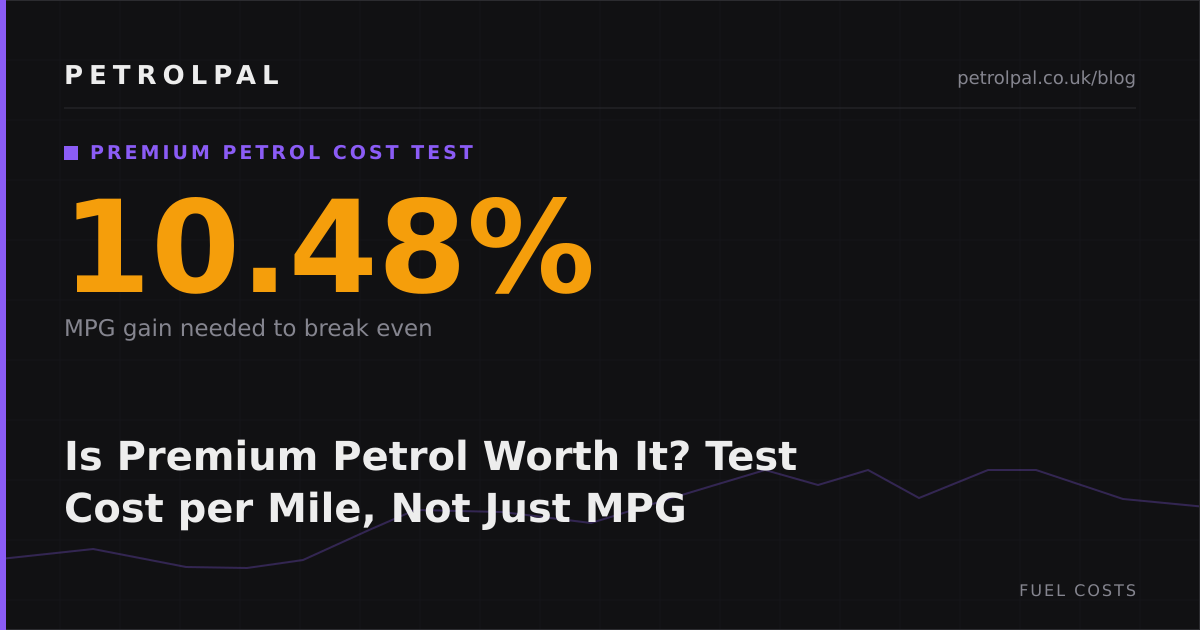
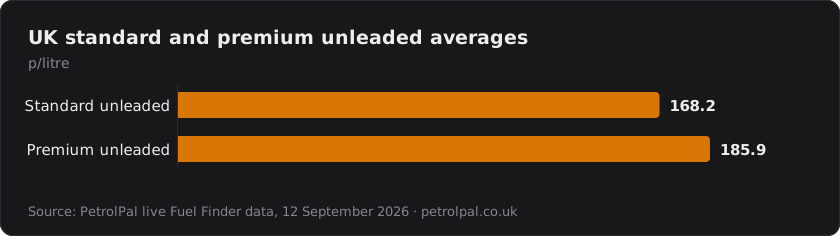
Premium petrol will not pay for itself in most E10-compatible cars unless it improves real fuel economy by more than its price premium. PetrolPal's UK snapshot showed standard unleaded at 168.24p per litre and premium unleaded at 185.87p, a 17.63p gap. Premium therefore needed a 10.48% MPG improvement merely to match standard petrol's cost per mile. It also added about £9.70 to a 55-litre fill. Source
That does not mean premium petrol is always wrong. Your handbook may require a higher octane grade, and a vehicle that cannot use E10 should use E5 super petrol. For an E10-compatible car approved for 95 octane, however, treat premium as a measurable trial rather than an automatic upgrade.
When can premium petrol be the correct choice?
Start with the vehicle requirement, not the marketing name on the pump. The Department for Transport says standard UK petrol is E10 at 95 octane. Where a station sells two petrol grades, the second grade is normally E5 at 97 octane or higher. E10 contains up to 10% renewable ethanol, while E5 contains no more than 5%. Source
These labels answer different questions. E5 and E10 describe the maximum ethanol content. The octane number describes the fuel's resistance to uncontrolled ignition. A fuel can therefore be called premium because of its higher octane rating, its additive package, or both. Do not assume that every product sold as premium has the same formulation.
Use the minimum grade specified by the manufacturer. Check the owner's handbook and the label inside the fuel flap. If the handbook requires 98 RON, do not run a money-saving experiment with 95 RON. If it recommends a higher grade but permits 95 RON, you can compare both while following the manufacturer's conditions.
Compatibility creates a separate case. The government says all cars manufactured since 2011 can use E10, and about 95% of petrol vehicles on the road are compatible. Some classic vehicles, early-2000s models and small mopeds may not be compatible. Owners can use the official checker, then confirm uncertain cases with the manufacturer. Source
For a non-compatible vehicle, E5 super petrol is the correct fuel rather than an optional economy purchase. The government says E5 at 97 octane or higher remains available at many larger stations for these vehicles. In that situation, cost per mile still helps with budgeting, but it should not overrule compatibility.
What does premium petrol need to achieve to break even?
The break-even rule is simple:
Premium MPG divided by standard MPG must be at least as large as premium price divided by standard price.
Using PetrolPal's snapshot, the price ratio was 185.87 divided by 168.24. That equals 1.1048, so premium needed to deliver at least 10.48% more miles per gallon. Source
Suppose your car returns 40 MPG on standard petrol. Premium would need to produce about 44.19 MPG at those prices. If standard returns 45 MPG, premium needs about 49.72 MPG. A smaller improvement can still increase range, but it does not repay the higher fuel bill.
You can also calculate pence per mile directly:
Cost per mile in pence = price in pence per litre × 4.54609 ÷ MPG.
At 40 MPG, 168.24p petrol costs about 19.12p per mile. At the same economy, 185.87p premium costs about 21.12p per mile. The car must use less premium fuel strongly enough to remove that 2p-per-mile difference.
Do the calculation with the two prices available to you. National averages are useful context, but they are not your decision. PetrolPal's latest data covered 7,876 standard-unleaded prices and 6,243 premium-unleaded prices, while local gaps varied by retailer and place. Source
How should you run a fair full-to-full fuel test?
Use a full-to-full test because a dashboard economy display can contain rounding, smoothing and earlier journeys. You need enough distance to reduce the effect of one cold start, one traffic jam or one unusually fast trip.
- Choose a repeatable period. Use at least two full tanks of standard petrol and two full tanks of premium. More tanks give a stronger result.
- Start from a consistent fill point. Use the same station and pump when practical. Stop at the first automatic click each time. Do not force extra fuel into the neck.
- Reset the trip counter. Record the odometer, litres added, pump price, total paid and displayed MPG.
- Keep use comparable. Match normal routes, speeds, passenger load, luggage, tyre pressures and air-conditioning use as closely as possible.
- Calculate actual MPG. Divide miles travelled by litres used, then multiply by 4.54609.
- Calculate pence per mile. Multiply the paid pence-per-litre price by 4.54609, then divide by actual MPG.
- Compare groups, not one lucky tank. Average the standard tanks and premium tanks separately.
Do not alternate after only a few miles and expect a clean result. Fuel already in the tank dilutes the next grade. The engine control system may also need normal driving time before any permitted adjustment becomes visible. The government says E5 and E10 can be mixed safely in an E10-compatible vehicle, but a mixed tank is weak evidence for a cost comparison. Source
Record conditions honestly. Strong wind, winter temperatures, roof equipment, short journeys and congestion can move fuel economy more than a small fuel effect. If the premium result looks dramatic, repeat it before accepting it.
Why can an MPG increase still cost more money?
MPG measures distance from a quantity of fuel. It does not include the price of that fuel. A higher MPG number feels positive, but the financial result depends on whether the percentage gain exceeds the percentage price increase.
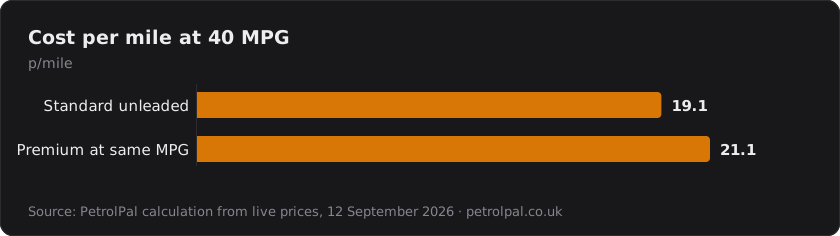
Consider a car that improves from 40 MPG to 42 MPG. That is a 5% gain. With premium costing 10.48% more in the snapshot, the driver still pays more per mile. Standard costs about 19.12p per mile at 40 MPG. Premium costs about 20.11p per mile at 42 MPG.
The same rule applies when prices change. If your local standard price is 165p and premium is 180p, premium costs 9.09% more. Your tested MPG must rise by at least 9.09% to break even. If another station sells premium for 175p, the required gain falls to 6.06%.
This is why a local price search matters before the test. Fuel Finder brings together current prices by fuel type and time-stamped forecourt details. Traders must submit price changes within 30 minutes. PetrolPal uses this official feed to help drivers compare grades and stations. Source
The cheapest test may involve changing the station rather than changing the grade. PetrolPal's snapshot put supermarket standard unleaded at 164.95p per litre and branded standard unleaded at 170.03p. That 5.08p station-type gap can matter without asking the engine to deliver any efficiency gain. These are broad group averages, so compare the actual stations on your route. Source
Does E5's lower ethanol content guarantee better economy?
No. The Department for Transport says E10 may reduce fuel economy by around 1% compared with lower-ethanol petrol, and it says this difference is unlikely to be noticeable in everyday driving. Source
That official estimate is useful context, but it does not prove that every premium product will improve your car's MPG by 1%. It also falls well below the 10.48% break-even gain required by PetrolPal's current average price gap. The actual result depends on the vehicle, journey, fuel formulation and prices paid.
Higher octane can help an engine only when its design and controls can use it. Some engines require the higher grade. Some permit both grades and may adjust operation. Others are designed around standard 95-octane petrol and may show no repeatable financial benefit from a higher number on the pump.
Avoid treating one smoother journey or quieter impression as proof of savings. Those observations can matter to you, but they do not replace measured litres, miles and cost. If your goal is financial, use financial evidence.
What result should make you keep buying premium?
Keep buying premium for economy only when repeated tests show a lower cost per mile after normal variation. A tiny apparent saving across one tank is not enough. Repeat the comparison and check whether the result remains in the same direction.
Use three decision levels:
- Required: The handbook specifies the higher grade, or the vehicle is not compatible with E10. Follow the requirement.
- Optional and cheaper: The manufacturer permits both grades, and repeated premium tests produce a clearly lower pence-per-mile result.
- Optional and dearer: The manufacturer permits both grades, but premium costs the same or more per mile. Return to standard unless you value another documented benefit.
You should also consider availability. PetrolPal recorded fewer premium prices than standard prices in the snapshot. A route that forces a costly diversion can erase a small measured benefit. Check the grade, price and update time before travelling. Source
Do not keep paying extra because the previous tank felt better. Save the figures. Recheck the calculation when pump prices change materially, because a result that breaks even at one price gap may fail at another.
How can you avoid common test errors?
Do not compare a motorway-heavy standard tank with a town-heavy premium tank. Do not change tyre pressures, roof loads or driving style during the test. Do not use the dashboard MPG number without checking litres added. Do not compare different fill levels.
Avoid selecting unusually cheap or expensive individual records without checking the forecourt. Use a nearby price that you can actually buy. Fuel Finder data is time-stamped, but the displayed pump price remains the final price at purchase. Source
Do not confuse E5 with a universal performance grade. In the UK, E5 is normally sold as 97-octane-or-higher super petrol, but compatibility and octane needs still come from the vehicle manufacturer. Source
Finally, do not chase an MPG target by driving differently on premium. The test asks whether the fuel changes the result under comparable use. If your driving changes, you tested your behaviour instead.