UK fuel prices entered September 2026 at 161.61p per litre for petrol and 183.49p for diesel in the latest official weekly figures. A 55-litre fill at those averages costs about £88.89 for petrol or £100.92 for diesel. PetrolPal's newer live snapshot was slightly higher at 163.1p and 185.3p, across 8,102 stations at 03:04 UTC on 4 September.
Prices are close to levels last associated with the 2022 energy shock, but “four-year high” needs care. Petrol remains below the 168.93p official average from 5 September 2022. Diesel is also below its 193.04p reading from 1 August 2022 and its 192.14p spring 2026 peak. The clear conclusion is still serious: fuel starts September far above January, and diesel drivers face the larger rise.
What Are UK Petrol and Diesel Prices in September 2026?
The latest DESNZ weekly road fuel prices cover the week beginning 31 August. They put unleaded petrol at 161.61p per litre and diesel at 183.49p. The department published those figures on 2 September.

PetrolPal's live Fuel Finder feed showed 163.1p for petrol and 185.3p for diesel early on 4 September. That snapshot covered 8,102 UK stations. It is newer and built from station-level Fuel Finder records, while DESNZ supplies a stable weekly national benchmark. Small differences between the two measures are expected.
The live figures make a 55-litre fill about £89.71 for petrol and £101.92 for diesel. Diesel therefore costs about £12.21 more per tank at the live national averages. Your actual bill depends on the station, fuel grade and litres needed.
Drivers should not treat a national mean as a local quote. PetrolPal's station statistics showed supermarket petrol averaging 160.31p, against 164.65p at branded forecourts. Supermarket diesel averaged 181.66p, against 186.51p at branded sites. On a 55-litre fill, those gaps equal about £2.39 for petrol and £2.67 for diesel.
Are Fuel Prices Really at a Four-Year High?
They are near the high range seen during major supply shocks, but neither fuel set a new four-year record this week. The official DESNZ CSV series recorded petrol at 168.93p on 5 September 2022 and 167.61p one week later. The current 161.61p is below both readings.

Diesel has followed a different path. It reached 193.04p on 1 August 2022. It also reached 192.14p during the week beginning 13 April 2026, so the latest 183.49p is not this year's peak.
“Near four-year highs” is a fair description of the pressure facing drivers. It is not the same as saying every current reading is the highest since 2022. Petrol is about 7.32p below its 5 September 2022 level. Diesel is about 9.55p below its August 2022 level.
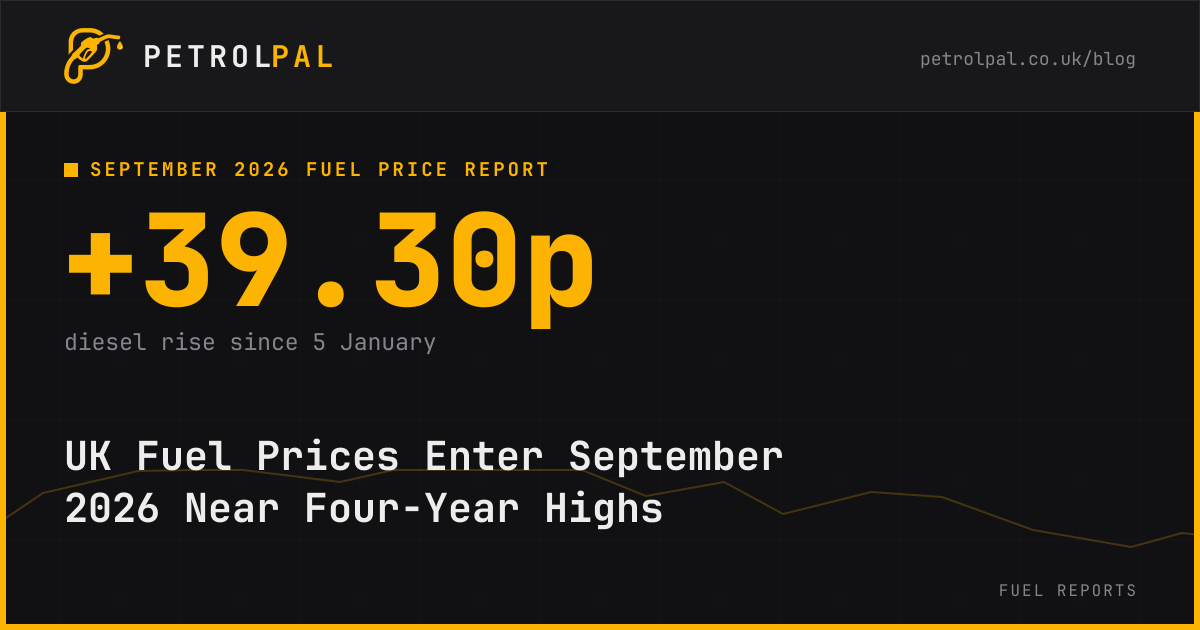
The more useful comparison is with the start of this year. On 5 January 2026, official averages were 134.90p for petrol and 144.19p for diesel. By 31 August, petrol had risen 26.71p per litre and diesel 39.30p. For a 55-litre fill, that change adds about £14.69 for petrol and £21.62 for diesel.
Why Did Prices Rise So Sharply Before September?
The immediate story is a rapid summer increase. DESNZ reported that average petrol prices rose 10.4p per litre in August compared with July, while diesel rose 16.9p. Those figures appear in the department's 27 August energy statistics release.
Crude oil matters because it is the raw material for petrol and diesel. Refinery availability and product supply also matter, especially for diesel. Pump prices then reflect transport, retail costs, margins, fuel duty and VAT. Sterling can change the UK cost because crude oil and many refined products trade in US dollars.
The oil outlook remains unusually uncertain. The U.S. Energy Information Administration's August Short-Term Energy Outlook assumed severe limits on Strait of Hormuz transit through August. It forecast Brent crude to average about $85 per barrel in the third quarter of 2026. It also expected Brent to fall towards an average of $69 in 2027 as inventories rebuild and production recovers.
That forecast is a scenario, not a promise. A fresh disruption could push wholesale costs up again. Faster recovery, weaker demand or a stronger pound could reduce UK costs. Forecourt prices can also lag wholesale moves, so a fall in oil does not produce an instant matching drop at every pump. Our guide to how oil-price changes reach UK pumps explains that delay.
Did Fuel Duty Rise on 1 September 2026?
No. The main petrol and diesel duty rate remains 52.95p per litre through 31 December 2026. The government extended the temporary 5p cut that first began in March 2022. The current schedule is set out in HMRC's amended Fuel Duty rates.
This matters because the earlier plan would have started reversing the cut in September. That rise did not happen. Current high pump prices therefore came from market conditions rather than a September duty increase.
Under the legislative default, duty rises to 55.95p per litre on 1 January 2027 and 57.95p on 1 March 2027. HMRC says the government will confirm final rates at Budget 2026. Those 2027 figures should be treated as the present default path, not a final promise.
The direct tax content of a litre also includes VAT. VAT is charged at 20% on the complete pump price, including duty. For a clearer timetable and worked examples, read our September fuel-duty correction.
What Could Happen to Fuel Prices During September?
No honest forecast can give one exact month-end price. Three practical scenarios show what drivers should watch.
Easing scenario: Oil shipments recover, refinery supply improves and sterling strengthens. Wholesale costs fall and forecourts pass enough of the reduction through. National averages move lower during September, although the change arrives gradually and varies by retailer.
Holding scenario: Brent stays near the EIA's third-quarter assumption, sterling remains broadly steady and refinery margins do not change sharply. Petrol stays around the low 160s and diesel around the low-to-mid 180s. Local competition creates larger differences than the national weekly movement.
Rising scenario: Supply disruption returns, refined diesel becomes tighter or sterling weakens. Wholesale costs rise again. Diesel remains more exposed because its current national price already sits about 21.88p above petrol in the latest official data.
These are conditions, not point forecasts. The official series updates weekly, while Fuel Finder station reports change throughout the day. Check the live PetrolPal fuel-price map before a long trip or large fill.
How Much Can Drivers Save Without Waiting for Prices to Fall?
Start with the station choice. PetrolPal's 4 September statistics covered 7,863 unleaded price records and 7,961 diesel records. The supermarket-to-branded average gap was 4.34p for petrol and 4.85p for diesel. A 55-litre fill saves roughly £2.39 or £2.67 at those average gaps.
Do not drive a long detour for a small saving. A ten-mile round trip can consume much of a £2 discount, especially in congestion. Compare stations already on your route. PetrolPal's route planner can help you avoid an unnecessary diversion.
Buy only what you need if you expect prices to move soon. Filling a nearly full tank offers little benefit, even if one station is cheaper. If your tank needs 20 litres, a 5p difference saves only £1.00. For 50 litres, the same gap saves £2.50.
Use current station data rather than relying on a remembered cheap brand. PetrolPal's live snapshot put Costco lowest among brands with enough listed sites, but membership rules and limited locations reduce its relevance for many journeys. Sainsbury's, Tesco and Morrisons were the next lowest large groups for regular petrol in the same dataset. Local results can reverse that order.
Finally, reduce avoidable consumption. Correct tyre pressures, smoother acceleration and fewer high-speed miles lower fuel use regardless of the pump price. The cheapest litre is useful, but a litre you do not burn saves its full cost.
What Should Drivers Watch Next?
The next official weekly release will show whether the late-August plateau continues into September. Watch the petrol and diesel lines separately. Diesel's 0.67p weekly rise between 24 and 31 August contrasted with petrol's 0.02p fall in the official series.
Also watch Brent crude, refinery news and sterling against the US dollar. None gives a direct one-for-one pump forecast. Together, they show whether cost pressure is building or easing before it appears at forecourts.
For households, the important benchmark is the complete monthly fuel bill. A driver buying 100 litres per month pays about £163.10 for petrol or £185.30 for diesel at PetrolPal's 4 September live averages. That gap is £22.20 per month before any difference in vehicle economy.
September starts with expensive fuel, no duty rise and a wide range of possible market outcomes. Drivers cannot control oil markets. They can compare nearby prices, avoid costly detours and track the weekly trend before the next major fill.