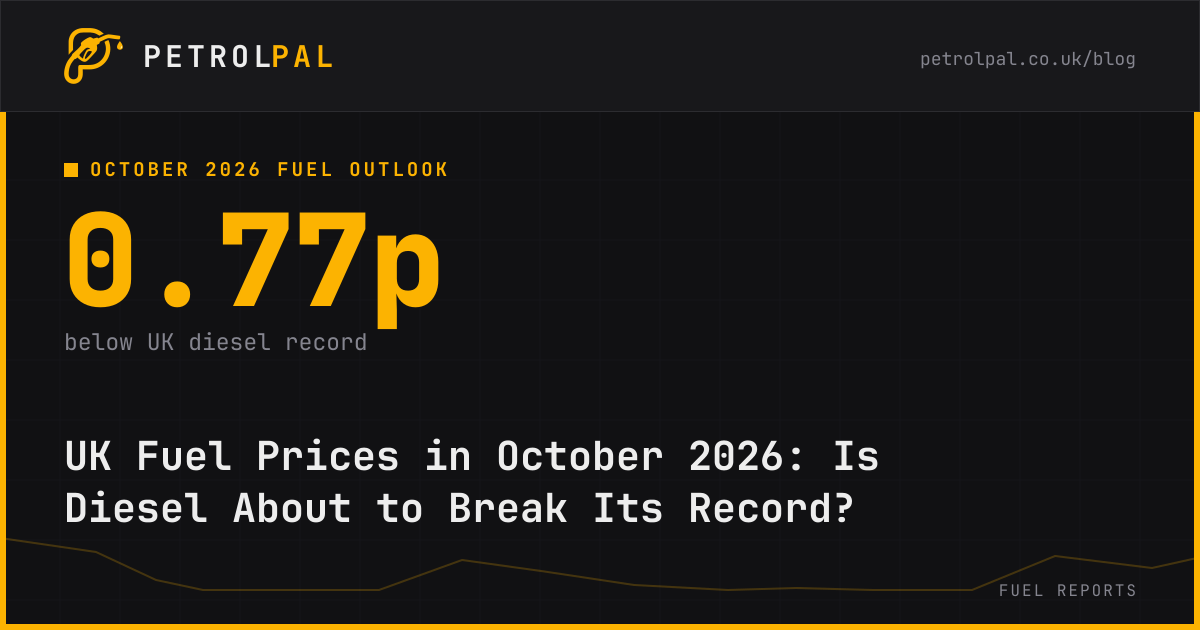
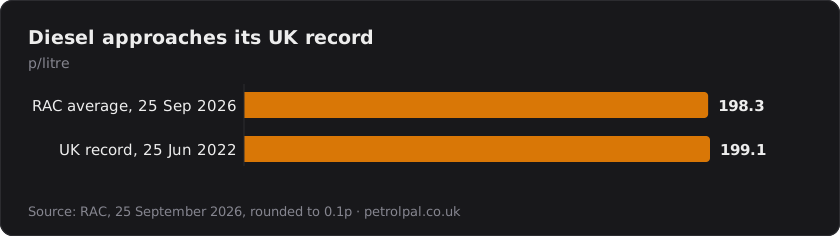
Diesel is entering October 2026 within touching distance of its UK record. The RAC put the national average at 198.32p per litre on 25 September, only 0.77p below the 199.09p record set in June 2022. PetrolPal's 28 September snapshot averaged 198.86p for diesel and 173.87p for petrol. A 55-litre fill at those PetrolPal averages costs about £109.37 for diesel or £95.63 for petrol. Source Source
The record may fall, but it is not certain. The next move depends on crude oil, refined diesel costs, exchange rates, retailer buying cycles and local competition. Drivers cannot control those forces. They can compare nearby prices, check timestamps and avoid paying more than necessary at the next fill.
How Close Is Diesel to Its UK Record?
Very close. The RAC's 25 September update placed diesel at 198.32p per litre. The established record was 199.09p, reached on 25 June 2022. That left a gap of 0.77p per litre.
The RAC also put petrol at 173.60p on 25 September. It said petrol had risen by 40.8p since 28 February, while diesel had risen by 55.9p. Those were large increases over seven months, not a forecast that the same pace would continue.
PetrolPal's detailed snapshot, fetched on 28 September, showed diesel averaging 198.86p across 8,014 prices. Its diesel median was 199.9p. Petrol averaged 173.87p across 7,907 prices, with a median of 173.9p. Source
These figures come from different datasets and methods. PetrolPal should not declare that the national record has fallen because its own average sits near 199p. The RAC series provides the like-for-like national record comparison. PetrolPal's data gives drivers a broad and recent view of listed forecourt prices.
The careful answer is therefore simple: diesel was on the brink of its record as October approached. It could pass 199.09p if forecourts continue to raise prices, but a fall in wholesale costs or slower retailer increases could keep the average below that line.
What Do PetrolPal's Latest Prices Show?
The 28 September PetrolPal snapshot covered 8,131 stations. It averaged standard petrol at 173.87p and diesel at 198.86p. Diesel was almost exactly 25p per litre more expensive than petrol. Source
That 25p gap changes a normal fill materially:
- A 40-litre fill costs about £69.55 for petrol and £79.54 for diesel.
- A 50-litre fill costs about £86.94 for petrol and £99.43 for diesel.
- A 55-litre fill costs about £95.63 for petrol and £109.37 for diesel.
These calculations multiply the 28 September average by the litres purchased. They do not account for different vehicle efficiency. A diesel car may travel farther per litre than a comparable petrol car, so pump cost alone does not establish the cheaper vehicle to run.
PetrolPal's public summary used a separate rounded view. It showed petrol at 173.8p, diesel at 199.2p and 8,162 stations, with an update time of 28 September at 03:26 UTC. Source Small differences between the public summary and detailed statistics can occur because the endpoints use different views. This report uses the detailed endpoint for all comparisons and calculations.
The listed extremes also need care. PetrolPal's data can include old, incorrect or unusual submissions. A national minimum is not automatically a useful buying opportunity. Check the station, fuel grade, timestamp, route and displayed forecourt price before relying on any individual listing.
Why Are Diesel Prices Rising So Fast?
The immediate pressure comes from the cost of replacing fuel stocks. The RAC said Brent crude had reached $106 per barrel and had stayed around $100 for the previous two weeks. It expected retailers to continue passing on higher supply costs. Source
Crude oil is only the starting material. Pump prices also reflect refining, transport, storage, biofuel blending, exchange rates, taxes and retailer margins. Diesel and petrol can move at different speeds because they are separate refined products with different supply and demand conditions.
The UK buys oil and refined fuel in international markets, commonly priced in US dollars. A weaker pound can make those purchases more expensive even if the dollar oil price does not change. A stronger pound can soften part of an increase, but it does not guarantee lower forecourt prices.
Retailers also buy new supply at different times. One station may change its price before another because its storage tank was replenished sooner. Competition matters too. Several nearby forecourts may hold prices down, while an isolated or motorway site can charge more.
This explains why an oil-price headline does not translate into the same pump change everywhere on the same day. Drivers should watch the direction of local prices rather than assume every site will track the national average immediately.
How Much of the Pump Price Is Fuel Duty?
Fuel duty on standard road petrol and diesel is 52.95p per litre through 31 December 2026. The government extended the temporary 5p cut that began in 2022. The legal default is 55.95p from 1 January 2027 and 57.95p from 1 March, but the government said Budget 2026 will confirm the final rates. Source
That distinction matters for October. The September pump-price rise was not caused by a new fuel-duty increase. The rate remains fixed at 52.95p during October, November and December under the current rules.
Road fuel uses the standard 20% VAT rate. VAT is 20% of the pre-VAT amount, which includes fuel duty, so the VAT component equals one-sixth of the final pump price. Source
Drivers should treat the 2027 path as a policy risk, not a settled pump-price forecast. The published default rates show what current law provides. Budget 2026 can change them before they take effect.
Are Supermarkets Still Cheaper Than Branded Forecourts?
On average, yes in PetrolPal's 28 September snapshot. Supermarket diesel averaged 196.21p per litre, compared with 200.41p at branded sites. The 4.20p gap is worth about £2.31 on 55 litres. Independent sites averaged 198.56p. Source
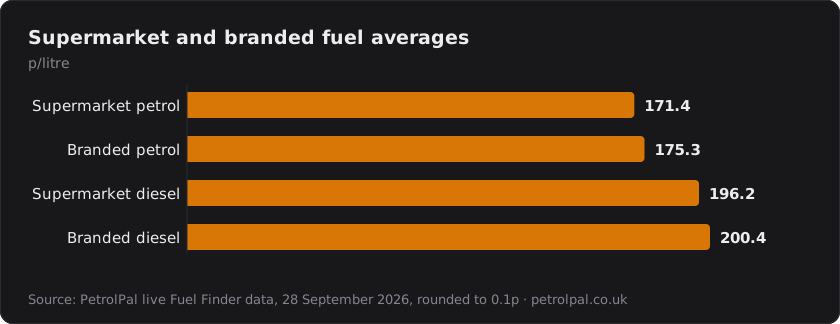
Petrol showed a similar pattern. Supermarkets averaged 171.37p, branded sites averaged 175.29p and independent sites averaged 173.68p. The supermarket-to-branded gap was 3.92p, worth about £2.16 on a 55-litre fill.
These are group averages. They do not prove that every supermarket beats every branded station. Costco had especially low averages in the dataset, while individual supermarket and branded locations varied widely. Membership rules can also affect access to some prices.
Use the national pattern as a prompt to compare, not as a rule. A branded station on your normal route may cost less overall than a supermarket requiring a special journey. Calculate the likely fill saving and compare it with the extra fuel, time and any membership cost.
How Current Are the Prices in Fuel Finder?
Fuel Finder requires motor fuel traders to submit a price update within 30 minutes of a change. The rule has applied since 2 February 2026. Traders can submit through the service, API, text message or phone system. Source
The 30-minute rule improves transparency, but it does not guarantee that every record is correct at every moment. A submission can be late or wrong. A station can run out of a grade, close temporarily or change a display shortly before your arrival.
Check the timestamp for each local result. Be cautious when a price is much lower than nearby alternatives, especially if its timestamp is old. Confirm the grade and price on the forecourt sign and pump before filling.
PetrolPal's detailed snapshot was fetched at 04:07 UTC on 28 September. Its latest source sync was at 03:26 UTC. This timing makes the report useful for an end-of-September national view, but the figures will age after publication. Use the live map for the next journey.
What Can Drivers Do Before October Prices Change Again?
Start with the journey you will make. Search near home, work or the route ahead. Compare the correct fuel grade and recent timestamps. Then calculate the saving on the litres you expect to buy.
Use this formula:
Saving in pounds = price difference in pence × litres bought ÷ 100.
A 5p gap saves £2.50 on 50 litres. A 10p gap saves £5.00. A distant station can consume part of that saving, so include only options that fit the route or require a small detour.
Avoid waiting until the tank is nearly empty. More remaining range gives you more choice and reduces the chance of buying at an expensive motorway or isolated site. Do not top up automatically whenever prices rise, though. Buying fuel you do not need ties up money and adds weight.
Keep the comparison practical:
- Select petrol or diesel correctly.
- Check the listed update time.
- Compare stations on or near the route.
- Calculate the saving for the litres needed.
- Confirm opening hours and access rules.
- Verify the grade and displayed price at the pump.
National averages explain the market. Local comparisons determine what you pay.
What Is the Outlook for October 2026?
Diesel begins October with a real chance of passing its 2022 record. RAC's 25 September average was only 0.77p short, and PetrolPal's 28 September data showed listed diesel prices clustered around 199p. Continued high oil and replacement costs would support further increases.
A record is not guaranteed. Oil, refined-product prices, sterling and retailer competition can move quickly. The useful response is not to predict an exact October peak. It is to compare recent local prices and avoid the most expensive convenient option.
PetrolPal's latest snapshot showed a 4.20p diesel gap between supermarket and branded averages. That national gap will not appear in every town, but it shows why checking before filling can still save money when the whole market is expensive.