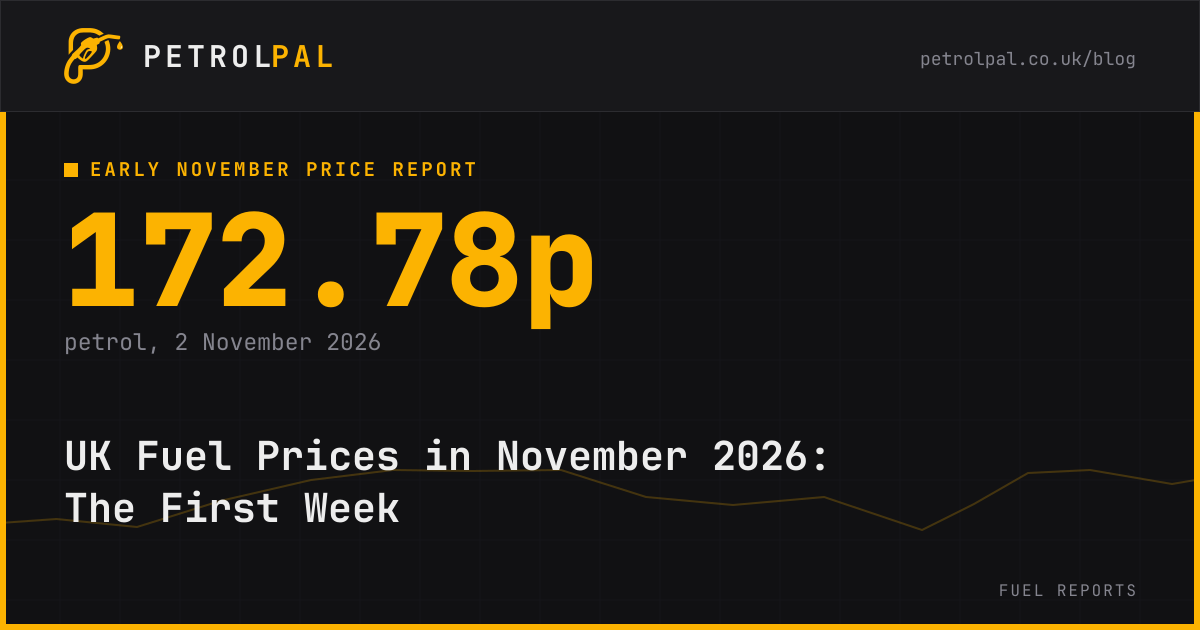
The first official November UK fuel-price reading is in. Petrol averaged 172.78p per litre and diesel 198.58p in the week beginning 2 November, according to the Department for Energy Security and Net Zero (DESNZ). Both fell from the final October observation. PetrolPal's separate station-price snapshot, fetched at 05:05 UTC on 4 November 2026, shows what listed forecourts look like closer to your next fill. These are early-month observations, not a completed November average.
What does a national decline mean if your usual station still charges more? Compare nearby pumps before your next fill. A national average does not mean that every forecourt has cut its price. Your local price, fuel grade and likely fill size determine what you will actually pay.
What Are UK Petrol and Diesel Prices in Early November 2026?
DESNZ's weekly series puts unleaded petrol at 172.78p and diesel at 198.58p per litre for the week commencing 2 November. That is the newest official weekly observation available on 4 November. It is not a forecast for the rest of the month. A November monthly average cannot be calculated from one weekly reading.
The same official series put petrol at 174.07p and diesel at 199.22p on 26 October. The week-to-week changes are therefore minus 1.29p for petrol and minus 0.64p for diesel. Both prices eased, but diesel remains 25.80p per litre above petrol in the 2 November reading. Those figures compare the same series and avoid confusing a platform snapshot with a government average.
PetrolPal's public price summary, captured at 05:05 UTC on 4 November, showed 171.1p petrol, 198.5p diesel, 189.6p premium petrol and 216.9p premium diesel. Its feed reported 8,190 stations and a source update at 04:18 UTC. These are rounded values from PetrolPal's own Fuel Finder view, not DESNZ's weekly sample. The public page changes as fresh prices arrive; the stated time identifies the archived snapshot used here.
Why is the PetrolPal petrol figure below DESNZ's? The datasets use different collection, timing and averaging methods. The 171.1p platform figure is not evidence that the official 172.78p figure is wrong. For a local buying decision, neither national number replaces the price shown at the pump.
How Have UK Fuel Prices Changed Since October?
The official DESNZ CSV shows petrol at 175.28p and diesel at 200.04p on 12 October. By 26 October they had reached 174.07p and 199.22p. The first November reading then fell again to 172.78p and 198.58p. This is a measurable movement in official weekly pump averages, not proof of a permanent downward trend.
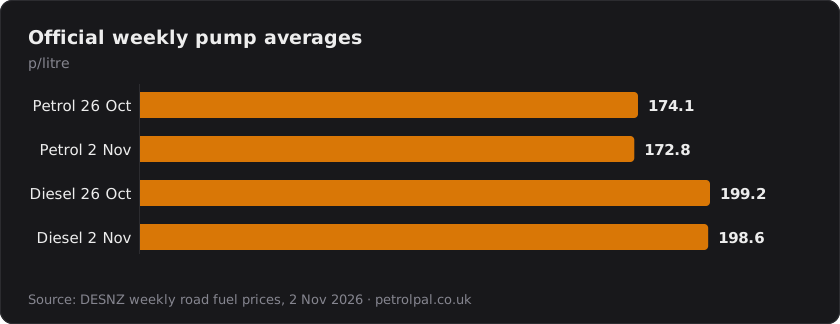
Compared with 12 October, the 2 November reading is 2.50p lower for petrol and 1.46p lower for diesel. A 55-litre petrol purchase at the lower average would cost about £1.38 less than at the earlier one. For diesel, the equivalent difference is about 80p. These are arithmetic examples using national averages; no driver receives that saving automatically.
PetrolPal's rounded feed provides a separate 4 November 05:05 UTC snapshot: 171.1p for petrol and 198.5p for diesel across 8,190 feed stations. It is a useful later check, but it cannot be subtracted from the official October averages. The methods differ. For a like-for-like change since October, use the DESNZ weekly series above.
Both grades eased between 26 October and 2 November in the official weekly series. Diesel still cost 25.80p more per litre than petrol on 2 November. This is a one-week change, not a reliable sign of where prices will go next. Your nearby stations can move differently from the national average.
Why Is Diesel Still More Expensive Than Petrol?
In DESNZ's 2 November observation, diesel costs 25.80p per litre more than petrol. The two products have different refining and supply markets, even though both use crude oil. Pump prices can also reflect exchange rates, distribution, retailer costs, VAT and competition. This price gap is an observation, not a measured breakdown of its causes.
PetrolPal's detailed 4 November statistics snapshot found a 170.81p unleaded mean from 6,272 listed prices and a 198.54p diesel mean from 3,585. The diesel sample is much smaller. Each grade's average describes its own priced records; it does not show a matched petrol-versus-diesel price at every station. The detailed statistics also differ slightly from PetrolPal's rounded public summary.
Could fuel duty explain the diesel premium? Not by itself. DESNZ lists 52.95p per litre duty for both petrol and road diesel in its 2 November dataset. The Budget 2026 rates annex sets out an extended duty freeze through 30 June 2027, subject to the policy being implemented. Equal duty rates do not make the final pump prices equal.
A comparison of one diesel car and one petrol car needs more than the litre price. Their fuel use per mile, purchase cost, maintenance, vehicle tax and driving pattern also matter. If you already own a diesel, compare the prices of diesel pumps on your actual route. Switching fuel grade or car type because of one weekly gap would be a much larger decision.
What Would a Fill Cost at November's Early Prices?
At PetrolPal's 4 November rounded summary, 55 litres of petrol at 171.1p comes to £94.11, while 55 litres of diesel at 198.5p comes to £109.18 after rounding the final total. The difference is £15.07 for the same volume. This compares pump spend, not how far each vehicle will travel.
Here is the method: multiply the pence-per-litre price by the litres purchased, then divide by 100 to get pounds. For petrol, 171.1 × 55 ÷ 100 = 94.105. The result rounds to £94.11. For diesel, 198.5 × 55 ÷ 100 = 109.175, which rounds to £109.18. Your receipt uses your station's price and the litres dispensed.
What if you need 40 litres instead? At the same dated prices, petrol costs £68.44 and diesel £79.40. A difference between two petrol forecourts is more useful than a petrol-versus-diesel comparison if your car can only use petrol. For example, a 5p-per-litre local gap is £2.75 across 55 litres, before any detour cost.
Do not drive a long way just to capture a small nominal saving. A cheaper station can cost you more once extra travel is included. Check access conditions too: a membership forecourt, a station that has closed, or a pump without your fuel grade is not a useful alternative. Local availability matters as much as the displayed national mean.
Tip
Tip
Calculate the expected fill saving in pounds, then compare it with any extra travel before you set off.
Do Supermarkets Offer Cheaper Fuel in This Snapshot?
PetrolPal's detailed statistics at 05:05 UTC on 4 November group 1,976 supermarket unleaded prices at an average of 168.61p. The 3,780 branded-site unleaded prices averaged 171.89p. The observed gap is 3.28p per litre, or about £1.80 for 55 litres. It is a group comparison, not a guarantee that a specific supermarket will beat a nearby branded forecourt.
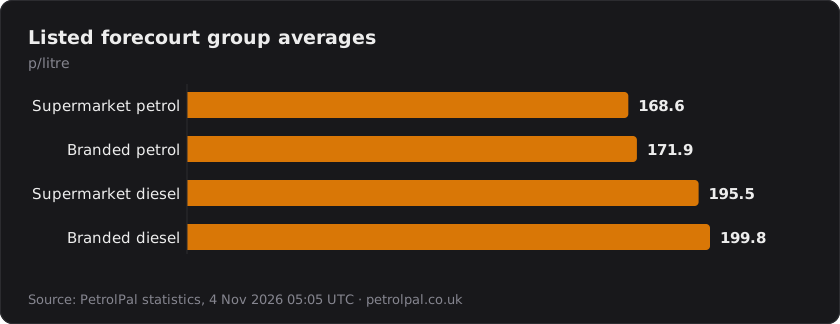
For diesel, 1,045 supermarket prices averaged 195.47p, while 2,186 branded-site prices averaged 199.82p. That gap is 4.35p per litre, worth about £2.39 for 55 litres at those group means. Independent sites form another category, with different coverage. The totals are counts of listed grade prices within groups, not a controlled price test at matched locations.
An individual supermarket can still be dearer than a branded pump down the road. Some lower-price chains have access rules. Likewise, a motorway station can be convenient but expensive. First check the stations near your route, then compare the exact fuel grade and the time each price was updated. If a forecourt price looks implausibly low, confirm it on arrival.
What Does the Budget Mean for November Fuel Costs?
The 2 November DESNZ table records petrol and road-diesel duty at 52.95p per litre, with 20% VAT. Budget 2026 proposes to keep the temporary duty cut and freeze in place through 30 June 2027. It does not promise that every station price will remain fixed. Wholesale costs and retailer prices can move while the tax rate stays the same.
The Budget rates annex describes the planned rate path, including a higher rate from 1 July 2027. That future step is not part of November's pump price. The proposed freeze through June 2027 still needs implementation. It does not guarantee that pump prices will fall or even stay the same.
It would be misleading to credit the early-November weekly price decline to a duty cut. The official table shows the same 52.95p duty rate on 26 October and 2 November. The figures establish that duty did not change between those dates, but they do not isolate which wholesale or retail factor moved the pump average. A change in crude oil alone cannot prove a change in retailer margin either.
How Should You Compare Fuel Prices This Month?
The Fuel Finder reporting rule requires traders to submit a changed fuel price within 30 minutes from 2 February 2026. That reporting window helps drivers compare listed forecourts, but it cannot guarantee that each record matches the pump at the second you arrive. Check the grade, update time and displayed price before filling.
Start with stations on your usual route rather than a national average. Select the correct grade, compare recent entries and note any access restrictions. Estimate the litres you need. Multiply a local price gap in pence by those litres and divide by 100. If the estimated saving is less than the likely detour cost, keep your normal route.
How often should you check? Check before a planned fill. Prices can move after any snapshot, including the one from 4 November. PetrolPal's summary listed 8,190 stations at 05:05 UTC. Not every station had prices for every grade: the detailed snapshot counted 6,272 unleaded records and 3,585 diesel records. Check the grade you need.
Warning
Warning
A reported price can be stale or incorrect. Check the pump display before buying fuel.
What Is the Early November Answer?
Early November's official pump averages are lower than late October's, but the month is only just under way. DESNZ recorded 172.78p petrol and 198.58p diesel for 2 November. PetrolPal's 4 November feed gives a separate, later view of listed station prices. These dated figures can help you assess a local offer; they cannot predict the month-end average.
The most useful comparison is between stations you can reach. Use the same fuel grade, check each timestamp and work out the saving for your likely fill. Allow for the detour. If the station's displayed price differs from the listing, use the pump price before you buy.