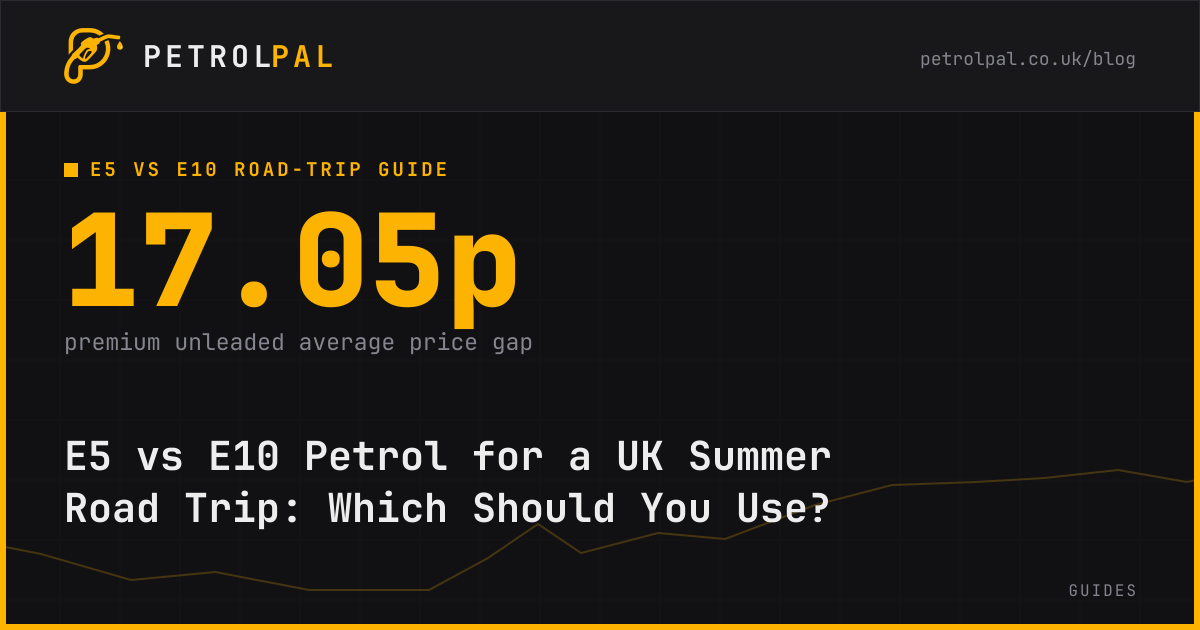
E10 is the right petrol for most UK road trips. The Department for Transport says 95% of petrol vehicles can use it, while PetrolPal's live data shows premium unleaded, the usual E5 choice, averaging 17.05p per litre more. Choose E5 when your vehicle requires it, not simply because it sounds better.
That distinction matters before a long summer drive. E10 is standard 95-octane petrol. E5 is usually sold as a 97-octane or higher premium grade. Their labels describe maximum ethanol content, not a quality ranking. Check compatibility first, then compare live prices and plan fuel stops on the PetrolPal route planner.
What Is the Difference Between E5 and E10 Petrol?
E10 contains up to 10% renewable ethanol, while E5 contains up to 5%, according to the Department for Transport. In the UK, E10 is normally the 95-octane standard grade. E5 usually sits within a costlier 97-octane or higher premium product.
The letter and number only identify ethanol content. They don't tell you that one fuel cleans every engine better, creates more power in every car, or lasts a fixed number of months. Octane and additive packages vary by product, so compare the grade required by your owner's manual.
Why does ethanol content affect consumption? Ethanol carries less energy per litre than petrol. The DfT estimates that E10 can reduce fuel economy by around 1%. It also says drivers are unlikely to notice that change in everyday use. Speed, tyre pressure and roof equipment can have a greater effect.
E10 became the standard 95-octane grade in Great Britain in September 2021. Northern Ireland followed in November 2022. The change applied only to petrol. Diesel grades weren't altered by this policy.
The DfT says E10's introduction could reduce transport carbon dioxide emissions by 750,000 tonnes each year, comparable with removing 350,000 cars. That estimate describes the national blend change. It doesn't mean an individual litre or journey cuts emissions by the same fixed percentage.
The practical definition is simple: E10 is standard petrol with up to 10% ethanol, while E5 has no more than 5%. The DfT guidance links E10 to an estimated 1% economy reduction and a national annual carbon saving of 750,000 tonnes.
Is Your Car Compatible With E10 Petrol?
Around 95% of petrol-powered vehicles on UK roads can use E10, and every new car made since 2011 is compatible, says the Department for Transport. Most cars and motorcycles made since the late 1990s also have manufacturer approval, but age alone isn't a safe decision tool.
Use the official GOV.UK E10 vehicle checker before departure. Select the manufacturer, then check the model, engine size and year where requested. Your owner's manual, filler-cap label or manufacturer guidance can provide a second check.
What if the checker doesn't list your model? Don't assume that silence means approval. The DfT advises drivers to use E5 when they remain unsure. A manufacturer, owners' club, specialist garage or model-specific handbook may supply the missing answer.
Some older fuel systems contain hoses, seals or metals that weren't designed for sustained exposure to higher ethanol blends. Compatibility depends on the exact engine and fuel system, not whether the car feels old or new. An approved 2005 model may accept E10, while another vehicle from the same period may not.
Compatibility and preference are separate questions. A car that accepts E10 doesn't automatically benefit from premium E5. Some high-performance engines require 97, 98 or 99 octane, but that requirement comes from the manufacturer. Buying a higher octane solely to avoid E10 may add cost without a measurable road-trip gain.
The official rule is broad but not universal: 95% of petrol vehicles can use E10, and all post-2011 cars are compatible. The GOV.UK checker remains the correct test because approval can vary by manufacturer, model, engine and year.
How Available Is E5 on a UK Road Trip?
E10 is standard at almost all UK stations, while sites offering two petrol grades should stock E5 97+, according to the Department for Transport. PetrolPal separately recorded 6,211 premium-unleaded prices against 7,817 standard-unleaded prices on 8 August 2026.
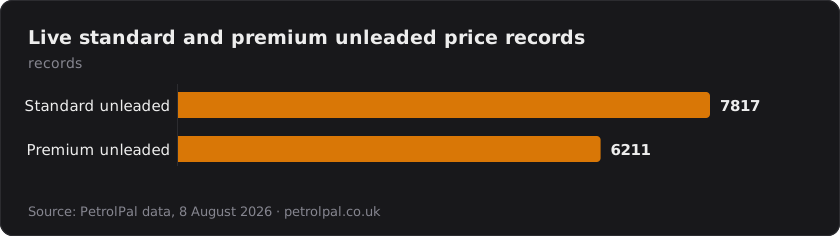
The grade distinction needs care. PetrolPal's feed classifies premium and standard grades, not the ethanol label displayed at each pump. Premium unleaded is the usual route to E5, but the 6,211 count isn't a verified E5 stock count. Always confirm the circular E5 label on the dispenser and nozzle before filling.
The DfT says almost all UK filling stations sell E10 as standard. Stations offering two petrol grades should stock E10 95 octane and E5 97+ octane. A small, rural or remote site may sell only one petrol grade, so an E5-dependent driver should plan ahead.
Could you simply wait for the warning light? That's risky in an incompatible classic. Search for suitable stations before entering a remote area, then keep a sensible reserve. PetrolPal's fuel map and route planner show premium unleaded, but the pump label remains the final check.
Labels make that check quick. E5 and E10 appear inside circles on the pump and nozzle. Vehicles made from 2019 onwards should also show accepted fuel labels near the filler cap. Older vehicles may rely on a manual or compatibility record instead.
PetrolPal's sample contained 1,606 fewer premium-unleaded records than standard-unleaded records. That gap measures listed grades, not verified ethanol content. An E5-only driver can use premium listings to shortlist stops, but should confirm the E5 pump label before relying on any forecourt.
PetrolPal's 8 August sample found premium-unleaded records at 79.5% of the standard-unleaded count. That figure is a navigation proxy, not an E5 availability rate. The DfT says remote sites may carry one grade, so E5-dependent drivers should confirm suitable stops early.
How Much More Can the Premium Grade Cost on a Summer Trip?
Premium unleaded averaged 178.603p per litre, compared with 161.555p for standard unleaded, in PetrolPal's 8 August data. The 17.05p gap adds about £9.38 to a 55-litre fill. Local differences can be smaller or much larger.
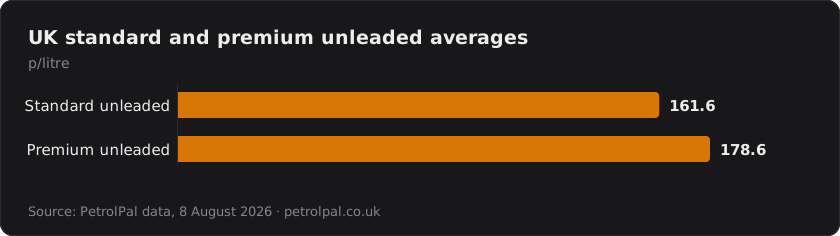
A 55-litre fill at those averages costs about £98.23 for premium and £88.86 for standard. Over three similar fills, the difference reaches roughly £28.13. That calculation uses the unrounded per-litre averages and isolates pump price. It doesn't assume both fuels deliver identical mileage in every vehicle.
Does E10's estimated 1% economy loss cancel the premium? Usually not at this price gap. A 1% change on an £88.86 fill is under 90p, while the observed premium-grade difference is £9.38. Your car and route will vary, but the price gap is roughly ten times the value of that simple 1% comparison.
The biggest cost mistake is treating ethanol and octane as the same decision. E5 often costs more partly because it is sold as a higher-octane premium product. If your engine requires that octane, the comparison is academic. If it only requires 95 octane and accepts E10, premium E5 needs a specific benefit to justify its price.
Road-trip conditions can swamp a small fuel-economy difference. The RAC cites Energy Saving Trust figures showing an empty roof rack adds 16% aerodynamic drag at 75mph, while a roof box adds 39%. These are drag figures, not direct fuel-use percentages, but their scale puts the DfT's 1% E10 estimate into context.
PetrolPal's national premium average isn't a quote for your route. Retailer, region and motorway location all matter. Check live prices near your journey rather than applying one national premium everywhere. Even a short planned stop can avoid an expensive motorway fill.
At PetrolPal's 8 August averages, premium unleaded cost 17.05p per litre more than standard, or £9.38 on 55 litres. The DfT's estimated 1% E10 economy effect is too small to erase that average pump-price difference for most compatible cars.
Can You Mix E5 and E10 in the Same Tank?
Drivers of an E10-compatible vehicle can safely mix both grades, according to the Department for Transport. You can top up an E10 tank with E5, or add E10 after using E5. The combined ethanol and octane levels will sit somewhere between the two fuels.
That flexibility helps on a trip. A compatible car doesn't need an empty tank before switching. Nor must you keep buying premium because the previous fill was E5. Choose a fuel that meets the manufacturer's minimum octane and compatibility requirements.
What if you accidentally put E10 into an incompatible car? The DfT says one tank shouldn't be a major problem. Fill with E5 next time. Unlike putting petrol into a diesel vehicle, draining normally isn't required after one accidental E10 fill.
The exception is repeated use. The DfT warns that prolonged E10 use in a non-compatible vehicle may cause harm. Don't treat the one-tank reassurance as standing approval. If the vehicle runs poorly, has a known fuel-system issue or received the wrong fuel type entirely, seek professional advice.
Mixing doesn't turn the tank into a precisely known blend. The actual ethanol content of either grade may be below its label's maximum. For an approved vehicle, that uncertainty is acceptable. For an unapproved classic, deliberate mixing isn't a substitute for confirmed compatibility.
The DfT's position is clear: E5 and E10 can share a tank in an E10-compatible vehicle, and one mistaken E10 fill in a non-compatible vehicle usually doesn't require draining. Continued E10 use is different because prolonged exposure may harm an incompatible fuel system.
How Should Classic-Car Drivers Plan Their Fuel Stops?
Many classic brands aren't covered by the official checker, and the DfT advises unlisted vehicle owners to continue using E5 97+ octane. That makes route planning more important because PetrolPal's current sample has 1,606 fewer premium than standard unleaded records.
Start with evidence for the exact vehicle. Check its handbook, manufacturer bulletin, owners' club and a specialist familiar with its fuel system. Record the accepted grade on your phone. A screenshot or note prevents uncertainty when someone else fills the car.
Plan the next E5 stop while you still have range. Use PetrolPal's premium fuel filter, then confirm opening hours and the pump label. On rural routes, keep enough reserve to reach an alternative. Don't carry petrol in an unsuitable container or store it inside the passenger compartment.
Should you add a generic ethanol treatment? Only if the vehicle or product manufacturer supports that use. An additive can't rewrite an engine's octane requirement or prove every hose and seal compatible. Mechanical inspection may be the better investment before a long, hot drive.
For a seasonal car, storage advice should come from its manufacturer or a recognised specialist. Precise claims that E5 or E10 always lasts a fixed number of months aren't dependable across containers, temperatures and fuel systems. This guide therefore doesn't assign either grade a universal shelf life.
A classic road trip needs one simple policy: use E5 when the vehicle is unlisted or not approved for E10, and locate suitable stops in advance. The DfT confirms E5 remains available as 97+ octane at stations selling two petrol grades.
Which Petrol Should You Choose for Your Road Trip?
Around 95% of petrol vehicles can use E10 (Department for Transport, 2022), while PetrolPal found an average 17.05p-per-litre premium for the higher grade on 8 August 2026. For an approved 95-octane car, E10 is normally the practical and cheaper choice. Use E5 when compatibility or the manufacturer's octane requirement demands it.
Check the official E10 checker before leaving. Then compare suitable grades on PetrolPal's live fuel map. An E5-dependent classic needs planned stops, especially on rural routes. An E10-compatible car can mix grades safely and has more forecourt choice.
The final answer belongs to your vehicle, not the label's marketing. Follow its handbook, buy the required octane, confirm E5 or E10 at the nozzle, and compare the real route cost. That four-step check is quicker than recovering from the wrong assumption miles from home.