UK fuel prices have started to ease in May 2026, but drivers are not back to normal. The latest official weekly data shows unleaded petrol averaging 156.81p per litre and diesel averaging 188.14p per litre on 11 May 2026. Petrol is almost flat week on week, while diesel is finally drifting lower after April's sharp rise.
What Happened to UK Fuel Prices in May 2026 So Far?
The first half of May has brought relief, but not a reset. The Department for Energy Security and Net Zero published average UK pump prices for the week commencing 11 May 2026 at 156.81p per litre for unleaded petrol and 188.14p per litre for diesel.
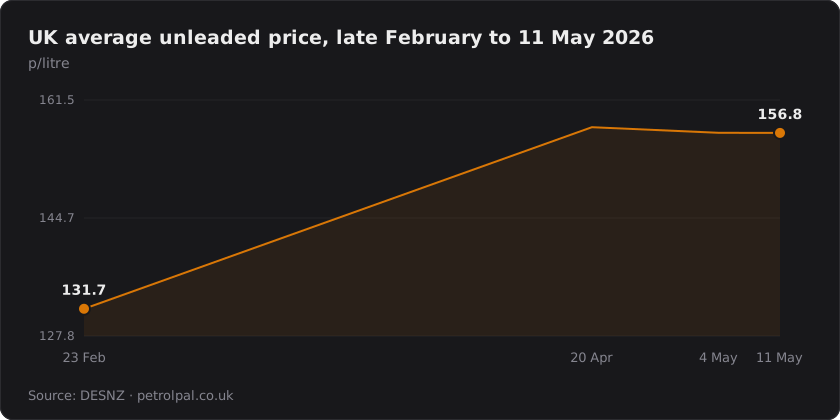
Compared with the week commencing 20 April, petrol is down 0.81p per litre and diesel is down 3.10p per litre. That means diesel has done most of the easing, but diesel drivers are still paying far more than petrol drivers at the pump.
For a 55-litre tank, the latest average prices work out at:
| Fuel | 11 May 2026 average | 55-litre fill |
|---|---|---|
| Petrol | 156.81p/litre | £86.25 |
| Diesel | 188.14p/litre | £103.48 |
The diesel premium is now 31.33p per litre. On a 55-litre fill, that is about £17.23 more than petrol before you factor in vehicle efficiency.
Why Are Prices Still So High?
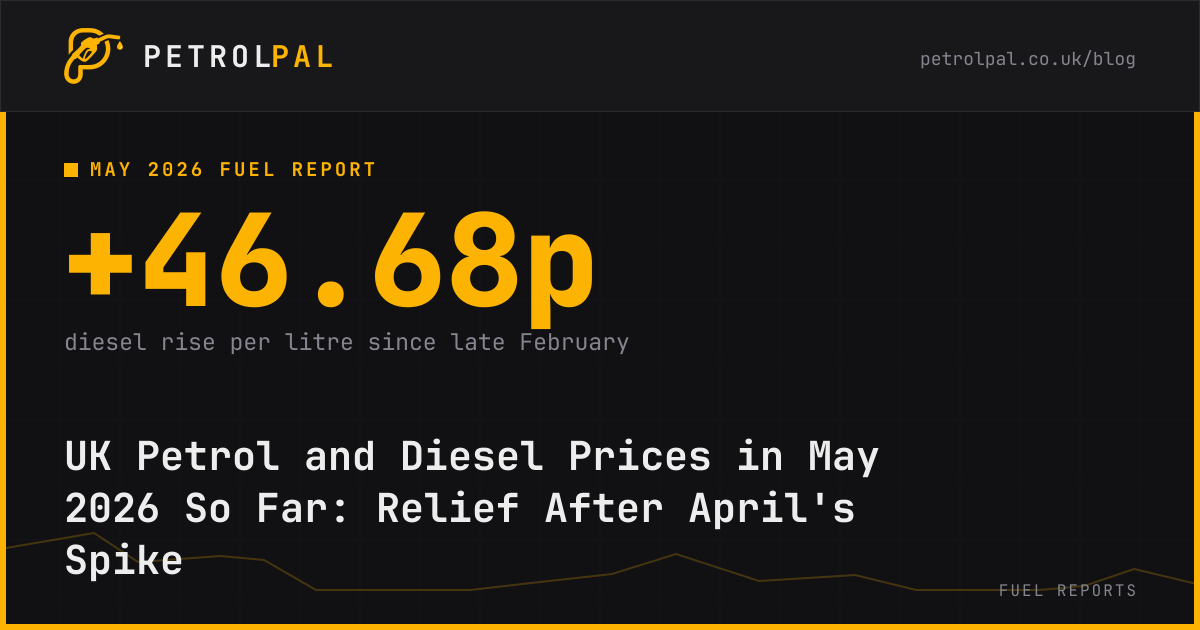
The problem started before May. DESNZ data shows petrol at 131.71p per litre and diesel at 141.46p per litre on 23 February 2026. By 11 May, petrol was 25.10p higher and diesel was 46.68p higher.
That adds about £13.81 to a 55-litre petrol fill and £25.67 to a diesel fill compared with late February. So even after the latest easing, most households are still looking at a much more expensive refill than they were before the spring spike.
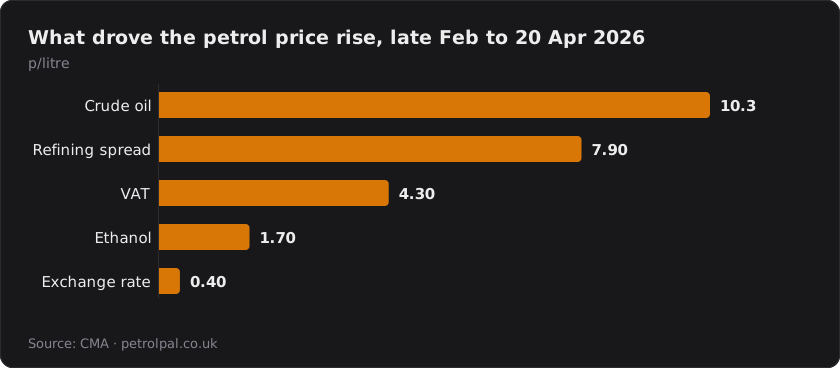
The CMA's May 2026 enhanced road fuel monitoring report explains why the rise was so sharp. It found that average UK petrol rose from 131.7p per litre at the end of February to 157.6p in the week commencing 20 April, while diesel rose from 141.5p to 191.2p over the same period.
The CMA said wholesale costs were the main driver. Its analysis attributed 10.3p of the petrol rise to crude oil, 7.9p to the refining spread, 1.7p to ethanol, 0.4p to the exchange rate effect and 4.3p to VAT. For diesel, crude oil added 10.0p, the refining spread added 15.1p, FAME biofuel added 0.5p, the exchange rate effect added 0.4p and VAT added 8.3p.
In plain English: crude mattered, but diesel was hit especially hard by refining conditions. That helps explain why the diesel gap widened so much.
Warning
Warning
The latest weekly averages are national figures, not a promise about any single forecourt. Local prices can sit well above or below the average, especially near motorways, in rural areas, or where one retailer has little nearby competition.
Why Is Diesel Still So Much More Expensive Than Petrol?
Diesel is still carrying the bigger shock from spring 2026. On 11 May, the official average diesel price was 188.14p per litre, compared with 156.81p for petrol. That 31.33p gap is the number diesel drivers should watch most closely through the rest of May.
The CMA report points to refining spreads as the main reason diesel moved differently. By the week commencing 20 April 2026, the CMA found the diesel refining spread was almost twice the petrol refining spread. It linked this to tighter global conditions for middle distillates, the product group that includes diesel.
That matters because pump prices do not move only with crude oil. They also reflect the cost of turning crude into the specific fuels drivers buy, transport costs, retailer costs, duty and VAT. When diesel refining spreads widen, diesel can become much more expensive than petrol even if crude oil is the same starting point.
The May data suggests diesel has begun to ease. It fell from 191.24p on 20 April to 188.14p on 11 May. But that is only a 3.10p fall after a 49.78p rise from late February to 20 April in the official weekly series.
Are Retailers Making More Money From the Spike?
This is the question drivers are asking, and the answer is mixed.
The CMA found that average retailer fuel margins were broadly unchanged overall between February and March 2026, moving from 10.3p per litre to 10.7p per litre across the retailers in its dataset. It also said most retailers in the dataset had lower margins in March than February.
But that does not mean there is nothing to investigate. The same report found supermarket retailer margins rose from 9.8p per litre in February to 11.2p in March, higher than their 2025 average of 9.8p. The CMA said the supermarket increase was driven by two supermarket retailers and that it would keep monitoring margins closely.
Non-supermarket margins moved the other way on average, falling from 10.9p in February to 10.3p in March. Still, the CMA found three non-supermarket retailers with higher margins in March than February.
That is why the best practical answer for drivers is not to guess which brand is fairest. It is to compare the live local price before filling up, especially when prices are volatile.
Where Can Drivers Still Save in May?
The biggest savings are local. The CMA used Fuel Finder data to look at forecourts that reported prices on 7 April 2026 and found local price dispersion of up to 16p per litre for petrol and 17p per litre for diesel within a 10-minute drive. For an average 55-litre tank, it said motorists could have saved up to £9 by switching from the most expensive to the cheapest retailer within that local area.
It also found examples of drivers saving up to £7 per tank in Trafford, Sunderland and Hammersmith, while Aberdeen showed a smaller but still useful saving of up to £3 per tank.
Motorway prices remain a separate trap. The CMA found motorway retailers were more expensive than non-motorway retailers on average, with the day-to-day difference reaching up to 26p per litre for petrol and up to 17p per litre for diesel between 11 March and 13 April 2026. On a 55-litre tank, that is just over £14 extra for petrol and more than £9 extra for diesel.
Supermarkets still tend to be cheaper than non-supermarket retailers. The CMA found that the supermarket discount varied day to day and reached up to 8p per litre for petrol and 11p per litre for diesel between 11 March and 13 April. That works out at just under £5 on a petrol fill and just under £6 on a diesel fill for a 55-litre tank.
What Fuel Finder Changes for Drivers
May 2026 is the first fuel price spike where the new government Fuel Finder scheme is operating at national scale. Fuel Finder launched on 2 February 2026 and brings together live retail fuel prices and forecourt information across the UK.
The government says retailers must submit price updates within 30 minutes of a price change. The data is available to authorised organisations and third-party apps, which means price comparison tools can show fresher pump data than older voluntary schemes allowed.
That matters most in a market like this one. When petrol and diesel are moving quickly, yesterday's cheapest station may not be today's cheapest station. A 4p per litre difference is £2.20 on a 55-litre fill. An 8p difference is £4.40. A 16p difference is £8.80.
If you are already passing a cheaper forecourt, those savings are real. If the cheaper station requires a long detour, the fuel burned getting there can eat the gain. The useful comparison is not just cheapest price, but cheapest useful stop.
Tip
Tip
For a quick rule of thumb, multiply the price gap in pence per litre by your tank size. A 6p gap on a 55-litre fill is £3.30. Then compare that with the extra distance and time needed to reach the cheaper station.
How May Fuel Prices Affect Inflation
The latest full inflation bulletin still covers March, not May, but it shows why fuel prices are getting attention. The Office for National Statistics said motor fuels made the largest upward contribution to the monthly change in both CPIH and CPI annual rates in March 2026.
The ONS reported that petrol rose by 8.6p per litre between February and March, while diesel rose by 17.6p. It also said overall motor fuel prices rose by 4.9% in the 12 months to March 2026, compared with a fall of 4.6% in the 12 months to February.
That March data does not include the full April peak or the early May easing. The next inflation releases will show whether the pump price spike was short and sharp or whether it feeds into wider transport costs for longer.
For drivers, the simpler point is immediate: fuel is still materially more expensive than it was in February, and diesel remains the hardest hit.
What to Watch for the Rest of May 2026
There are three signs to watch.
First, watch whether diesel keeps falling faster than petrol. If the diesel refining spread narrows, the diesel premium should shrink. If it stays wide, diesel drivers may continue paying more than the headline petrol average suggests.
Second, watch whether petrol breaks meaningfully below 156p per litre in the official weekly series. Petrol has barely moved between 4 May and 11 May, falling only 0.01p. A clearer fall would show that wholesale easing is finally reaching forecourts.
Third, watch local gaps. The national average tells you the market direction, but the local spread decides what you actually pay. In a market where a nearby forecourt can be 6p, 10p or even more below another, using live local prices is no longer a small optimisation. It can be the difference between a painful fill and a merely expensive one.
What May 2026 Means for Your Fuel Budget
May is not the month when fuel prices returned to normal. It is the month when the April surge stopped getting worse in the official weekly data.
Petrol is still more than 25p per litre above late February. Diesel is still more than 46p per litre higher. For a typical 55-litre tank, that means the spring shock is still costing drivers roughly £13.81 extra for petrol and £25.67 extra for diesel compared with 23 February.
The practical response is simple: check the local price before filling up, avoid motorway refills where possible, and treat diesel prices with extra caution until the diesel premium narrows. The national average tells you the story. Your nearest forecourts decide the bill.