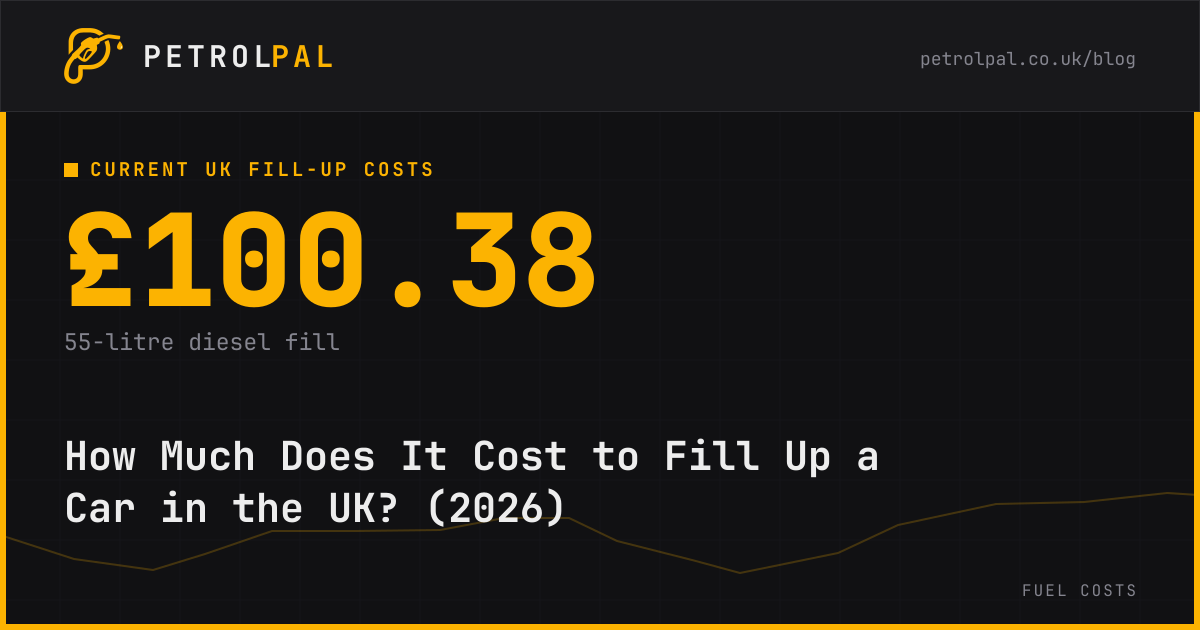
A full 55-litre tank costs about £96.01 with petrol or £109.83 with diesel at PetrolPal's national station averages on 5 October 2026. Those estimates use 174.5704p and 199.6998p per litre, respectively, before the final bill is rounded. If the tank is 10% full, buying 49.5 litres costs about £86.41 or £98.85. A driver pays the local pump price, not the national mean. Check PetrolPal's fuel prices before choosing a forecourt.
The detailed statistics covered 7,909 regular-petrol prices and 8,018 standard-diesel prices in a database of 8,134 stations, last synced at 03:17 UTC on 5 October. The separate public price embed reported 174.5p for petrol, 200.0p for diesel and 8,165 stations at the same sync time. Its aggregation differs, so the calculations below consistently use the detailed statistics rather than mix the two summaries.
How much does a full tank cost at different capacities?
Tank size makes a bigger difference than a headline national price alone suggests. The table multiplies each capacity by the unrounded national station averages from PetrolPal's detailed snapshot, then rounds the final amount to pennies. It is an estimate for a genuinely empty-to-full fill, not a claim about what a particular vehicle or retailer will charge.
| Tank capacity | Full petrol tank | Full diesel tank | Petrol from 10% left | Diesel from 10% left |
|---|---|---|---|---|
| 40 litres | £69.83 | £79.88 | £62.85 | £71.89 |
| 45 litres | £78.56 | £89.86 | £70.70 | £80.88 |
| 50 litres | £87.29 | £99.85 | £78.56 | £89.86 |
| 55 litres | £96.01 | £109.83 | £86.41 | £98.85 |
| 60 litres | £104.74 | £119.82 | £94.27 | £107.84 |
| 70 litres | £122.20 | £139.79 | £109.98 | £125.81 |
The from-10% columns assume exactly one tenth remains and the driver replaces exactly nine tenths of the stated capacity. Fuel warning lights do not follow a universal 10% threshold. A vehicle may have a different reserve, and its gauge can be imprecise. Use these columns as budgeting examples, not as a prediction of the volume your next receipt will show.
Find your actual tank capacity in the vehicle handbook or manufacturer specification. Do not infer it from the dashboard's estimated remaining range: that estimate changes with consumption. If you put 35 litres into a 50-litre tank, pay for 35 litres, regardless of what the gauge suggested before filling. Likewise, do not force extra fuel into the filler neck to reach an assumed handbook capacity.
How do you calculate a fill-up from a local pump price?
Use litres purchased × pence per litre ÷ 100 = pounds paid. If a pump displays 175.9p per litre and you buy 40 litres, the calculation is 40 × 175.9 ÷ 100 = £70.36. This is an illustration using a hypothetical pump price, not a PetrolPal quote for a particular station. The receipt can vary slightly if the pump rounds quantities and money differently.
To estimate a purchase before leaving home, multiply tank capacity by the fraction you expect to add. A 55-litre tank at one quarter full needs about 41.25 litres to reach full. At the unrounded 5 October national averages, that is about £72.01 for petrol or £82.38 for diesel. Those figures are not universal forecourt prices. Replace the average with a reachable station's displayed grade and price for a decision about a real journey.
You can also reverse the question: with a £40 budget and petrol at a hypothetical 175p per litre, divide 40 by 1.75 to estimate 22.86 litres. Make sure the vehicle uses that fuel grade. If you have an exact amount left on a prepaid card, leave a margin for price changes and pump rounding. PetrolPal's map helps you inspect nearby options; confirm the displayed price at the forecourt before you buy.
National averages combine thousands of stations. They answer a broad budgeting question, but a specific trip depends on local prices and distance. A rural or motorway stop may differ substantially from a town station. A data refresh may also occur after this article's 5 October snapshot, so do not label these example totals as a live quote.
Why does the same tank cost more at some stations?
Forecourts face different site costs, competition and supply conditions. PetrolPal's 5 October category averages put regular petrol at 172.44p across 2,496 supermarket prices, 174.28p across 937 independent prices and 175.82p across 4,476 branded prices. The supermarket-to-branded gap before rounding is about 3.37p per litre. On 55 litres, that category-level difference is about £1.85.
For standard diesel, the same snapshot shows 197.33p across 2,501 supermarket prices, 199.35p across 1,057 independent prices and 201.11p across 4,460 branded prices. The supermarket-to-branded gap is about 3.78p per litre, or £2.08 on 55 litres. These are averages across different sets of stations, not the saving available from switching between any two specific pumps. Sample sizes also differ by fuel type.
A national supermarket average does not prove that a supermarket near you is cheapest. An independent forecourt on your route may beat it, and a long drive for a small gap can erase the saving. If one station is 2p per litre cheaper and you need 40 litres, the maximum pump-price saving is 80p before travel. Consider extra fuel, time and any parking or route restrictions. The PetrolPal route planner can help you assess stops on an existing journey.
Check the correct grade when comparing prices. Premium unleaded is not interchangeable with a regular-petrol quote for cost comparisons. Use the handbook to confirm what your car requires. If a price looks unusually low, check the station's reporting time and confirm the sign or pump before filling. A submitted price can change between an online check and arrival.
How much more does diesel cost to fill than petrol?
On 5 October 2026, the detailed PetrolPal averages differed by about 25.13p per litre: 174.57p for regular petrol and 199.70p for standard diesel. Across an empty 55-litre tank, that is about £13.82 more for diesel. From 10% remaining, the difference on 49.5 litres is about £12.44. Both are comparisons of national averages, not of pumps on the same street.
Diesel's higher transaction cost does not by itself show which vehicle costs less per mile. Compare real fuel consumption for the particular petrol and diesel vehicles, their purchase prices and other ownership costs. A diesel vehicle may use fewer litres for the same distance, yet still cost more to buy and maintain. The correct fuel for the vehicle is not a discretionary switch you make at the pump.
The public JSON embed reports 174.5p petrol and 200.0p diesel on the same update. Those numbers are produced by a different public summary and do not reproduce every figure above. For that reason, do not take a station count from one endpoint and use it as the denominator for the other's average. DESNZ's weekly series offers another national measure, collected on a different schedule and method; it is not a substitute for today's local pump check.
What part of the pump bill is tax?
HMRC's amended duty schedule sets duty on standard unleaded petrol and road diesel at 52.95p per litre through 31 December 2026. It lists later default rates, but says the government will confirm final rates at Budget 2026. Do not treat a proposed later rate as a guaranteed bill for a future fill.
The standard VAT rate is 20%. For an ordinary VAT-inclusive pump price, VAT is one sixth of the displayed amount, because the displayed amount includes the tax. At the 5 October detailed averages, that gives about 29.10p VAT per litre of petrol and 33.28p per litre of diesel. Adding the 52.95p duty gives approximately 82.05p and 86.23p in these two calculated tax components. These estimates use the dated average prices, not an itemised receipt from a station.
The rest of the displayed price is not simply retailer profit. It also reflects the fuel, distribution, blending obligations and other costs. A change in duty or VAT would not necessarily appear as an identical and immediate pump-price change at every site. Check current legislation and the actual station price when budgeting later in the year.
How can you reduce the cost of your next fill?
Compare reachable stations before an urgent low-fuel stop limits your options. The PetrolPal fuel finder lets you start with the grade you need, then narrow the decision to places on a practical route. Check the reporting time, look at the posted price and avoid a separate journey if the saving is too small. One penny per litre saves only 50p on a 50-litre purchase.
Work out the total saving, not just the pence-per-litre gap. Suppose a nearby station is 4p per litre cheaper and you need 45 litres. The apparent saving is £1.80. If reaching it requires an extra round trip, the fuel you burn and time you spend may outweigh that amount. This is a hypothetical comparison, not a forecast for a named forecourt. A stop on your normal route is often a better option than a distant headline bargain.
Plan ahead without trying to empty the tank. An early refill keeps several routes available, while a last-minute stop may leave only an expensive motorway site. Check tyre pressures against the vehicle maker's recommendation and remove unused roof equipment to avoid wasting fuel over later journeys. These actions change consumption, not the pump price itself. Record real litres and distance over several fills if you want to understand your own cost per mile.
For a realistic household budget, keep the tank capacity and a usual refill volume in a note. Update the price per litre from a nearby station when you plan a purchase. A 55-litre car does not incur the full-tank cost each time; someone adding 30 litres pays for 30 litres. The dated national example is useful context, but the next local price and actual litres decide the receipt.